Pentagon prepares AI training on classified data, as new reactors change waste management approach
Pentagon discusses training military AI versions on classified data in secure data centers — this should improve model accuracy but creates new risks of leaks and disputes over acceptable scenarios. In parallel, new nuclear reactors promise flexible carbon-free energy, but complicate waste management: different designs will require different storage and logistics schemes.
AI-processed from MIT Technology Review; edited by Hamidun News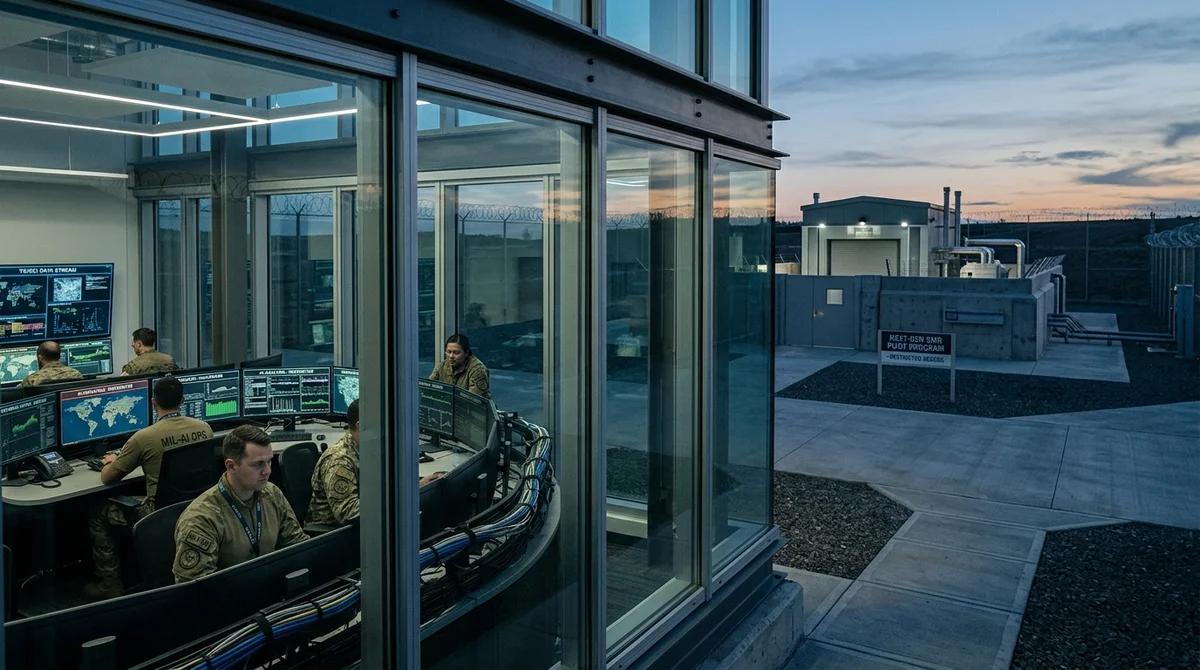
The Pentagon discusses a new stage of military application of generative AI: companies may be allowed to train special versions of models on secret data in protected networks. Against this backdrop, another technological line — new nuclear reactors — is also moving from theory to practice, but alongside the promise of cheap low-carbon energy comes new questions about waste management.
Secret models for the army
According to MIT Technology Review, the US Department of Defense wants to create protected environments where AI developers can fine-tune military versions of their models on classified data. This is not just about accessing a model within a classified network, but about deeper customization for real military tasks — from intelligence analytics to operational planning support. The logic is clear: if a model trains on materials not available on the open internet, it can better understand the context, terminology, and scenarios that the military works with.
This approach is noticeably different from what is happening now. Large models are already being used in closed networks for answering questions and analyzing documents, but the model weights themselves are usually not trained on a classified dataset. In the new configuration, the Pentagon wants to place copies of models in certified data centers for state secrets, retaining ownership of the data. In rare cases, AI company employees may receive clearance if it is impossible to carry out customization or system verification without it.
Where risks arise
The main risk is that classified information could become part of the model itself, rather than simply sitting in a database or search index. This complicates auditing, access control, and verifying what conclusions the model can draw for users with different levels of clearance. A separate issue is control over usage rules. After the Pentagon's deals with OpenAI and xAI, it became clear that the military wants not an experimental pilot, but a full-fledged infrastructure for combat and analytical tasks.
"We will not allow any company to dictate the conditions of how we make operational decisions," the
Pentagon said.
The dispute around Anthropic showed that the conflict is not just about technology, but about boundaries of the permissible. The company publicly objected to scenarios involving mass surveillance and fully autonomous weapons, while the Pentagon insists on the broadest possible access to models for legitimate military purposes. This turns defense contracts with AI labs into a new form of bargaining: the government needs powerful models without restrictions, while developers try not to lose control over how they are used.
- More accurate answers on closed military data
- Growing requirements for isolation, logging, and model auditing
- Separate military versions of neural networks for military tasks
- Increased political and ethical pressure on AI companies
Reactors change the rules
In parallel, MIT Technology Review draws attention to another infrastructure topic — a new generation of nuclear reactors. Most operating nuclear power plants are still built according to a familiar pattern: a large facility, water cooling, low-enriched uranium, and centralized storage of spent fuel. New projects promise to move away from this standard.
In development are small modular reactors, microreactors, and installations with alternative coolants and fuel configurations that should be built faster, operate more flexibly, and fit better into the energy systems of the data center era. The problem is that along with the new reactor architecture, the waste profile changes as well.
Basic methods — cooling pools, dry storage in containers, further isolation — don't disappear, but there is no universal scenario for all new installations. Different fuel types and cooling methods produce different materials with different packaging and logistics requirements. It is especially difficult with small reactors: if they are to be located at many sites, storing waste at each site will be inconvenient and expensive.
Therefore, some companies are already considering a centralized model: sending microreactors and their spent materials back to a single hub, such as a manufacturing facility or specialized storage site. Experts believe that the industry will not have to rewrite the entire nuclear waste management system from scratch, but will need to refine it. So far, many conclusions are based on models and calculations, and a clearer picture will only emerge after commercial installations are launched.
What this means
Both stories are about the same thing: the key technologies of 2026 increasingly resemble not universal consumer tools, but strategic infrastructure. AI is moving into classified military networks, and the energy sector is looking for new reactors to meet growing demand from industry and AI data centers.
For the market, this means one thing: winners will be not only the creators of models and reactors, but also those who know how to safely integrate them into real systems.
Access Frontier LLMs & Multimodal AI in One Workspace
Discover NomadNet AI (nomadnet.ai) — unified access to frontier language models, research synthesis, and multimodal workflows.
The AI world, distilled — once a week
Seven stories that actually mattered, hand-picked. No noise, no reposts, no press releases.
Done! Check your inbox for a confirmation.