Tomato-picking robot learns to predict grip complexity and achieves 81% success
Researchers have created a tomato-picking robot that doesn't merely locate ripe fruit but predicts the complexity of each grip and selects the optimal…
AI-processed from Science Daily AI; edited by Hamidun News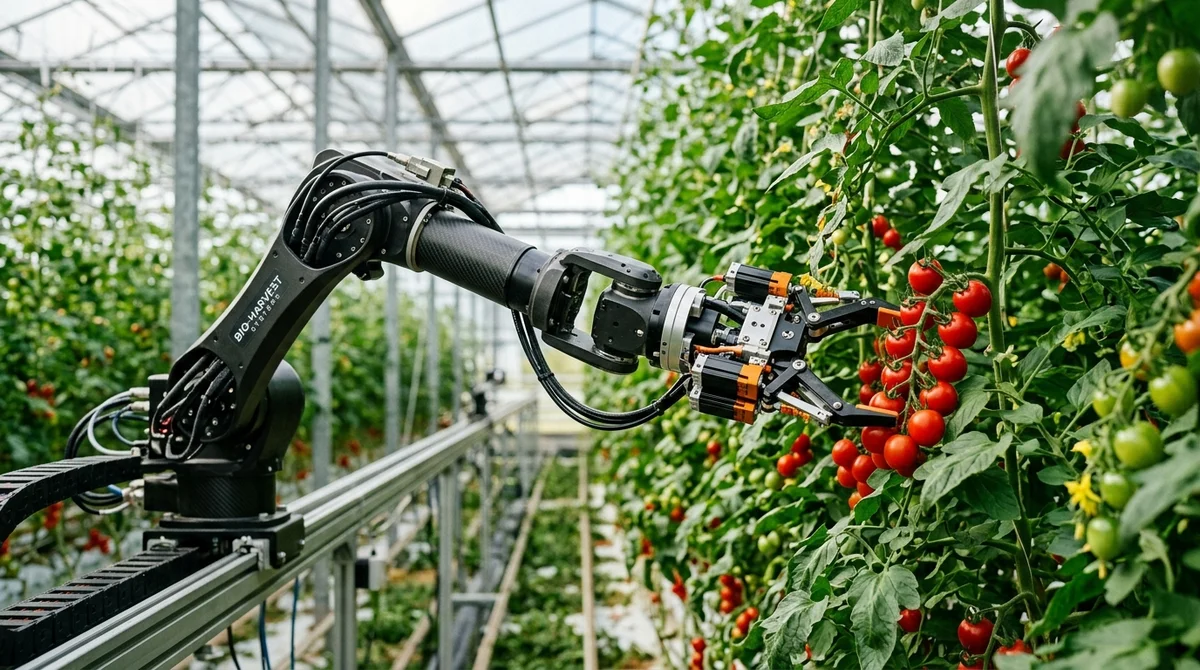
Researchers have developed a new tomato-harvesting robot that predicts the complexity of each harvest operation before executing it and selects an optimal strategy. The harvest success rate has reached 81% — approximately 20 percentage points higher than classical systems.
Why ordinary robots struggle
Agricultural robotics has long been able to recognize fruit ripeness. Neural networks have learned to distinguish a ripe red tomato from a green one with high accuracy. But recognition is only half the task. The real challenge lies in the physical action. A real greenhouse is chaotic: dense clusters, hanging leaves, different fruit angles, non-standard shapes. The algorithm "found ripe → grabbed" does not account for approach angle, obstacles, or the probability of damaging adjacent fruits. Every mistake means lost harvest or plant damage. This is precisely why harvest success rates for classical fruit-picking robots rarely exceed 60%. At industrial scale, this is unacceptable.
How the predictive approach works
The new system adds an intermediate step between "saw" and "grabbed." Before each movement, the robot builds a prediction: how accessible is the fruit, what is in its way, what force vector will cause the least damage. Based on this prediction, the system selects the optimal approach angle — before the first movement of the manipulator. If the first attempt fails, the robot automatically switches to an alternative vector without stopping the cycle or requiring operator intervention. Critically, the system was trained on real greenhouse data, not synthetic examples. Simulations do not reproduce the full complexity of living plants — wind, humidity, uneven ripening within a cluster.
Test results
- 81% successful harvests — versus ~60% for standard systems
- Real-time adjustment of harvest angle without cycle restart
- Ability to work with fruit clusters, not just individual tomatoes
- Training on real, not synthetic data
The 20 percentage point gap is substantial: with thousands of fruits per day, this means hundreds of saved tomatoes per robot workstation.
Cooperation, not replacement
The research authors emphasize: the goal is not to displace people from farms, but to create an efficient environment for collaborative work. The robot takes on monotonous precision work: angle selection, grasping, cutting. Humans handle where algorithms still lag — non-standard situations, quality control, adaptation to sudden changes in conditions.
"The breakthrough opens the path toward farms where robots and people work side by side," the authors note.
This model reduces physical strain on greenhouse personnel and makes robot implementation gradual — without the need to immediately transition all production to automation.
What this means
The predictive logic of "assess first, then act" is a principle that extends far beyond agriculture. The same architecture is applicable in warehouses, manufacturing, medicine — anywhere a robot must work in an unstructured environment. The agricultural sector has historically lagged in robotization precisely because of this complexity. If the 81% figure can be reproduced at industrial scale, the economics of farm automation will change significantly.
Want to stop reading about AI and start using it?
AI News is a curated feed of AI/tech news. Hamidun Academy teaches you to use AI systematically in your work.