Baidu releases Qianfan-OCR — a 4B model for document recognition and understanding
Baidu unveiled Qianfan-OCR, a 4B model that combines OCR, layout analysis, and document understanding in a single architecture. Instead of a multi-step…
AI-processed from MarkTechPost; edited by Hamidun News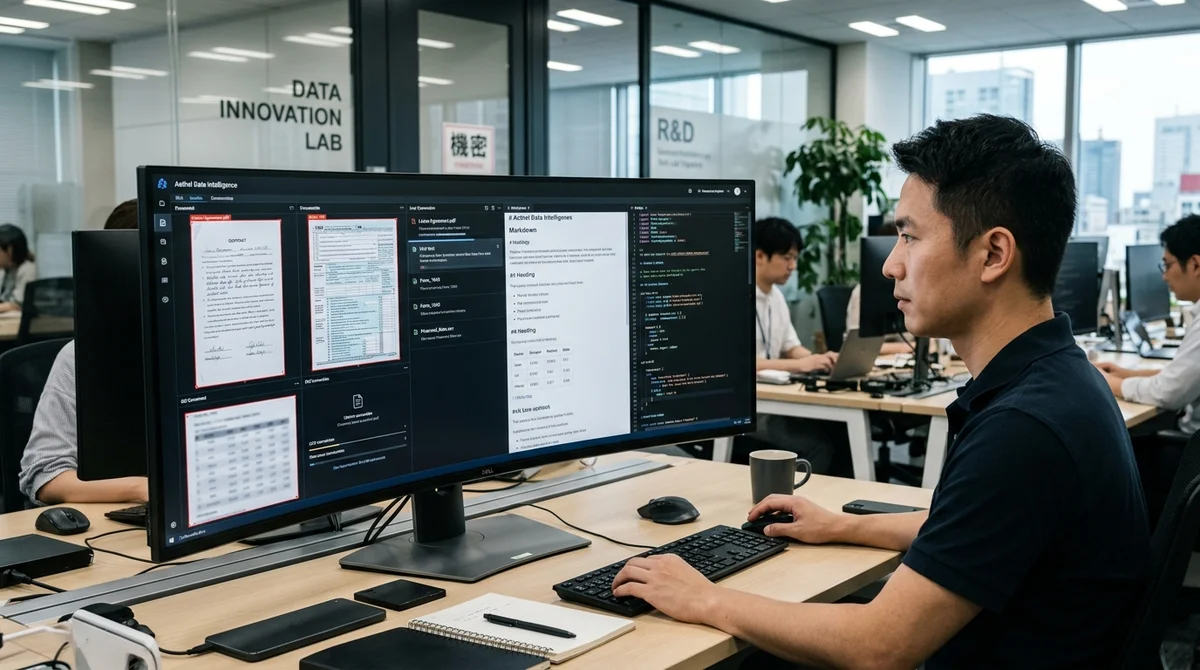
Baidu has launched Qianfan-OCR — a unified 4B-parameter model for document processing that combines text recognition, structure analysis, and content understanding. Instead of a classical multi-stage OCR pipeline, the system transforms document images directly into structured Markdown and can perform user-requested tasks.
Why the market is moving away from OCR pipelines
Classical OCR systems are typically assembled from several independent modules: one finds regions on a page, another recognizes text, a third attempts to understand tables, headers, and reading order. This approach works for simple documents, but breaks down on complex layouts, scans, forms, mixed content, non-standard formats, and multi-page files. The more steps in the chain, the higher the risk that an error at an early stage will corrupt the entire result.
Against this backdrop, Baidu's Qianfan takes a unified vision-language approach. Qianfan-OCR should not simply read characters but perceive a document as a complete object: with blocks, structure, logic, and meaning. For companies, this is an important shift because businesses typically need not raw text, but ready-to-use data they can work with in search, analytics, automation, and internal AI scenarios, including production processes.
What Qianfan-OCR can do
According to the team's description, this is an end-to-end model with 4 billion parameters that combines document parsing, layout analysis, and document understanding in a single architecture. The key difference from traditional OCR is that the model does not rely on a long chain of sequentially connected modules. Instead, it takes an image as input and immediately produces structured output, including image-to-Markdown transformation.
This significantly reduces the number of intermediate conversions. The prompt-driven logic is particularly noteworthy. The model can be used not only for basic recognition but also for applied tasks, where the user specifies what exactly should be extracted from the document.
The paper directly mentions scenarios for table extraction and answering questions about document content. This moves OCR away from an archival tool for scans toward an interface for working with corporate files in company workflows. The Markdown format is important here too.
For teams building knowledge bases, AI search, or LLM pipelines, simply getting unstructured text is insufficient. You need headers, lists, tables, and a logical order of blocks. If the model immediately returns a document in a format convenient for machine processing, this reduces post-processing volume and makes the result more suitable for automatic indexing, summarization, and subsequent question-answering layers.
For integration, this is a notable advantage.
- Direct transformation of document images into Markdown
- Page structure analysis without separate pipelines from multiple modules
- Table extraction on user request
- Answering questions about document content
- A single model instead of a collection of disparate components
Where this will be useful
The practical value of such models lies in reducing intermediate operations between document and useful action. If the system truly understands layout, text, and meaning in a single pass, this simplifies processing of contracts, instructions, reports, questionnaires, presentations, and internal knowledge bases. This is especially relevant for teams wanting to automatically convert PDFs and scans into formats suitable for RAG, knowledge search, or subsequent LLM analysis.
For developers and product teams, there's another important point: unification reduces engineering complexity. Instead of maintaining several OCR and post-processing services, you can build a shorter stack. This doesn't guarantee perfect quality on every document type, but the direction is clear: the market is moving from a set of specialized detectors toward large models that work with documents as multimodal objects and immediately prepare them for downstream tasks, while also enabling faster deployment of new scenarios.
What this means
Qianfan-OCR shows that OCR is rapidly transforming from a narrow character-recognition technology into a layer of document intelligence. If such models confirm their quality in real-world scenarios, companies will find it easier to automate document processing without complex multi-stage pipelines and manual assembly of separate components. The biggest winners will be teams that need fast transition from PDFs and scans to data ready for search, analytics, and AI assistants.
Want to stop reading about AI and start using it?
AI News is a curated feed of AI/tech news. Hamidun Academy teaches you to use AI systematically in your work.