eternal.ag raises €8M for autonomous greenhouse harvesting robots
Germany’s eternal.ag has raised €8M for greenhouse harvesting robots. Its main product is the tomato-focused Harvester, which the company says can operate…
AI-processed from TNW; edited by Hamidun News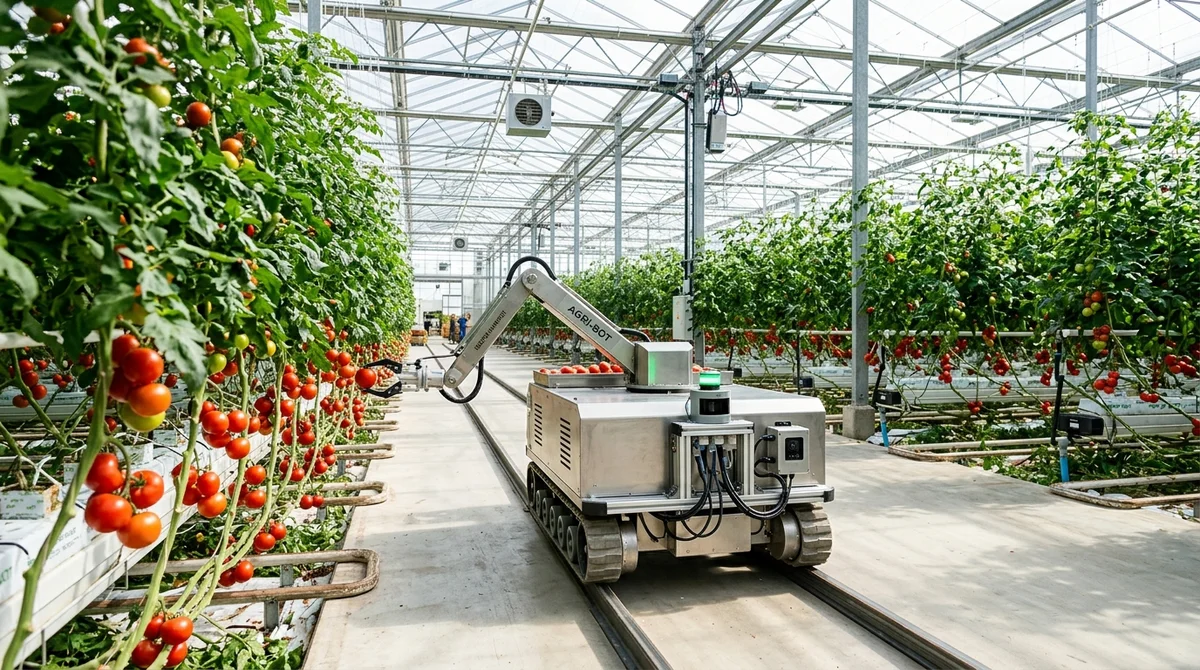
German agritech startup eternal.ag has raised €8 million to develop autonomous robots for greenhouses. The company is betting that harvest collection in controlled environments can be automated not through impressive demos, but through stable operation in real farms.
Why This Is Difficult
The greenhouse robotics market has long promised much, but regularly stumbles at commercial scale. The problem isn't just mechanics: a robot needs to work carefully with tomatoes and other fragile crops, recognize plants of different shapes, account for differences in row layouts, and maintain pace as conditions inside the greenhouse change. This very gap between a laboratory prototype and a reliable 22-hour shift in a real farm has broken the ambitions of many startups for years.
Demand for such solutions, meanwhile, is only growing. Greenhouses are becoming increasingly important for year-round vegetable and fruit production, and labor availability is falling. eternal.
ag points to a roughly 30% decline in labor supply in European greenhouses since 2010. For the industry, this isn't abstract statistics: when people are lacking for physically demanding and repetitive harvest work, supply predictability, operational quality, and farm economics all suffer.
Betting on Simulation
eternal.ag's key difference is a simulation-first approach. The company first trains and validates robots in virtual greenhouses built on NVIDIA Isaac Sim, only then deploying them to the real environment. The idea is to run failure scenarios, quickly change parameters, and test new versions in software rather than spending months on expensive iterations in hardware and on live crops.
"Autonomous robots only work when they handle the real variability of plants, layouts, and daily operations," says eternal.ag co-founder and CEO Renjy John.
After launching in a greenhouse, the system collects feedback from each robot action and uses that data for further learning. For John, this is also a second attempt at solving the same task: his previous project Honest AgTech, also related to greenhouse autonomy, went bankrupt in July 2023. Judging by the current strategy, eternal.ag is proceeding more cautiously: from one clear use case to a scalable platform, rather than the other way around.
What They Already Have
eternal.ag's first commercial product is called Harvester. It's a fully autonomous robot for greenhouse tomatoes that, according to the company, can operate up to 22 hours a day and is integrated into an AI system that monitors cut quality and harvest uniformity. The platform is being built modular from the start so that new functions and crops can be added over time, rather than being limited to one type of task.
- €8 million was invested by Simon Capital, Oyster Bay Venture Capital, EquityPitcher Ventures, and Backbone Ventures
- eternal.ag was founded in 2025 by Renjy John and Sherry Kunzachan
- The team currently has 26 people; headquarters are in Cologne, with an office in Bangalore
- The money will go toward accelerating development, commercial deployments across Europe, and expansion to new crops
- The company's long-term goal is fully autonomous greenhouses by 2040
Important caveat: some of the impressive metrics so far come from the company itself and haven't yet been validated by independent testing at scale on the wider market. But the overall trajectory looks disciplined: first one scenario for tomatoes, then new crops and tasks; first simulation and failure testing, then broader deployment at commercial sites. For agro-robotics, this is a rare and valuable form of caution.
What This Means
For AI and robotics, this is a good example of how the market is starting to value not just a model or manipulator, but the system's learning process. If eternal.ag can actually reduce the refinement cycle from months to days and maintain quality on real farms, greenhouse automation will have a chance to move out of the category of beautiful promises into a working infrastructure layer of the food chain in Europe.
Want to stop reading about AI and start using it?
AI News is a curated feed of AI/tech news. Hamidun Academy teaches you to use AI systematically in your work.