Samsung to direct $73 billion to chip production expansion and research in 2026
Samsung plans to spend more than 110 trillion won, or $73.3 billion, in 2026 on capital expenditures and research. The main focus is expanding memory…
AI-processed from Bloomberg Tech; edited by Hamidun News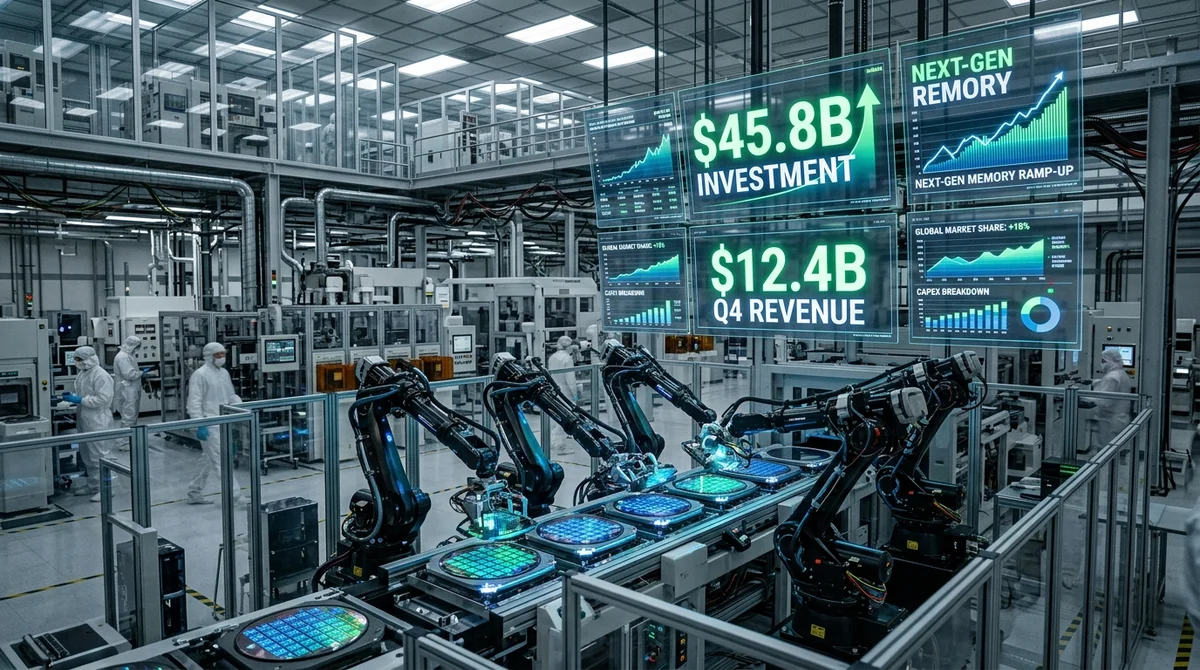
Samsung Electronics plans to invest more than 110 trillion won, or approximately $73.3 billion, in capital expenditures and research in 2026. The company is betting on two directions at once: expanding memory chip production and exploring new opportunities in sectors linked to artificial intelligence.
Where the Money Will Go
The planned budget represents one of Samsung's largest investment packages in recent years. This involves not only the construction and modernization of production facilities, but also research expenditures meant to support the next growth cycle. At the center of the plan is increasing capacity in the memory chip segment, where demand is particularly sensitive to the development of data centers, AI services, and more powerful computing infrastructure.
This decision combines current demand with preparation for the next technological cycle. For the market, it's a signal that Samsung is not counting on a short-term spike in AI interest, but is preparing for a long period of elevated semiconductor demand. When a company of this scale invests tens of billions of dollars upfront in factories, equipment, and R&D, it essentially confirms that artificial intelligence infrastructure is becoming not a side business, but one of the main capital centers in the technology sector and in the strategy of the world's largest tech companies.
- Samsung is allocating more than 110 trillion won for capital expenditures and research in 2026
- Key production priority — expanding memory chip capacity
- Separate focus — research and new directions linked to AI
- Investments are designed for a long-term demand cycle, not a one-off launch
Why Memory Matters
Artificial intelligence is typically discussed through models, chatbots, and applications, but the foundation of this market is hardware. The more models are trained and used, the greater the load on servers, accelerators, and memory subsystems. This is why expanding memory chip production becomes a strategic move: without sufficient memory capacity and speed, it's impossible to scale computations the way modern AI business requires.
The entire upper layer of AI services is built on this foundation. For Samsung, this is also a question of position in the global supply chain. Memory is one of the segments where the company traditionally plays a key role, meaning it can convert the general AI boom into direct revenue growth and technological influence.
Even if specific AI products change quickly, the need for chips capable of handling new workloads remains fundamental and long-term. That's why investments in capacity look not like a bet on a trendy fashion, but as an attempt to secure a fundamental position in the next phase of the market.
Betting on Research
Importantly, Samsung is talking not just about expanding production, but also about research. This demonstrates a broader strategy: the company wants not only to manufacture more components, but simultaneously to explore new technological growth points where semiconductors, computing infrastructure, and AI intersect. In this logic, R&D is not an appendix to manufacturing, but a second equal circuit that should provide future products and competitive advantages.
This approach reduces the risk of ending up as a mere volume supplier. If the AI market shifts toward new architectures, more energy-efficient solutions, or specialized systems, those who can quickly adapt both production and their own developments will win. Samsung clearly shows it wants to maintain flexibility: increase output where demand is already visible, and simultaneously invest in directions that could become key in several years.
What It Means
Samsung's plan shows that the AI era is increasingly defined not only by software, but by industrial investments. For the market, it's yet another confirmation: the race for leadership in artificial intelligence is happening not only in models, but in factories, memory, equipment, and research laboratories. For business and investors, it means a simple thing: evaluating AI now requires looking not only at model quality, but at who controls scarce components and production capacity.
Want to stop reading about AI and start using it?
AI News is a curated feed of AI/tech news. Hamidun Academy teaches you to use AI systematically in your work.