LG and NVIDIA discuss physical AI: robots, data centers, and mobility
LG and NVIDIA are in talks about physical AI, data centers, and mobility. LG CEO Ryu Je-chol met with NVIDIA's director of Omniverse and Robotics in Seoul…
AI-processed from AI News; edited by Hamidun News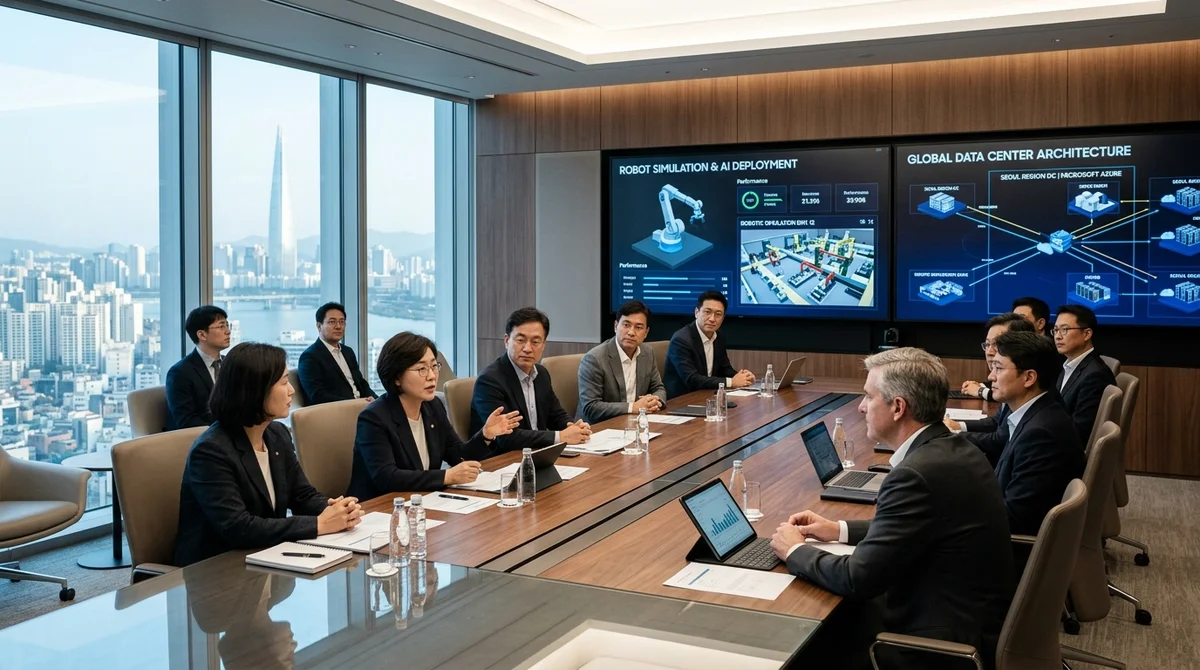
LG and NVIDIA are negotiating a collaboration in the field of Physical AI—technologies that control robots, industrial systems, and transport in the real world, not just process text in the cloud.
What Happened in Seoul
LG CEO Ryu Jae-cheol held a meeting with Madison Huang, Director of Product Marketing for Omniverse and Robotics at NVIDIA. Following the negotiations in Seoul, three key areas emerged: Physical AI, data centers, and mobility. This combination is no accident.
Physical AI is a fundamentally different class of technology compared to generative AI. A language model processes tokens; a physical system must perceive the three-dimensional world in real time, build spatial models, and make decisions with consequences in physical space. This requires a different infrastructure: high-performance computing alongside the device, a reliable cloud environment for model training, and a simulation platform—to train robots thousands of hours virtually before risking actual equipment.
LG is an obvious candidate for the role of a major customer. The company moved beyond consumer electronics long ago: the B2B segment includes industrial displays, delivery and cleaning robots (CLOi series), smart building systems, and commercial cooling solutions. These products already operate in airports, hotels, and shopping centers—the next step is to make them truly autonomous.
What NVIDIA Offers
In recent years, NVIDIA has built one of the most comprehensive ecosystems for Physical AI. For a major manufacturer like LG, this means a ready-made technological foundation—rather than building infrastructure from scratch:
- Omniverse — a platform for digital twins and simulations: robots are trained in a virtual environment before deployment in a real factory
- Isaac — a stack for industrial robotics from training perception models to deploying on physical systems
- Jetson — chips for edge computing: AI inference directly on the device without constant cloud access
- DGX — data center-level server platforms for training large-scale models
- DRIVE — a platform for autonomous transportation systems and mobility
Physical AI Leaves the Labs
NVIDIA has actively promoted the term Physical AI since 2024. Jensen Huang positions it as the wave following generative AI: language models have learned to understand text and images—now it's the turn of systems that understand the physical world and can act within it.
In practice, this means: a robot in a warehouse finding the required item without a preset route; an industrial manipulator adapting to parts of different shapes; autonomous transport in a port or on a production floor.
"The next wave of AI will be physical—machines will begin to understand the surrounding world and act within it," —
Jensen Huang, CES 2025.
Such AI requires three components working together: a powerful multimodal model, edge computing directly on the device, and a simulation environment for iterative training. This is exactly the combination NVIDIA offers—and what LG views as the foundation for its products.
What This Means
The LG and NVIDIA negotiations signal that Physical AI is transitioning from a conceptual stage to real industrial projects. Major electronics manufacturers are forming alliances with owners of technological stacks. Whoever first builds a comprehensive infrastructure—data centers, edge platforms, simulation environments—will secure a position in industrial automation for the next decade.
Want to stop reading about AI and start using it?
AI News is a curated feed of AI/tech news. Hamidun Academy teaches you to use AI systematically in your work.