Google DeepMind Introduces AI co-clinician System for Doctors and Telemedicine
Google DeepMind announced AI co-clinician, a research system designed to support doctors and patients under specialist supervision. In blind tests, doctors…
AI-processed from DeepMind Blog; edited by Hamidun News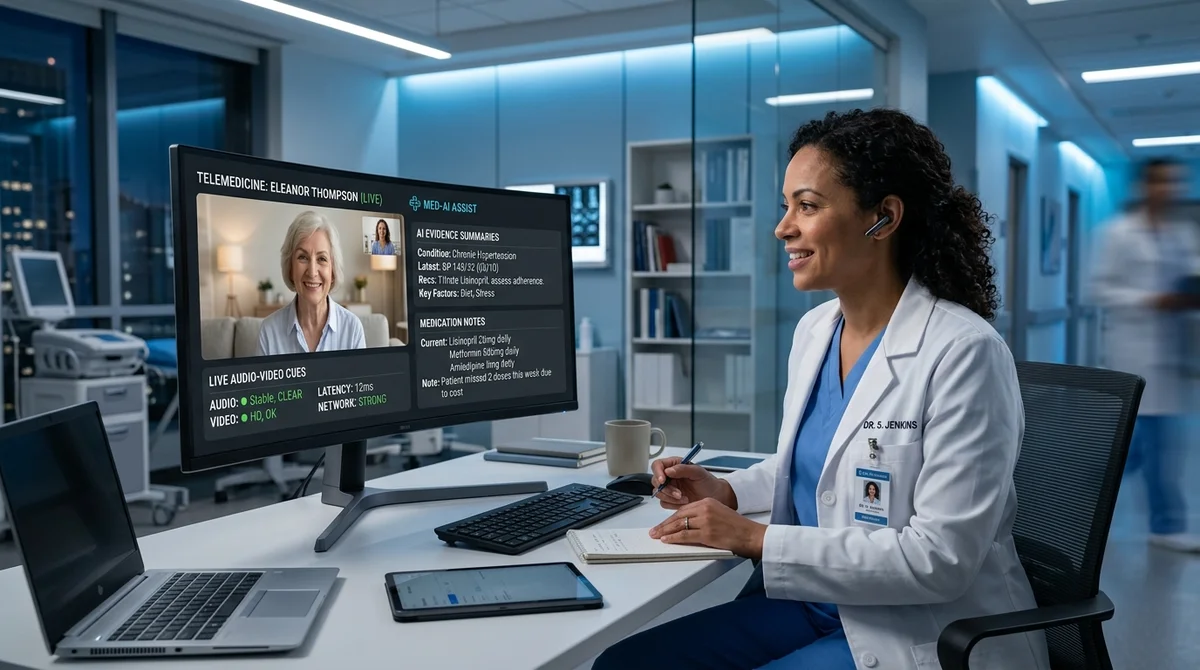
Google DeepMind on April 30, 2026 presented a research initiative called AI co-clinician — a system designed to assist doctors and patients within a clinical team, rather than replace specialist decision-making. The company is exploring whether such AI can speed up access to evidence-based information, better answer questions about medications, and support telemedicine consultations under physician supervision.
Why the project is needed
DeepMind starts from a simple problem: the healthcare system lacks people. The company cites a WHO forecast of a shortage of more than 10 million medical workers by 2030. Against this backdrop, AI is often presented as a universal solution, but in practice doctors need not just a talkative chatbot, but a tool they can trust in real clinical scenarios — with verifiable answers, clear limitations, and the ability to keep final decisions with humans.
This is why DeepMind describes the model as a co-clinician, not an autonomous doctor. The idea is that a patient, doctor, and AI form a trio: the system helps gather data, find relevant recommendations, and support the patient along the treatment path, but clinical responsibility remains with the specialist. The company calls this approach a step toward AI-augmented care — medicine where AI extends team capabilities rather than making final verdicts alone.
"Medicine has always been a team sport, and AI agents can bring new
participants to it."
How the system was tested
For "doctor-AI" scenarios, DeepMind adapted the NOHARM framework together with academic physicians. It evaluates two types of errors: when the system says something incorrect and when it fails to mention critically important information. In blind comparisons, doctors consistently preferred AI co-clinician answers to popular tools for synthesizing evidence-based information.
In a separate analysis of 98 realistic primary care queries, the system passed 97 cases without critical errors, which DeepMind presents as an improvement over two other widely used AI systems. The model was also tested on complex medication and therapeutic intervention questions. For this, they used the RxQA dataset from OpenFDA, which checks not only factual knowledge but medical reasoning.
According to the company, AI co-clinician improved significantly on open-ended questions about drugs and therapy, as they occur in real practice, rather than in multiple-choice test format.
- 98 realistic primary care queries
- 97 out of 98 cases without critical errors
- Advantage on open-ended questions about medications and therapy
- 20 synthetic clinical scenarios for telemedicine simulations
- Comparable or better results than primary care physicians on 68 out of 140 criteria
Another line of research concerns multimodal mode for telemedicine. DeepMind, working with doctors from Harvard and Stanford, tested the system on live audio and video, leveraging Gemini and Project Astra. In simulations with 20 clinical scenarios, the agent could do things that purely text-based systems cannot: for example, suggest the correct inhaler technique or guide a patient through shoulder movements to identify possible rotator cuff injury. But the company's overall conclusion is cautious: by more than 140 parameters, expert physicians still proved stronger, especially in detecting warning signs and conducting critically important examinations.
Limitations and safeguards
This is perhaps the key part of the news: DeepMind is very clearly not selling AI co-clinician as a ready medical product. The company states that current research collaborations are not intended for diagnosis, treatment, prevention of diseases, or provision of medical advice. This is specifically research into how such systems can be safely evaluated and where they are genuinely useful without overstated promises.
For patient telemedicine scenarios, DeepMind uses a two-agent architecture: the Planner module continuously monitors the course of the consultation, while the Talker module conducts the dialogue and should remain within safe clinical boundaries. For physician scenarios, the system emphasizes "clinical level" evidence, including verification of found information and citation checking. In parallel, the company is launching staged evaluations with partners in the USA, India, Australia, New Zealand, Singapore, and the UAE to test the approach in different medical contexts.
What this means
DeepMind demonstrates an important shift: medical AI is increasingly measured not just by exam test scores but by its ability to function within real clinical processes. Replacing a doctor is very far from here, but the role of an assistant that helps with evidence-based information, medication questions, and part of the telemedicine routine looks no longer like an abstract demonstration but as a subject of systematic verification.
Want to stop reading about AI and start using it?
AI News is a curated feed of AI/tech news. Hamidun Academy teaches you to use AI systematically in your work.