Democratic Alliance ministers in South Africa embroiled in scandal over AI errors
In South Africa, two Democratic Alliance ministers have found themselves at the center of a scandal over AI hallucinations in official documents. Solly…
AI-processed from Bloomberg Tech; edited by Hamidun News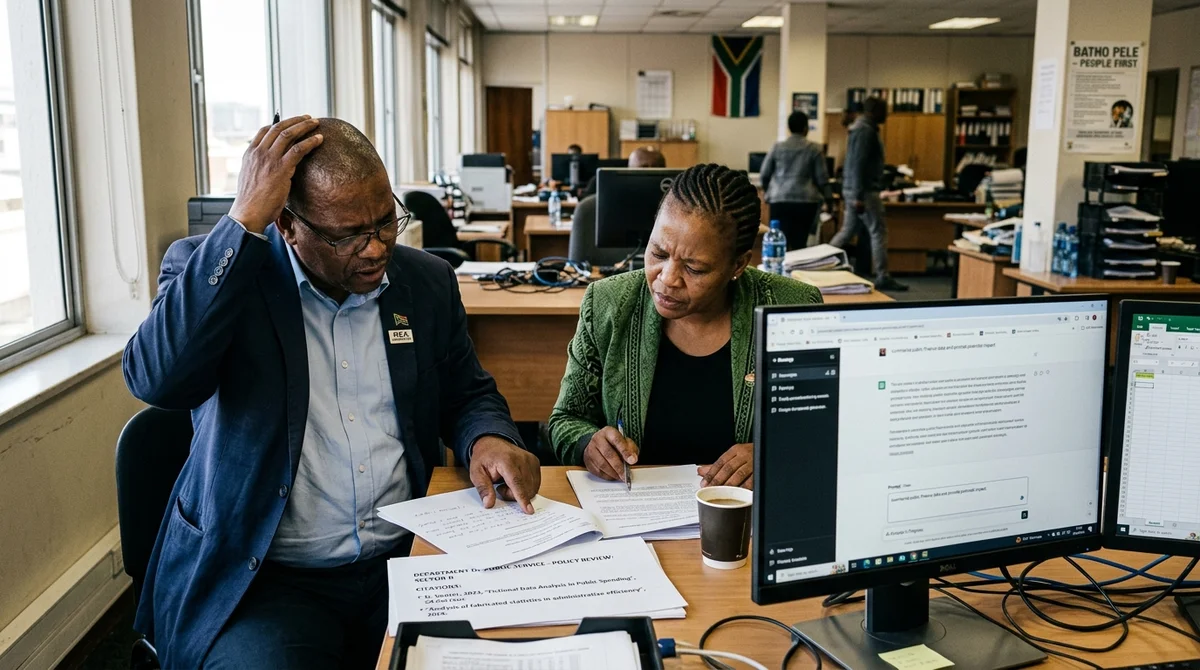
South Africa's authorities received a rare and painful example of how AI hallucinations transform from abstract risk into political scandal. Over one week, two ministers from the Democratic Alliance faced pressure due to unreliable references in official documents.
Two failures in a row
For the Democratic Alliance, this story is particularly inconvenient. Since 2024, the party has been part of the ruling coalition as the second-largest force and consistently promotes the idea of technological modernization of the state. Against this backdrop, a series of errors looks not like a private oversight by officials, but as a blow to their own political thesis: if you promise to make government faster and smarter with new tools, you must be the first to show that you can control their quality.
On April 30, Interior Minister Leon Schreiber suspended two high-ranking employees after officials found references resembling AI hallucinations in a cabinet-approved document on immigration policy. And on April 26, Communications and Digital Technologies Minister Solly Malatsi was forced to completely withdraw a draft national AI policy submitted for public consultation. The irony is that problems were found in the very document that was supposed to set rules for responsible use of artificial intelligence.
How errors were found
The scandal around the AI policy draft began after journalists and experts checked the references at the end of the document. In the 86-page draft published on April 10, 2026, after cabinet approval on March 25, there were 67 references. At least some of them turned out to be fictitious: publications either did not publish the cited articles, or the work titles themselves looked AI-generated. Ultimately, the ministry acknowledged that AI-generated citations likely entered the text without proper manual verification, and the document lost credibility even before consultations were completed.
The document itself was ambitious: it proposed creating several new structures to regulate AI, including a national commission, an ethics council, a safety institute, and a special insurance fund in case of damage from such systems. Therefore, the scandal struck not only at the form but also at the content: discussions of regulatory architecture quickly faded into the background because the original text had lost all credibility.
"This should not have happened.
We will learn this lesson with humility," Malatsi said.
Four days later, a similar problem surfaced in another department—in a revised white paper on citizenship, immigration, and refugee protection. This document also had high status because it had already passed through cabinet and was described as the largest overhaul of the migration system in a generation. When dubious references were noticed there as well, the story stopped looking like a single mistake by one department. It became a signal that AI could be used in government faster than procedures for verifying its results could be developed.
Political cost of the error
For a government of national unity, this is an uncomfortable episode on several levels. First, it damages the reputation of ministers who came with promises of greater discipline and technological sophistication. Second, it gives opponents a ready argument against accelerated AI implementation in public administration. Third, it postpones the very discussion of regulation: instead of debating the architecture of future policy, the country is forced to deal with who and how allowed unreliable data to be published in official papers.
- urgent verification of references and appendices in current policy projects
- mandatory verification of materials created with AI in the document approval process
- internal investigations and disciplinary measures in two departments
- delay in the new version of the national AI policy
- increased distrust of the thesis that digitalization automatically makes government more efficient
At the same time, the reason for the dispute does not cancel out the essence of the problem that the party raised earlier. South African public administration truly suffers from slow processes and poor quality control. But this story revealed an uncomfortable truth: generative models do not automatically fix bureaucracy. If you simply overlay a chatbot layer on top of old procedures, errors will not disappear—they will become more convincingly presented.
What this means
The story in South Africa is a good maturity test for any state and business already integrating generative AI into work processes. The model can accelerate a draft, select wording, and assemble structure, but it does not bear responsibility for facts. The more official a document and the higher the cost of error, the more important manual verification of references, sources, and conclusions. Otherwise, AI becomes not a tool of efficiency, but a factory of plausible failures.
Want to stop reading about AI and start using it?
AI News is a curated feed of AI/tech news. Hamidun Academy teaches you to use AI systematically in your work.