Roblox prepares the Reality platform with AI rendering and a push for photorealistic graphics
Roblox is developing Reality, a hybrid platform where a conventional engine handles physics, synchronization, and game state, while AI improves the image on…
AI-processed from 3DNews AI; edited by Hamidun News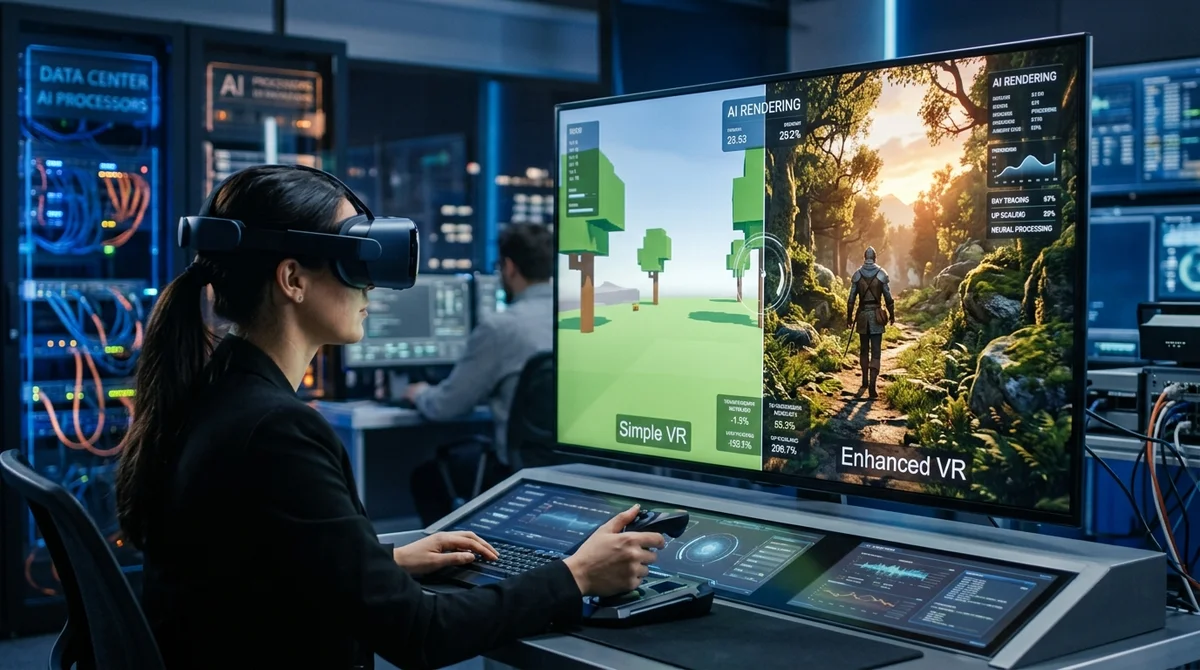
Roblox is preparing Reality — a new technical foundation for the platform, in which part of the visual layer will be created by an AI world model. The company wants to keep the familiar game engine for logic and synchronization, while entrusting neural networks with rendering more complex, detailed, and visually rich imagery.
How Reality Works
Reality is described as a hybrid system. At its core remains Roblox's familiar cloud engine, but on top of it the company wants to add so-called Video World Models — video world models that will operate in cloud edge infrastructure closer to the user. This is important for latency: the shorter the distance to the nearest data center, the higher the chance that such an approach will actually look smooth and not fall apart into motion artifacts.
The engine itself doesn't disappear anywhere and continues to do the most important part of the work. It is responsible for game state, player positions, physics, interactions between objects, and session synchronization. In other words, Roblox is not trying to completely replace the classic game runtime with a generative model.
The company proposes to divide responsibilities: the engine calculates what happens in the world, while AI improves how that world looks on screen.
What AI Will Render
After the basic engine delivers video and spatial scene data, an additional visual layer of enhanced quality should be formed on top. It can include more complex textures, lighting, movement of secondary objects, and detailed surroundings. Conceptually this resembles familiar image enhancement methods on the market, although Roblox is betting on its own architecture and a broader visual pipeline. In practical terms, this could give the platform several effects at once:
"DLSS 5 at home" — this is how
Roblox's approach has already been dubbed in the foreign press.
- More dense and realistic textures without a complete overhaul of old game worlds
- Complex lighting and visual nuances on top of already existing geometry
- More lively surroundings with additional objects and subtle animations
- Growth in visual quality without fully porting all game logic to a generative model
For Roblox this is especially interesting due to its huge database of already created user content. Instead of rebuilding the entire game catalog for a new engine, the company can try to use accumulated data as a foundation for AI rendering. If the scheme works, developers within the ecosystem could potentially gain the ability to refresh the look and bring it closer to a level that was previously unattainable for a typical Roblox project. This is especially important for authors with limited resources.
Technical Limits of Reality
For now all of this remains laboratory technology, not a ready consumer feature. The current version, according to the company's description, is not yet capable of real-time operation. The goal sounds ambitious: 2K resolution at 60 frames per second.
To approach such metrics, Roblox is counting on connecting data centers closest to the user equipped with accelerators like Nvidia H200 or B200. That is, this is not about a light software layer, but about heavy cloud infrastructure with very expensive hardware. There are also fundamental limitations of the world models themselves.
They currently struggle with maintaining state, long-term memory, custom game rules, and full simulation mode where everything should be predictable and consistent. Therefore, Roblox directly divides the roles: the reliability of gameplay remains with the traditional engine, while AI is entrusted only with visual elements. For this same reason, direct comparison with DLSS 5 is not entirely accurate: Nvidia already has solutions designed for real-time operation, while Reality is only moving toward that goal.
What This Means
Roblox is trying not just to improve graphics, but to rethink the very architecture of a mass gaming platform. If Reality reaches a working mode of 2K/60 fps without critical latency, the market will get an important precedent: generative models will be able to enhance the visual part of large online worlds without breaking their game logic.
Want to stop reading about AI and start using it?
AI News is a curated feed of AI/tech news. Hamidun Academy teaches you to use AI systematically in your work.