AWS introduced a system for migrating and upgrading LLMs in production with prompt optimization
AWS described the Generative AI Model Agility Solution — a framework for teams that want to move or upgrade LLMs in production without chaos or downtime. At…
AI-processed from AWS Machine Learning Blog; edited by Hamidun News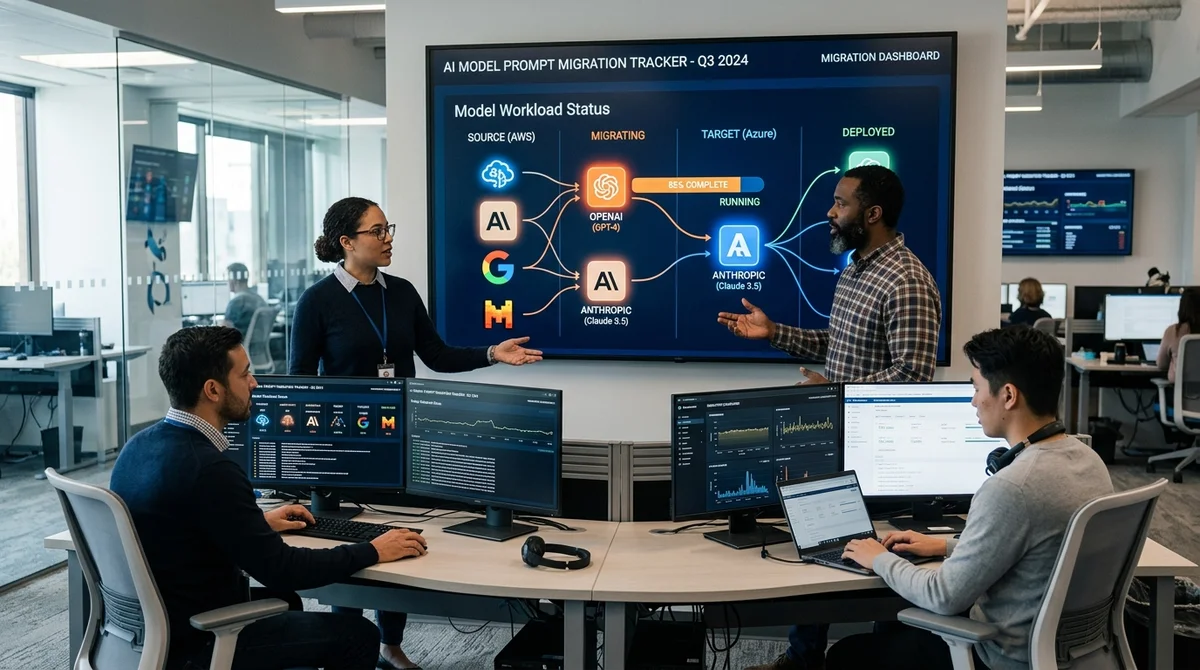
AWS introduced Generative AI Model Agility Solution — a set of practices and tools for teams that need to migrate or upgrade large language models in production. The idea is to change the underlying LLM without chaotic rewriting of the entire application, but to do it according to a formal scenario with checks on prompts, quality, and business metrics.
Why Migration Is Needed
Most AI products start with one model, then quickly run into constraints: costs rise, latency is unsatisfactory, limits change, a stronger version appears from another provider, or the business needs new security requirements. In a demo, this looks like a simple API swap, but in a real system it's more complex. The same prompt on a new model can become too verbose, follow format worse, make more factual errors, or process language differently.
AWS frames migration not as a one-time manual operation but as an engineering task with a repeatable process. This is an important shift: if a company has dozens of scenarios, chains with retrieval, structured responses, and automated actions, then moving a model without discipline quickly becomes a series of hidden failures. In production, such errors harm not only answer quality but also support, costs, expenses, and user trust.
What AWS Offers
At the center of the announcement is a systematic framework for migrating and upgrading LLMs in production. AWS speaks not just about tools but also about methodology: how to prepare the transition, how to convert prompts, how to optimize them for the behavior of the new model, and how to entrench best practices so the team can repeat this process again. Essentially, it's about standardizing what many companies still do manually and on intuition.
Based on this approach, the team goes through several mandatory steps:
- inventories current prompts, templates, and critical scenarios
- adapts instructions to the format and style of the target model
- optimizes prompts for the new behavior, constraints, and strengths
- runs quality, cost, and latency checks before release
- prepares a phased rollout and a rollback path for regressions
Separately, it's important that AWS ties migration specifically to prompt conversion and optimization. This is a practical emphasis. In most AI systems, the problem isn't that the new model is "bad" but that the application continues to speak to it in the language of the old model. If you don't adapt system instructions, few-shot examples, tool invocation format, and evaluation criteria, even a strong LLM can show worse results than the previous one simply due to incorrect integration.
What to Watch in Production
The main hidden risk when replacing an LLM is not the answer in the chat itself but the behavior of the entire chain around it. Particularly sensitive are scenarios where the model must return strict JSON, correctly invoke a tool, follow moderation policy, or not break a RAG pipeline. The difference between models often shows not in average text quality but in details: answer length, resilience to long context, tendency to refuse, precision in following instructions, and predictability on edge cases.
Therefore, the value of AWS's approach is that it formalizes comparison. Instead of subjectively saying "this model seems to answer better," the team gets a process: adapt the prompt, run a set of tests, compare with the baseline model, find regressions, and only then roll out changes. This mode is especially useful during a period when the LLM market changes too quickly: new versions are released constantly, pricing models are updated, and dependence on a single provider becomes a separate product risk.
What This Means
AWS essentially packages the idea of model agility into a working operational scheme: not to lock into one LLM but to build a system so that the model can be swapped without panic and complete product rewrite. For companies that are already pushing generative AI to production, this becomes not a secondary optimization but a core capability — quickly switching between quality, cost, and business requirements.
Want to stop reading about AI and start using it?
AI News is a curated feed of AI/tech news. Hamidun Academy teaches you to use AI systematically in your work.