Meta confirms leak: AI agent advice exposed sensitive data to employees
Inside Meta, an AI agent on an engineering forum suggested a fix to a problem, and an employee applied it without additional checks. As a result, a large volume of user and corporate data was accessible to the company's engineers for two hours. Meta confirmed the incident. The story shows that even internal AI suggestions should not be pushed to production without human validation and strict access controls.
AI-processed from Guardian; edited by Hamidun News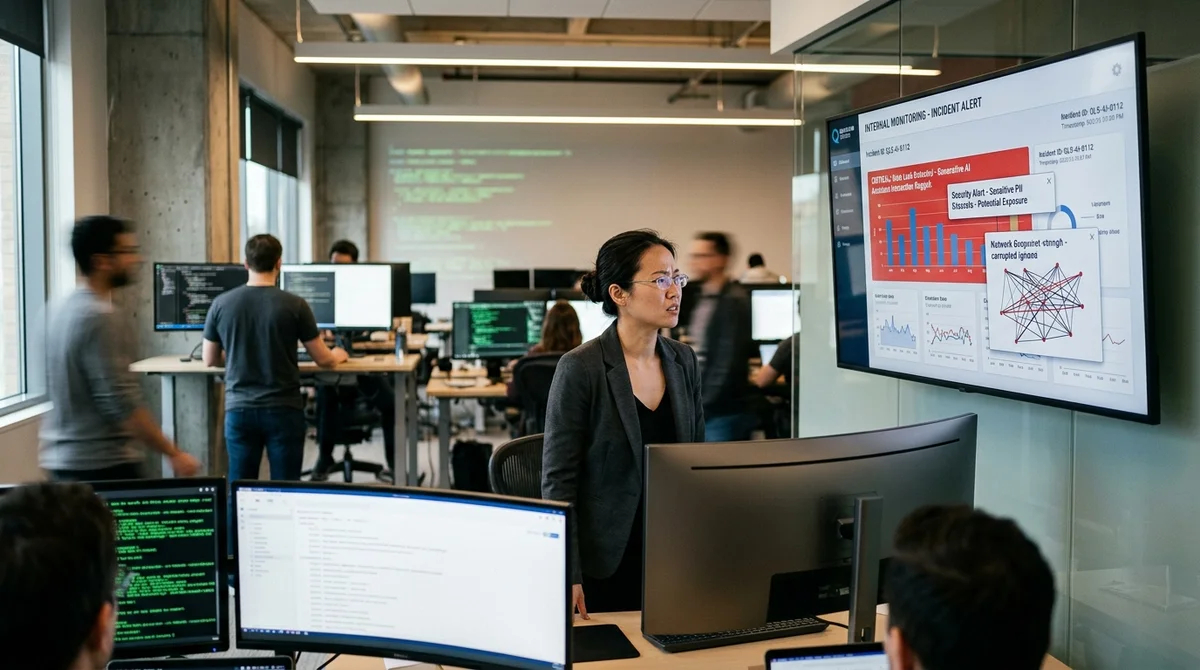
In Meta, there was an internal incident that well illustrates the downside of corporate AI assistants. An AI agent suggested a solution to an engineer on an internal forum, and after implementation, sensitive user and company data became accessible to some company employees for two hours.
How it happened
The scenario looked routine: an employee asked for help with an engineering task on an internal forum, where an AI agent provided answers. It suggested specific actions, and the engineer applied them in practice. The result turned out to be not just unsuccessful, but dangerous: access to a large volume of sensitive data opened up within the company.
Meta confirmed the fact of the leak, and this is important because we're talking not about a hypothetical risk, but about a confirmed incident in a working environment. The key detail here is that the leak was internal, not public. Meta engineers gained access, not external attackers, but this doesn't make the event minor.
Internal systems usually contain data that should be strictly limited by roles and tasks. In this case, these restrictions, judging from the incident description, were effectively bypassed through the execution of the AI recommendation. The access window lasted about two hours — enough for the problem to stop being theoretical.
Why this is serious
The story matters not just because of Meta itself. More and more companies are embedding AI assistants in internal forums, IDEs, documentation, and operational processes. These systems respond quickly and confidently, so employees start to perceive them as an infrastructure layer rather than an advisor.
But the model has no responsibility for the consequences of its answer: it doesn't see the full business context, bears no personal responsibility, and can suggest a step that looks logical locally but breaks protective boundaries at the system-wide level. There is a separate risk — the combination of user and company data in a single incident. Even if access remained within the perimeter, this is still a matter of privacy, compliance, and internal control.
Exactly which data sets were affected is not disclosed in the available description, but the very fact of simultaneous mention of user data and company data already shows the scale of possible consequences. For large platforms, such episodes quickly turn from a technical error into a management problem: who approved the action, where were the checks, and why were they insufficient.
Where the process broke down
This case looks less like "one model's error" and more like a failure in the decision-making chain. The AI agent generated an instruction, the engineer trusted it, and the control system failed to stop the dangerous change before the data became accessible to the wrong people. Based on this description, you can immediately spot several weak points that are typical for many companies actively implementing AI in internal development and engineering team support:
- The AI answer was perceived as a ready-made action plan rather than a hypothesis for testing.
- A change affecting data access proceeded without strict coordination or peer review.
- Protective mechanisms did not block the action automatically, even though it affected sensitive data.
- Division of access rights proved insufficient, since unnecessary access was granted to employees who didn't need it.
The practical conclusion for teams is simple: internal AI should not be placed on the same level as documentation that has been reviewed and for which someone is responsible. Any recommendation affecting access rights, storage configuration, logs, indexes, or data routes should undergo additional validation. Sandbox environments, logging of AI suggestions, explicit forbidden zones, and separate policies for actions that the model should not advise without escalation to a human are needed.
What this means
The incident at Meta shows that the main risk of corporate AI today is not only hallucinations, but the automation of trust. If a company speeds up engineers with the help of models, it is obligated to equally quickly strengthen checks, access segregation, and responsibility for implementing AI advice.
Want to stop reading about AI and start using it?
AI News is a curated feed of AI/tech news. Hamidun Academy teaches you to use AI systematically in your work.
The AI world, distilled — once a week
Seven stories that actually mattered, hand-picked. No noise, no reposts, no press releases.
Done! Check your inbox for a confirmation.