Nvidia explained the principle behind DLSS 5: the system only needs a 2D frame and motion vectors
Nvidia gave a more detailed explanation of how DLSS 5 works. According to Jacob Friedman, the system does not receive a full 3D scene, but a rendered 2D…
AI-processed from 3DNews AI; edited by Hamidun News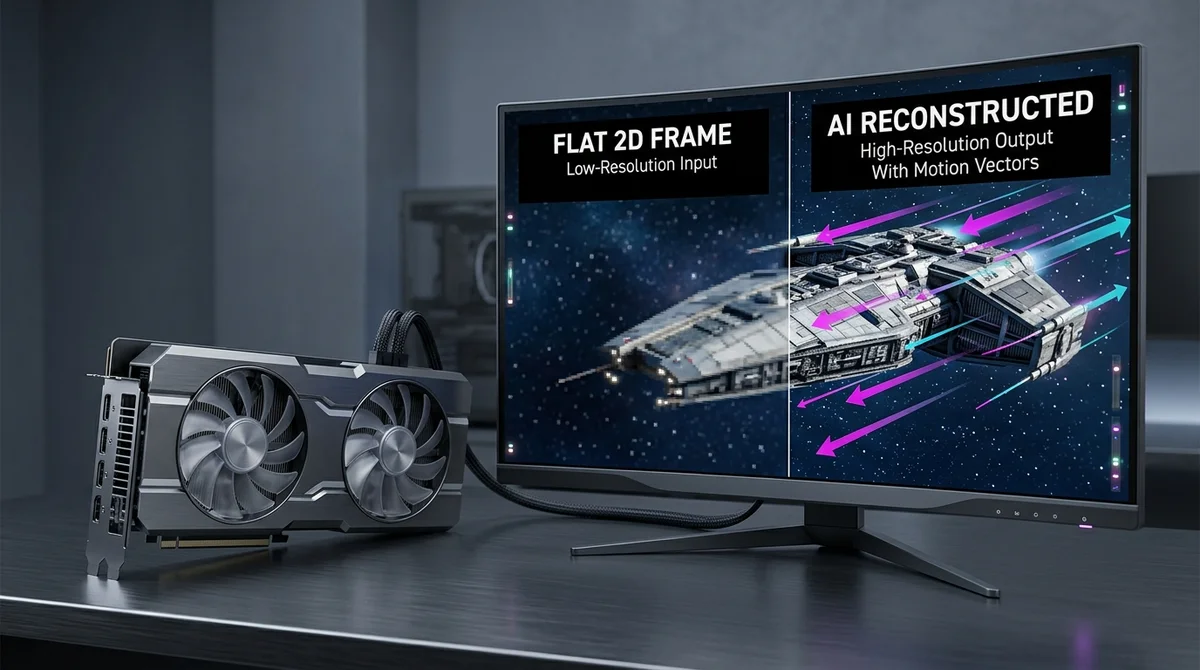
Nvidia has slightly opened the black box surrounding DLSS 5. According to Jacob Friedman, the system does not receive a complete 3D scene: instead, it receives a regular 2D frame already rendered by the game and motion vectors of objects.
What DLSS
Receives This is an important clarification for all debates about how exactly AI upscaling "draws" missing pixels. Many imagine DLSS as a model that sees the entire game world almost at the engine level. In practice, the scheme is much more compact.
The game first renders the frame at a lower resolution, then passes it to DLSS together with a motion map, which indicates how objects and individual image areas shift from frame to frame. Based on this foundation, the neural network reconstructs a more detailed image. This approach explains why the technology can significantly increase sharpness without a complete recalculation of the scene at native resolution.
The model does not need to rebuild world geometry or receive all internal engine data. It works as a reconstruction system: it searches for patterns, matches the current frame with element motion, and predicts how the final result should look at higher resolution. This is precisely why DLSS remains closely tied not only to the neural network itself, but also to how carefully the game prepares the source data.
"DLSS 5 receives a 2D frame and motion vectors as input".
Why Motion Vectors Are Needed Motion vectors are a key part of this scheme.
They indicate where and at what speed objects move between adjacent frames. Without them, the AI would have to guess almost blindly where the character's arm should be, where the shadow has shifted, or how to continue a thin line on a fast-moving object. The more accurate these data, the more stable the image appears in dynamics, when the player turns the camera, drives at high speed, or participates in a firefight with many effects on screen.
In practice, this provides several noticeable advantages: higher sharpness of fine details without full rendering at native resolution less flickering on thin lines, wires, grass, and distant objects more stable image in motion, not just on a static screenshot performance gains, because the game does not need to calculate every pixel at maximum quality From this also follows the reverse dependency: if the game poorly forms motion vectors, the final result will also suffer. Therefore, the quality of DLSS is determined not by a single "magical" Nvidia model, but by a combination of algorithm, engine, and specific implementation in a particular game.
Where
Method Limits Are Nvidia's explanation is also useful in that it sets boundaries for expectations. DLSS 5 does not "know" the scene the way the game engine itself does. It does not receive a complete three-dimensional model of the world in full volume, which means in any complex situation it relies on incomplete, albeit very useful information.
From this come typical artifacts familiar to users of reconstruction technologies: blurring of fine elements, trails at contrasting boundaries, or instability in frames with very complex motion, transparency, and a large number of small effects. At the same time, it is important not to confuse reconstruction with random redrawing. The meaning of DLSS is precisely that the system relies on real data from the game, not just "imagines" over the image.
But Friedman's explanation shows: even the strongest AI here remains dependent on the quality of the source frame and service telemetry. In other words, DLSS 5 is not a button to "make it look nice from nothing," but an advanced compromise between performance and visual quality.
What
This Means For players and developers, this is a useful signal: the main strength of DLSS 5 is not access to some hidden 3D magic, but the ability to most effectively reconstruct an image from a limited set of data. The better the game prepares the frame and motion vectors, the more convincing the result will be. And so the race for AI-graphics quality increasingly depends not only on Nvidia's model, but also on the discipline of the studios themselves in integrating the technology.
Want to stop reading about AI and start using it?
AI News is a curated feed of AI/tech news. Hamidun Academy teaches you to use AI systematically in your work.