White House presents AI regulation plan: Trump wants a single standard for the US
The White House has published a framework for a future AI law, effectively launching a new battle in Congress. The Trump administration is proposing a single…
AI-processed from Bloomberg Tech; edited by Hamidun News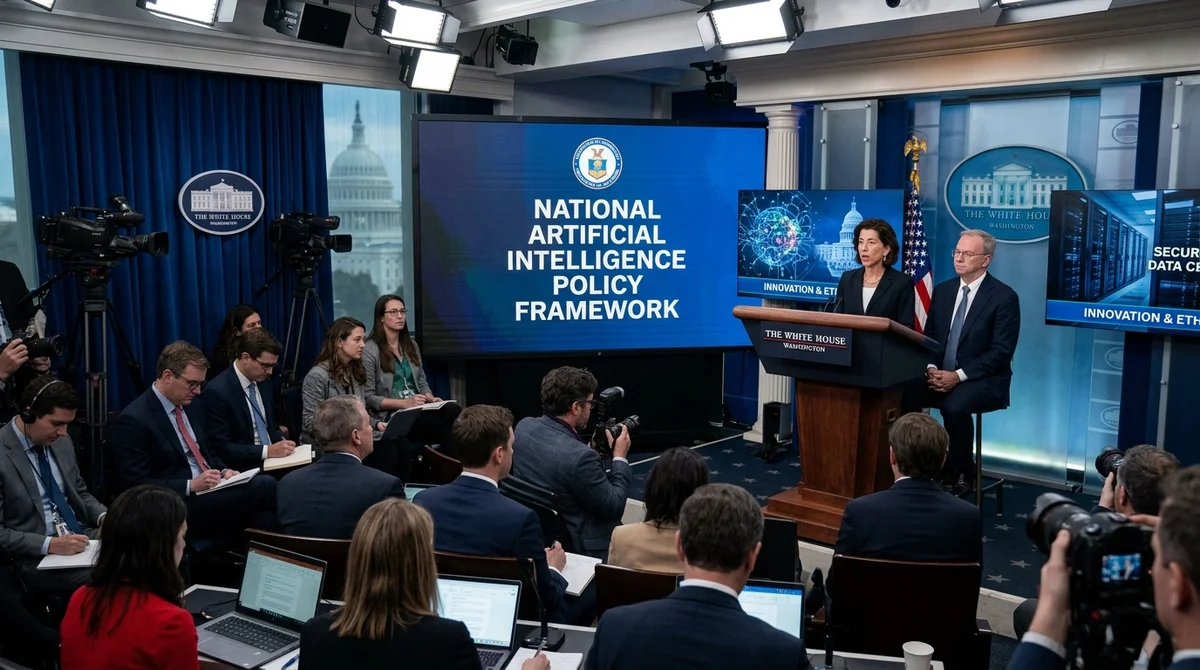
The White House has published a national framework for future federal artificial intelligence legislation. The Donald Trump administration proposes to Congress not a rigid set of prohibitions, but a political framework: unified rules for the entire country, fewer barriers for business, and separate measures to protect children, authors, and consumers.
What's Inside the Framework
A four-page document is not a bill and does not change anything by itself, but it sets the direction for Congress. The White House has gathered within it several priorities that, according to the administration, should simultaneously accelerate AI implementation and reduce the most sensitive risks to society. We are talking not only about models and chatbots, but also about infrastructure: data centers, energy systems, workforce development, and the powers of federal agencies.
- Tools for parents, including privacy controls, screen time, and content management
- Age verification and measures against child exploitation and promotion of self-harm
- Consumer protection from rising electricity rates due to AI data centers
- Approaches to copyright and digital copies of voice, face, and likeness
- Regulatory sandboxes, access to datasets, and AI training
A separate emphasis was placed on fraud and national security. The White House wants to strengthen government capabilities in combating identity spoofing using AI and other fraud schemes, especially against elderly people, as well as provide relevant agencies with more technical expertise to assess the capabilities of advanced models. At the same time, the administration explicitly states that it does not want to create a new federal AI super-regulator: instead, it proposes to rely on existing agencies and industry standards.
The Main Dispute with States
The most contentious part of the framework is the idea of federal priority over state laws. The Trump administration believes that the US cannot develop AI in a mode of fifty different rules, when California, Colorado, Texas, New York, and other states are moving in different directions. The White House proposes that Congress establish a single minimally burdensome standard and limit those regional regulations that, in Washington's view, are slowing down AI development and implementation.
"This framework will only work with unified rules across the country," the
White House document states.
But it is precisely here that the initiative faces the most political obstacles. Even among Republicans there is no complete agreement on how far one can go in relaxing regulations for large tech companies, and in the Senate the bill will still require Democratic support. Against the backdrop of midterm elections, reaching agreement will be even more difficult: some politicians are betting on consumer protection, jobs, and local communities, which are already in dispute with data center construction, their energy consumption, and environmental impact.
Innovation Instead of a New Regulator
In spirit, this is one of the "lightest" federal approaches to AI regulation in recent years. The White House does not propose to pre-decide in law the main conflict surrounding training models on copyright-protected content. Rather, the administration believes that the question of fair use should continue to be discussed in courts, and Congress should for now cautiously consider only licensing mechanisms and collective negotiations for compensation without rigid predetermination for the entire industry.
A similar approach is evident in the block on freedom of speech and innovation. The administration wants to prohibit federal agencies from pressuring AI platforms on political content moderation, expand regulatory sandboxes, and open more government datasets in formats suitable for model training. In parallel, the White House proposes investing in worker retraining, teaching AI skills in existing educational programs, and providing technical assistance to small businesses, so that the benefits of the AI boom are shared not only by the largest corporations.
What It Means
The White House has fixed its position: the US needs not new rigid restrictions, but a federal framework that will remove some regulatory uncertainty and accelerate the race for AI leadership. Now the main question is not whether the administration has a position, but whether Congress will be able to assemble from this political draft a real law without breaking it apart in disputes over states' rights, author protection, and the price of rapid growth.
Want to stop reading about AI and start using it?
AI News is a curated feed of AI/tech news. Hamidun Academy teaches you to use AI systematically in your work.