OpenAI and the UK government: eight months after the agreement, no pilot projects have launched
The UK government has yet to run a single pilot using OpenAI technology, even though the partnership was signed eight months ago. A freedom of information…
AI-processed from Guardian; edited by Hamidun News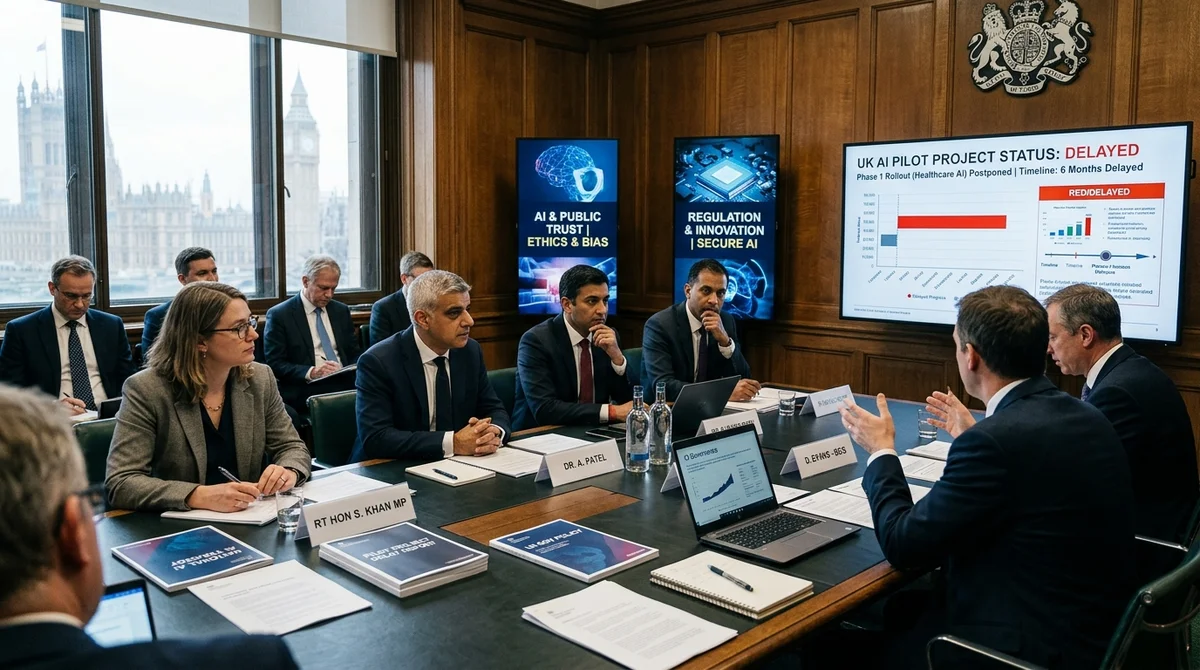
The UK government has still not launched a single pilot with OpenAI technologies, despite signing a partnership with the ChatGPT creator eight months ago and presenting it as an important step toward reforming public services. A Freedom of Information request revealed: behind the grand announcement, there have been no actual trials yet.
Partnership Without Pilots
When London announced a memorandum with OpenAI, it was not just about familiarizing itself with new technology. Ministers presented the agreement as a tool that would help modernize state services and use artificial intelligence to solve major public challenges. Against the backdrop of the general excitement around generative AI, this looked like a signal: the British government wants to be among those who implement such systems not in presentations, but in the everyday work of ministries.
In the British system, such initiatives are usually associated with digital modernization: speeding up responses to citizen requests, automating document drafts, supporting operators and analysts, reducing the burden on the front office. Therefore, the absence of even a limited test launch looks particularly striking. Expectations were about practical application, not a long stage of discussions and framework agreements. But eight months later, the picture looks noticeably more modest.
A Freedom of Information request found no evidence that the government had conducted any testing of OpenAI technologies at all. In other words, a gap has formed between public rhetoric and actual actions.
For this story, what matters is not just the fact of bureaucratic delay, but that the partnership was initially presented as a practical step toward reform, not as a framework intention for the future.
The partnership was supposed to help "solve the greatest challenges of society."
Why the Launch Is Stalling
The absence of pilots does not necessarily mean that cooperation has failed. In the public sector, even a limited test of a new AI system requires lengthy preparation: it is necessary to define use cases, coordinate work with personal data, verify the quality of the model's responses, integrate it into existing processes, and understand who is responsible for errors. Government officials are particularly cautious about tools that can affect citizen requests, documents, and official decisions.
Before a real launch, several steps are usually needed:
- select a specific task where AI saves time rather than creates additional risk
- test how the model works with sensitive and closed data
- define rules for human verification and the boundaries of automation
- coordinate legal and procurement procedures
- establish metrics: processing speed, quality, cost, and number of errors
There is also a purely political problem. It is much easier to sign a memorandum than to select a ministry, take one real process, set KPIs, and publicly show the result. Once a pilot begins, questions immediately arise about reliability, transparency, citizen rights, and who will be responsible if something fails. That is why government structures often reach strategic partnerships faster than they get to the stage where AI must work on live cases.
The problem is that without these pilots, it is impossible to verify the most basic promises. Until there are tests, it is impossible to honestly say whether OpenAI will speed up the processing of requests, relieve employees, or simply add a new layer of control and manual verification.
Against this backdrop, the story becomes a test of the maturity of government demand for generative AI: business is already implementing models in internal processes, while government still has to prove that it is capable of moving from announcement to execution.
What This Means
The story of the British government and OpenAI is a reminder of a simple fact: between signing a partnership and actually implementing AI, there is a long operational distance. For the market, this is a signal that even large states move from loud announcements to working cases more slowly than it seems from the outside.
Want to stop reading about AI and start using it?
AI News is a curated feed of AI/tech news. Hamidun Academy teaches you to use AI systematically in your work.