Kled AI and other services buy people's personal data to train models
A new shadow market for AI data has emerged: people record footsteps on the street, city noise, voices, and even private calls to earn dollars. For some, it…
AI-processed from Guardian; edited by Hamidun News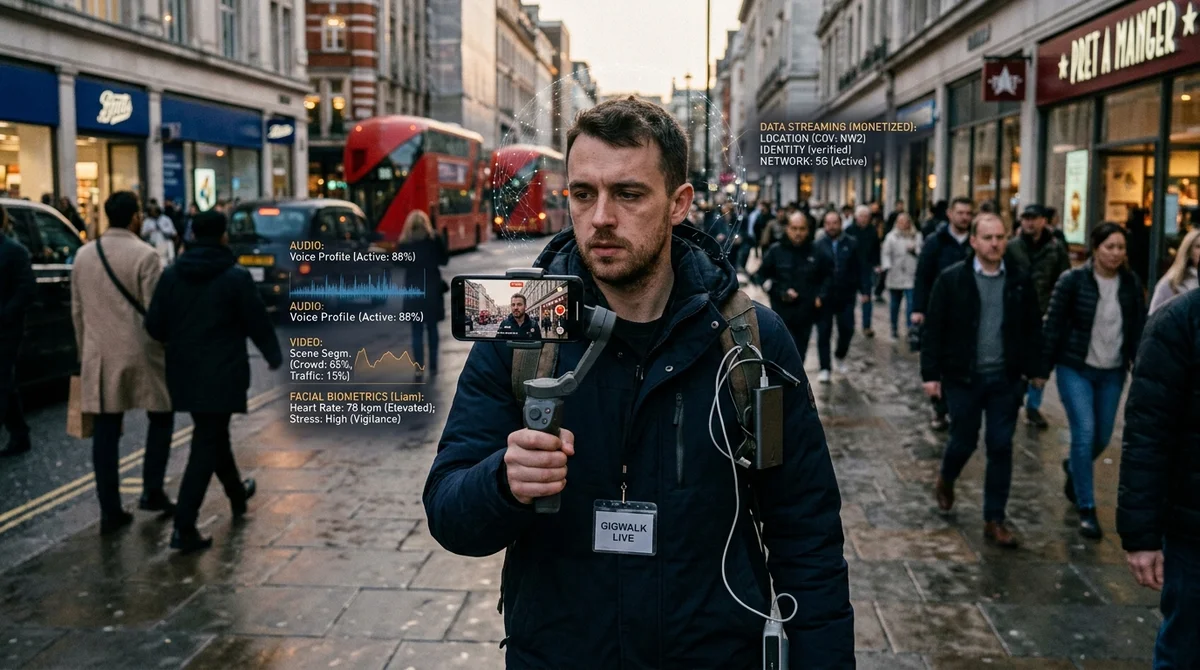
Around AI training, a new market is rapidly growing: ordinary people are selling companies pieces of their everyday life — voice, videos from streets, conversations and phone calls. For some, it's a way to buy groceries or settle bills; for platforms, it's a source of data that is increasingly scarce for new models.
How this looks
Participants in such platforms perform simple real-life tasks. Jacobus Lowe, a 27-year-old from Cape Town, recorded a walk around his neighborhood and earned $14 — roughly half his weekly grocery budget. In Ranchi, India, student Sahil Tigga earns over $100 a month recording street noise and his own voice for Silencio. And in Chicago, 18-year-old Ramelio Hill sold about 11 hours of personal conversations to Neon Mobile and received approximately $200.
- Videos of walks and city navigation
- Background noise from streets, cafes and transport
- Voice recordings and multilingual dialogues
- Personal calls and text messages
- Face and voice for AI clones
For many, this isn't exotic earnings, but a direct response to money shortage. In countries with weak currencies and high unemployment, payments in dollars can be more profitable than local work. Lowe himself openly said that USD payments feel completely different than they seem from the outside. Income is unstable and doesn't cover all expenses, but gives the opportunity to pay for food, education, or utility bills without lengthy searches for formal employment.
Why AI pays
AI companies are running out of quality open data on which they can safely train models. Large sets of texts increasingly restrict use for generative AI, and synthetic data doesn't always help: if a model learns from its own answers, quality can degrade. That's why platforms like Kled AI, Silencio, Luel AI and ElevenLabs buy what is still hard to replace — human context: live speech, unique sounds, urban behavior, facial expressions and intonation.
"Human data remains the gold standard for now".
Economists believe this employment format will grow. Companies pay people not only because they need realistic material, but also because it's legally cleaner than endlessly arguing over web scraping and copyright. For executors, it's a pragmatic exchange of privacy for quick money. For platforms, it's a way to close the data deficit on which future products are built, from voice assistants to navigation, facial recognition, and conversational bots.
The price of quick money
The main problem is that many agreements give platforms almost maximum rights to uploaded materials: perpetual or difficult-to-revoke use, transfer to partners, creation of derivative works, and absence of new payments, even if data generates profit for years. In other words, 20 minutes of voice recording today can later become an AI operator's voice, and the person won't see another cent and won't be able to effectively withdraw consent.
Risks are no longer theoretical. Neon Mobile was shut down after launch due to a vulnerability that gave access to phone numbers, call recordings and user transcripts. Another example is a New York actor who sold his face and voice to an AI video service for $1,000, then saw videos with his own digital copy generating millions of views and advertising dubious medical supplements. Explaining to acquaintances that it wasn't him in the video turned out to be a separate problem.
Kled AI's founder claims his company restricts data use to training and research tasks and checks buyers to avoid working with the porn industry and structures with questionable goals. But lawyers and privacy researchers still warn: users almost never understand exactly where their face, voice, or behavioral patterns will end up. Even if name and geolocation are removed, biometric data is inherently difficult to truly anonymize.
What this means
The market for AI training data turns personality into raw material: not just texts and images, but voice, habits, routes, conversations. For users, it's quick money here and now; for platforms, it's a long-term asset that can be reused for years. The stronger the deficit of quality data, the more often AI companies will buy not content, but people themselves as the source of that content.
Want to stop reading about AI and start using it?
AI News is a curated feed of AI/tech news. Hamidun Academy teaches you to use AI systematically in your work.