Michael Smith pleads guilty to fraud involving AI tracks and fake streams
In the US, Michael Smith pleaded guilty to a scheme involving AI-generated music and bots that brought him more than $8 million in royalties. Prosecutors say…
AI-processed from Guardian; edited by Hamidun News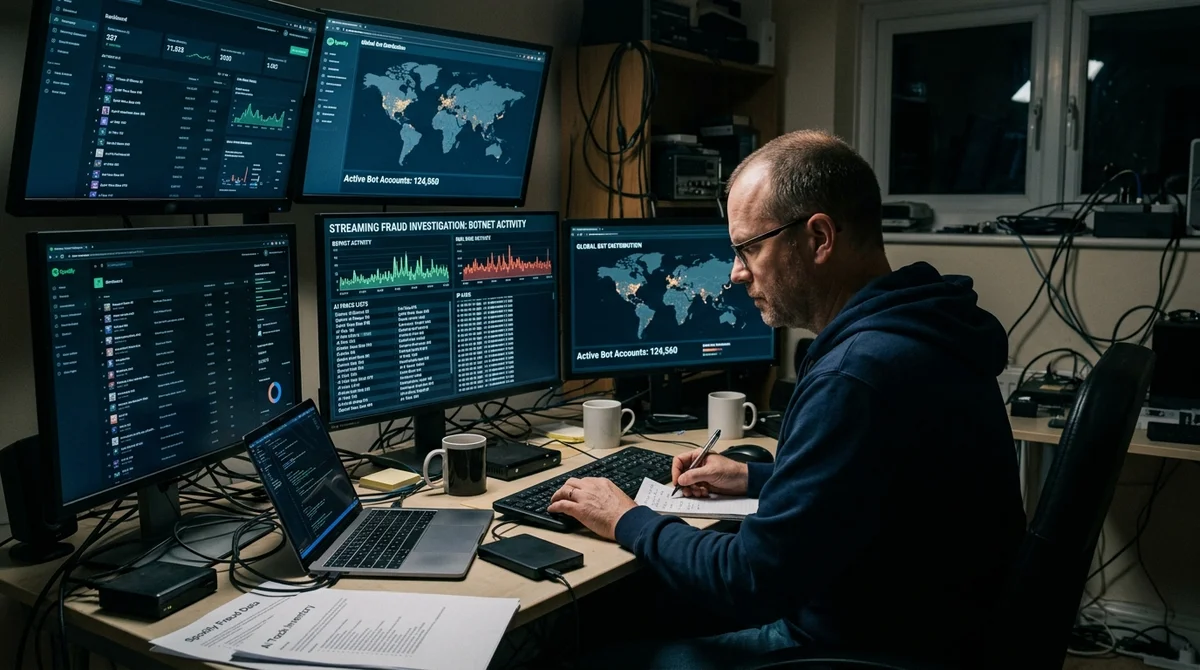
Michael Smith from North Carolina pleaded guilty in a major music streaming fraud case. According to prosecutors, he was massively uploading AI-generated tracks and artificially boosting their play counts using bots to claim royalties from the streaming platforms' shared pools.
How the scheme worked
Investigators believe that Smith built what was nearly an industrial-scale operation. He created thousands of accounts on music services and ran software that continuously streamed his own tracks. To avoid drawing attention with abnormally high numbers on a single song, the streams were distributed across a huge catalog.
This is where neural networks gave a key advantage: instead of recording real music, he could quickly release hundreds of thousands of compositions suitable for mass uploading and equally massive stream manipulation. According to case materials, the fake traffic came through major platforms like Amazon Music, Apple Music, Spotify, and YouTube Music. In total, the bot accounts generated billions of streams.
For U.S. authorities, this is one of the first truly significant cases where generative AI became not just a controversial creative tool, but a direct instrument of financial fraud.
Here AI wasn't used for musical experimentation, but as a way to scale deception in a way that would have been too time-consuming and expensive before.
Money and scale
The story spanned years. When charges were filed in September 2024, prosecutors said the scheme operated from 2017 to 2024 and could generate over a million dollars a year. In court documents, figures cited 661,440 streams per day, and the initial estimate of illegally obtained royalties exceeded $10 million. Under the current plea deal, Smith pleaded guilty to conspiracy to commit wire fraud and agreed to forfeit $8,091,843.64.
- The scheme lasted approximately seven years
- Daily stream manipulation reached 661,440 streams
- The plea deal includes forfeiture of $8,091,843.64
- Maximum sentence under the statute — up to five years in prison
The forfeiture amount itself shows this wasn't a gray area in music marketing or typical boost tactics for promoting an unknown artist. This was a full-scale scheme to siphon money from the royalty distribution system. The court is scheduled to hand down sentencing on July 29, 2026. Even if the final sentence falls below the maximum, the case has already become an important precedent: the government is establishing that stream manipulation using AI and bots is not a marketing trick, but criminal fraud.
Why the case matters
The streaming economy is structured so that artist payments come from a shared money pool proportional to the number of streams. This means fake streams don't just corrupt platform metrics — they literally steal money from real musicians, songwriters, and rights holders. That's why the victims in this case are considered not only the services but also musicians whose tracks were listened to by actual people. The prosecutor directly describes the scheme as a redistribution of royalties from genuine performers to someone who created both the music and its audience artificially.
"The songs and listeners were fake, but the stolen millions were very real," stated federal prosecutor
Jay Clayton.
The case extends beyond a single criminal story because music platforms are already drowning in a wave of AI content. Deezer previously estimated it receives about 60,000 fully AI-generated tracks daily, and many listeners can't even distinguish between machine and human music. Against this backdrop, Smith's scheme illustrates the main risk of the generative era: the problem isn't just who wrote the track, but who can automate production, publishing, and fake consumption of content in a single cycle.
What this means
For streaming services, this is a signal to accelerate anti-fraud systems and more carefully examine anomalous catalogs, not just suspicious spikes in hits. For the market overall, the case is important because the debate around AI in music is shifting from copyright to money and distribution infrastructure. Now the question becomes: who gets the royalties if music and listeners can be synthesized with minimal human involvement?
Want to stop reading about AI and start using it?
AI News is a curated feed of AI/tech news. Hamidun Academy teaches you to use AI systematically in your work.