Huawei unveils Atlas 350 and claims it outperforms Nvidia H20 in AI inference
Huawei introduced the Atlas 350 AI accelerator for inference workloads and immediately compared it with Nvidia H20, claiming higher computing power for the…
AI-processed from 3DNews AI; edited by Hamidun News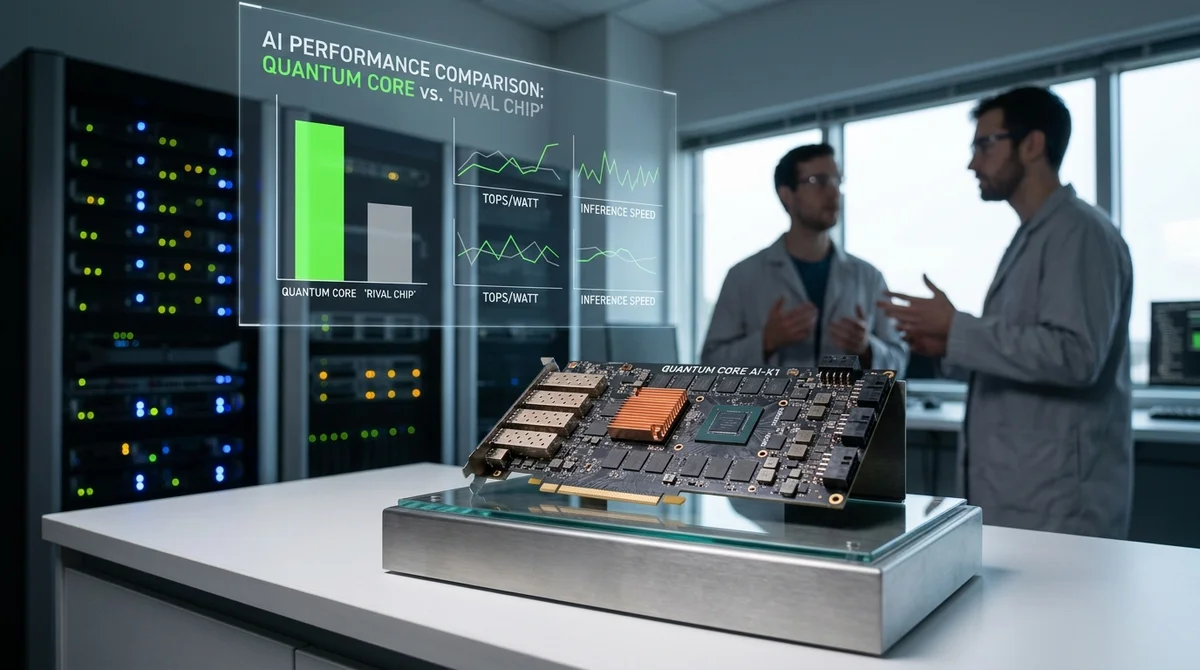
Huawei presented the Atlas 350 accelerator board for AI inference and claimed that in terms of computing power, the new product surpasses Nvidia H20, which is oriented toward the Chinese market. The device is built on the Ascend 950PR chip and became another step by Huawei in expanding its own line of AI hardware.
New Huawei Accelerator
The main emphasis in the announcement is not on versatility, but on a specific task: Atlas 350 is designed for inference—for running already trained models in real-world services. It is inference today that determines how quickly and cheaply an AI product responds to users, processes requests, and scales under load. Therefore, the comparison with Nvidia H20 looks not like an abstract marketing gesture, but as an attempt to demonstrate readiness to compete in the most applied part of AI infrastructure.
The pairing with the Ascend 950PR chip is also important. Huawei is clearly continuing to build not isolated devices, but a complete hardware platform around its own semiconductors. For corporate clients and developers, this usually means a more predictable ecosystem: the accelerator, the base chip, and the accompanying stack develop within a single product line.
The broader such a line is, the easier it is for a company to promote its solutions not as individual products, but as a full alternative to external suppliers.
Betting on Ascend
The emergence of Atlas 350 fits into Huawei's broader strategy: the company is consistently expanding AI offerings based on its own chips. The announcement specifically emphasizes that this direction intensified following notable progress in semiconductor development, including the Ascend family, without the use of American technology. For Huawei, this is not merely an image-related thesis. It is about an attempt to control a critically important layer of the AI chain—from the computational base to finished systems that can be deployed in data centers and corporate products.
From this announcement, several practical signals can be drawn:
- Huawei is strengthening its AI inference direction
- The Ascend line is becoming the center of the entire strategy
- The company is betting on its own component base
- Competition with Nvidia is moving into the applied segment
- The Chinese market receives another local option for AI workloads
This is important for the market also because Huawei no longer appears as a player simply catching up to leaders on individual points. When a company launches a new accelerator and immediately compares it to a specific Nvidia product, it sets the frame for the conversation itself: the discussion is no longer about the fact of presence in the segment, but about relative performance. For clients, this changes the optics: the choice begins to be based not on the principle of "is there an alternative," but on the principle of "how advantageous and mature is it."
Market Against Nvidia
The comparison specifically with Nvidia H20 for the Chinese market makes the announcement both politically and commercially precise. H20 is a benchmark for customers who need a powerful accelerator for AI tasks within the Chinese ecosystem. If Huawei is truly capable of offering higher computing power in this class, this increases its chances not only in individual tenders, but also in long-term infrastructure projects, where supply stability, compatibility, and the development of a local stack are important.
Even without disclosing all details, it is already clear what Huawei is aiming for. The company is cementing the idea that the Chinese AI market can rely not only on foreign solutions, but also on its own hardware platform. This is particularly sensitive for developers of large models, cloud services, and corporate implementations: the more local accelerators appear in the working class, the more real an independent ecosystem becomes, where critical computing infrastructure does not depend on a single external vendor.
What This Means
Atlas 350 is important not only as yet another accelerator in Huawei's catalog. It is a signal that competition in AI hardware is shifting from bold promises to a struggle for real inference, where performance, availability, and control over one's own technology chain matter. If Huawei confirms its claims in practice, the balance of power in the Chinese AI market could change noticeably.
Want to stop reading about AI and start using it?
AI News is a curated feed of AI/tech news. Hamidun Academy teaches you to use AI systematically in your work.