Silicon Valley animal rights activists want to recruit AI researchers as allies
In early February, San Francisco hosted an unusual meeting: animal rights activists and AI engineers sat down at the same table for the first time to discuss…
AI-processed from MIT Technology Review; edited by Hamidun News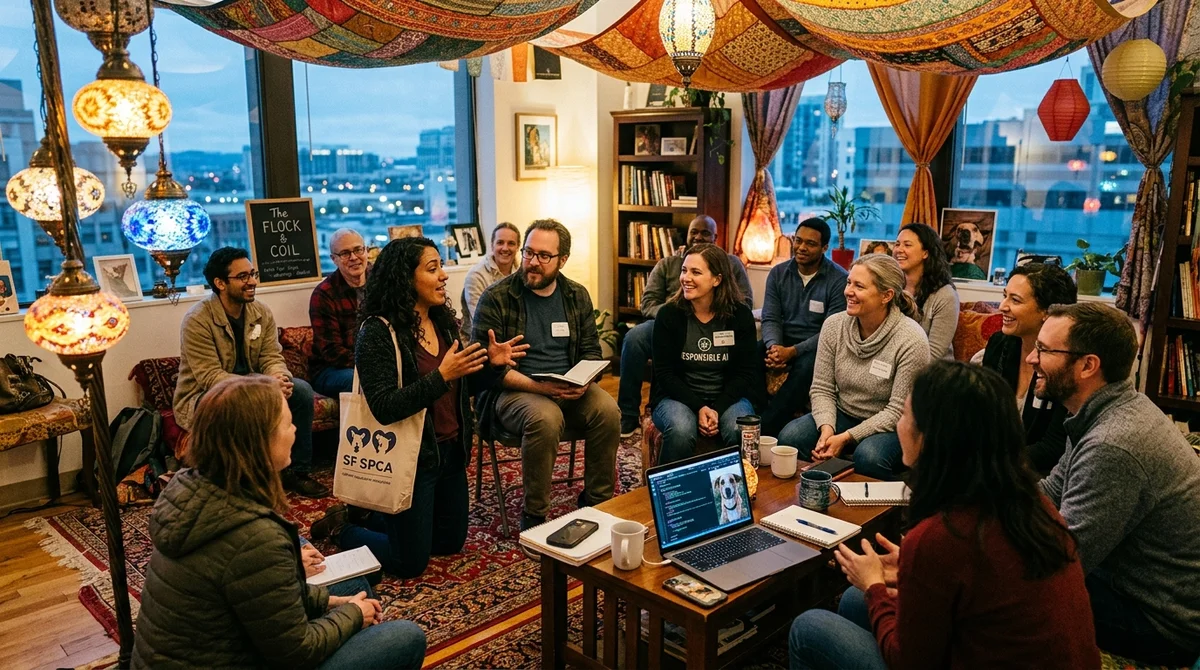
Activists for animal rights in San Francisco are increasingly seeking allies among AI researchers — and from the first meetings, they are finding a response.
Meeting of Two Worlds
In early February, dozens of people gathered in a small coworking space called Mox in San Francisco: animal welfare advocates, wildlife researchers, and engineers from AI companies. Shoes were removed at the entrance — Persian carpets lay on the floor, mosaic lamps glowed beneath colored awnings. The organizers deliberately created an atmosphere far from corporate format: live conversation mattered more than polished slides.
One of the speakers — a representative of a wildlife conservation organization — spoke concretely. Hundreds of millions of animals suffer annually; traditional protection methods have reached their limits, and the movement needs allies with different tools. He didn't need sympathizers — he needed engineers.
That evening became part of an organized campaign: the Bay Area animal welfare community is deliberately recruiting AI specialists as allies.
What AI Already Does for Animals
The intersection of animal welfare and machine learning has existed for a long time, but it is experiencing a surge right now. Meeting participants mentioned several areas where progress is already visible:
- Wildlife monitoring — CV-models recognize species from camera trap photos more accurately and faster than any volunteer, processing tens of thousands of images in just a few hours
- Poaching detection — acoustic forest analysis and satellite imagery allow tracking illegal hunting in real-time
- Decoding animal communication — the Earth Species Project applies LLM methods to analyzing whale songs, elephant calls, and bird vocalizations
- Monitoring housing conditions — sensors and ML models on farms track signs of stress and pain in animals before critical situations arise
- Fighting illegal wildlife trade — AI systems help detect advertisements for protected species sales on the dark web
Among the specific initiatives discussed at the meeting were platforms like Wildlife Insights from Google and academic projects on decoding animal language. Several participants discussed creating a shared dataset — analogous to what ImageNet did for computer vision.
Why the AI Community Is Hesitant
Animal welfare advocates have been trying to reach out to tech companies for years but hit a structural problem: AI laboratories are built around tasks with paying customers. Animals don't pay.
The situation began to change with the growth of the EA movement (effective altruism) and longtermism communities inside Bay Area tech. Some researchers from major AI laboratories openly support animal welfare as a domain with high potential for impact. In parallel, animal welfare organizations are building partnerships with foundations like Open Philanthropy and arranging joint research programs with university laboratories — gradually creating an economy that simply didn't exist before.
"This is not a request to do something beautiful for ecology.
This is a conversation about preventing immense suffering on a scale that previously seemed impossible," said one of the speakers.
Skeptics, however, point to real barriers: data about animals is fragmented and incompatible across organizations, there are no unified annotation standards, and long-term funding is unstable. Without proper data infrastructure, most ML models in this field remain prototypes, not working tools with measurable impact.
What This Means
The movement is still small but strategically structured. Animal welfare advocates are deliberately integrating themselves into Silicon Valley's AI network through informal events in coworking spaces, academic conferences, and joint research grants. If this coalition gains critical mass of interested engineers and stable funding, AI tools for monitoring and protecting animals could become as standard in the industry as climate applications are today.
Want to stop reading about AI and start using it?
AI News is a curated feed of AI/tech news. Hamidun Academy teaches you to use AI systematically in your work.