NVIDIA and PNY promote RTX PRO 6000 Blackwell for data analytics and AI development
PNY is promoting workstations with NVIDIA RTX PRO 6000 Blackwell as a replacement for CPU-based systems in data science. Its main arguments are pandas…
AI-processed from IEEE Spectrum AI; edited by Hamidun News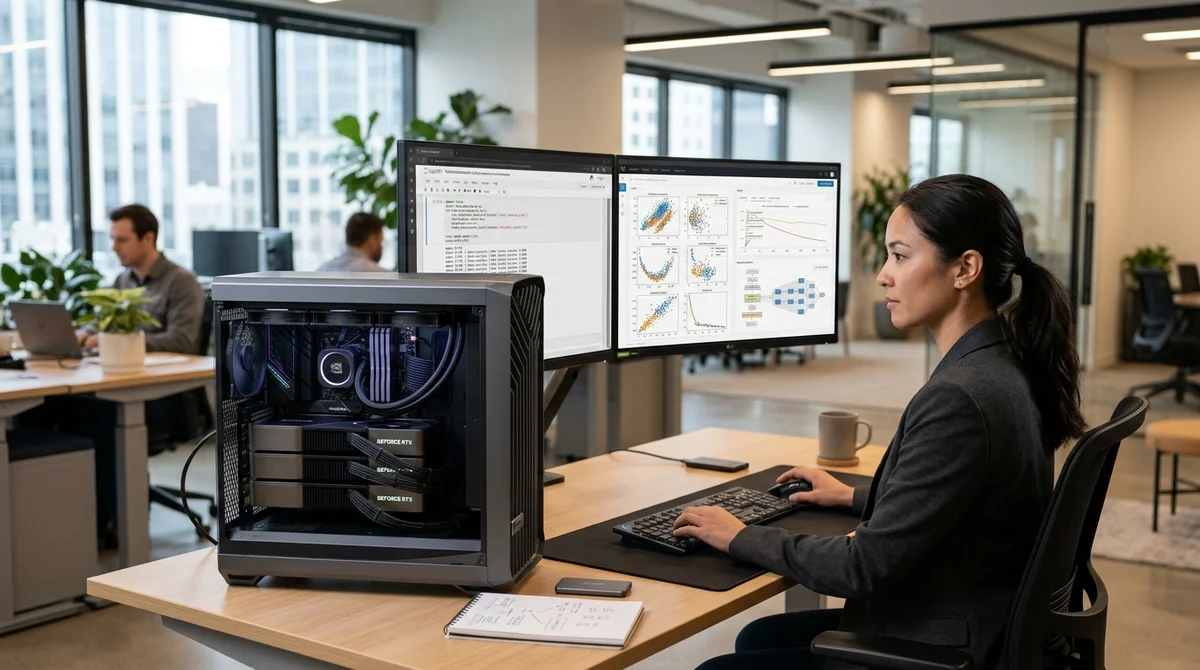
PNY in a sponsored article for IEEE Spectrum is promoting NVIDIA RTX PRO 6000 Blackwell Workstation Edition as a local alternative to cloud and data centers for data science tasks. The main thesis—some heavy AI and analytics pipelines can be accelerated by orders of magnitude right on the desktop.
Why CPU Is Not Enough
The narrative centers on three bottlenecks familiar to most data science teams. First—data preparation: cleaning, joining tables, imputing missing values, and feature engineering often consume the bulk of the time before model training. Second—scale: data volumes grow faster than desktop CPU systems can process them, so teams sometimes trim samples and lose result quality. Third—hardware: access to accelerators in the cloud and data centers is expensive and sometimes limited.
Against this backdrop, NVIDIA and PNY propose shifting some of the load back to local workstations. The idea is straightforward: if an analyst or ML engineer has a machine with multiple GPUs under their desk, they have less dependency on queues in shared infrastructure, verify hypotheses faster, and keep sensitive data in-house. For corporate teams, this is positioned as a compromise between speed, privacy, and cost control.
What Blackwell Promises
The main focus is on accelerating the entire pipeline—from pandas operations to model training. According to NVIDIA, the cuDF library from the CUDA-X stack can accelerate Python pipelines without code rewriting, and the combination with PyData and XGBoost should significantly reduce time for exploratory analysis and training. The platform is also designed for multi-user scenarios, advanced visualization, and collaboration through NVIDIA AI Workbench, so the same project can run on local machines, in the cloud, and in data centers.
- Up to four RTX PRO 6000 Blackwell Max-Q GPUs in a single workstation
- Pandas acceleration via cuDF without code changes—up to 50x speedup according to the company
- Join operation: nearly 5 minutes on CPU versus 14 seconds on GPU
- Group by: nearly 4 minutes on CPU versus 4 seconds on GPU
- XGBoost training, which previously took weeks, the company promises to compress to minutes
"the most powerful desktop GPU ever created"
The publication's marketing tone is direct—this is how PNY describes the RTX PRO 6000 Blackwell in the accompanying video. This is a strong claim, but the article itself contains no independent tests or comparisons with alternatives in the same configuration. Therefore, these figures should be viewed as vendor guidance: they show the class of tasks where GPUs truly provide a benefit, but do not replace full benchmarks tailored to your stack and data.
Betting on Locality
A separate argument is economics and security. When part of the pipeline is moved from the cloud to a workstation, the company spends less on compute and storage rental, and sensitive datasets remain within the perimeter. For industries with on-premise processing requirements, this matters more than raw performance. Plus, a local machine reduces dependency on GPU shortages in data centers: you rarely need to wait for a training slot or negotiate a separate budget.
PNY also emphasizes the enterprise angle: integration with existing IT infrastructure, NVIDIA ConnectX networking solutions, deployment tools, and high uptime. The message is clear: RTX PRO 6000 Blackwell is marketed not as a "card for enthusiasts" but as a building block for corporate AI development. Especially for teams that need fast iterations on large datasets but are not ready to move entirely to the cloud or constantly compete for shared cluster resources.
What This Means
The AI hardware market is increasingly shifting from universal promises to a concrete scenario: delivering data center-level performance to data science teams right at the desk. If the claimed accelerations hold up under real workloads, such workstations could become an intermediate layer between an analyst's laptop and an expensive GPU cluster. But they should be purchased only after validation on your own pipelines, not based on marketing benchmarks.
Want to stop reading about AI and start using it?
AI News is a curated feed of AI/tech news. Hamidun Academy teaches you to use AI systematically in your work.