Silicon Valley and Trump administration to test their alliance at AI summit in Washington
On March 24, a summit will take place in Washington where the Silicon Valley-Trump administration alliance will face particular scrutiny. Tech companies will…
AI-processed from Bloomberg Tech; edited by Hamidun News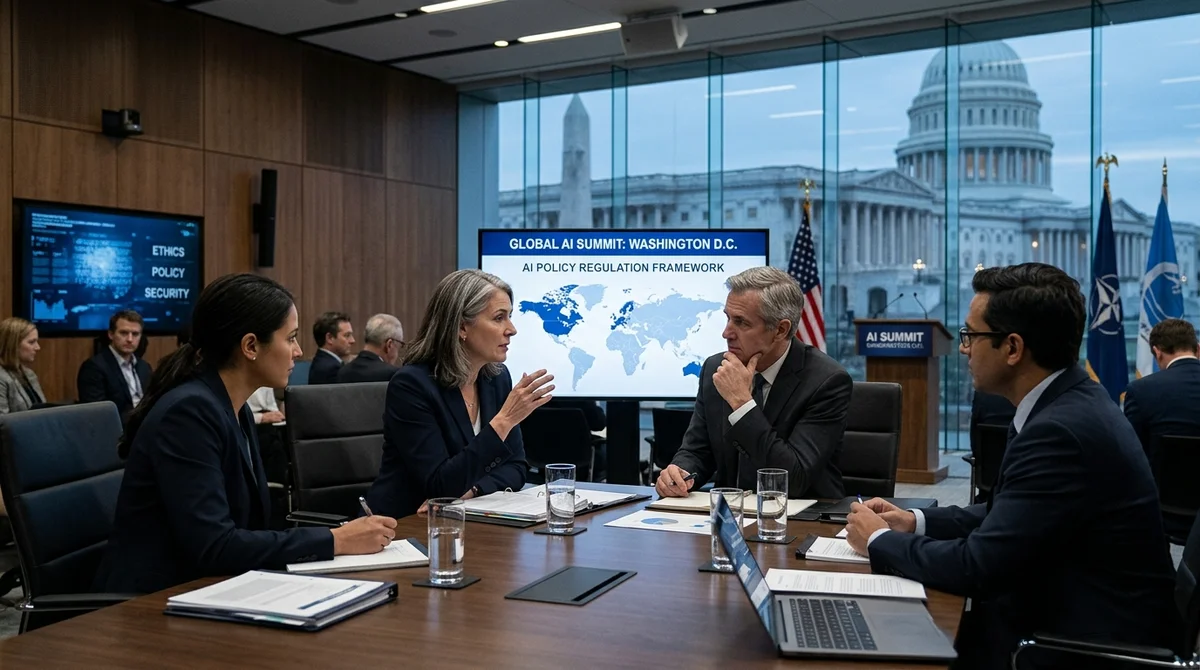
On Tuesday, March 24, 2026, a summit will take place in Washington where the alliance between Silicon Valley and the Donald Trump administration will be particularly visible. But the conversation about U.S. leadership in artificial intelligence will no longer unfold in an atmosphere comfortable for the industry: on the agenda—concerns about AI's impact on employment and its role in the war in Iran.
The Washington Summit
For technology companies, this meeting is a chance to publicly demonstrate that they share a common language with the White House. Business leaders are heading to the capital with a clear thesis: the U.S. must maintain its leading position in the AI race, which means not stifling the industry with premature restrictions.
At such forums, the argument is typically made that faster AI solutions are a matter of not only economics but also national competitiveness.
But now this thesis does not sound in a vacuum. If until recently AI in political rhetoric was often marketed as an engine of growth and innovation, the conversation has now become harsher.
Society increasingly asks how many jobs will disappear, who will benefit from automation, and where the boundary lies between civilian applications of the technology and its involvement in military conflicts.
Therefore, the Washington summit becomes not just an industry meeting, but a test of the durability of this alliance.
Pressure on the Industry
The main problem for technology leaders is that the discussion of AI has moved beyond laboratories, venture funds, and corporate presentations.
The economic impact of the technology is now perceived not as a distant prospect, but as a process that already affects the labor market.
Automation of intellectual tasks promises increased efficiency, but simultaneously amplifies fears about job cuts, income redistribution, and concentration of power among a few major players controlling models, computation, and data.
Under this pressure, several issues come to the fore:
- the risk of displacing certain office and service professions;
- concentration of resources among a limited number of large AI companies;
- lack of transparency in how decisions are made by AI systems;
- use of AI in a military context, including the conflict around Iran.
The military aspect makes the dispute even more acute.
When artificial intelligence figures in the context of war, it ceases to be merely a business tool or technological platform.
In this case, public discourse quickly shifts from convenience and productivity to questions of responsibility, control, and permissible boundaries.
For the industry, this is an uncomfortable frame: it is easier to talk about U.S. leadership than to answer the question of what price society is willing to pay for it.
Alliance with the White House
For the Trump administration, proximity to Silicon Valley also has practical importance.
The White House gains support from a sector that sets the pace of the technological agenda, while business gains a direct channel of influence over federal decisions.
This pairing allows both sides to speak of U.S. leadership in AI as a shared national mission.
But the closer the political alliance, the harder it becomes for companies to maintain the image of neutral innovators when conflict grows around the technology.
This is precisely why the summit becomes a test not only for the industry but for the entire political structure around AI.
If company leaders cannot convincingly demonstrate that American leadership is compatible with economic guarantees and public oversight, pressure on them will intensify.
Then the focus of the discussion will shift: instead of accelerating AI deployment, issues of oversight, restrictions, and direct accountability for consequences will come to the fore.
What This Means
The Washington summit shows that the era of unconditional enthusiasm around AI is coming to an end.
Now, rhetoric alone about innovation and the global race is no longer sufficient: technology companies will have to simultaneously prove economic benefit, address public fears, and explain where they draw the line between AI development and its use in war.
Want to stop reading about AI and start using it?
AI News is a curated feed of AI/tech news. Hamidun Academy teaches you to use AI systematically in your work.