China launches campaign against deepfakes, fraud, and AI abuse
China has launched a four-month campaign against AI abuse. The focus is on deepfakes, fraud, disinformation, lack of AI content labeling, and services…
AI-processed from TNW; edited by Hamidun News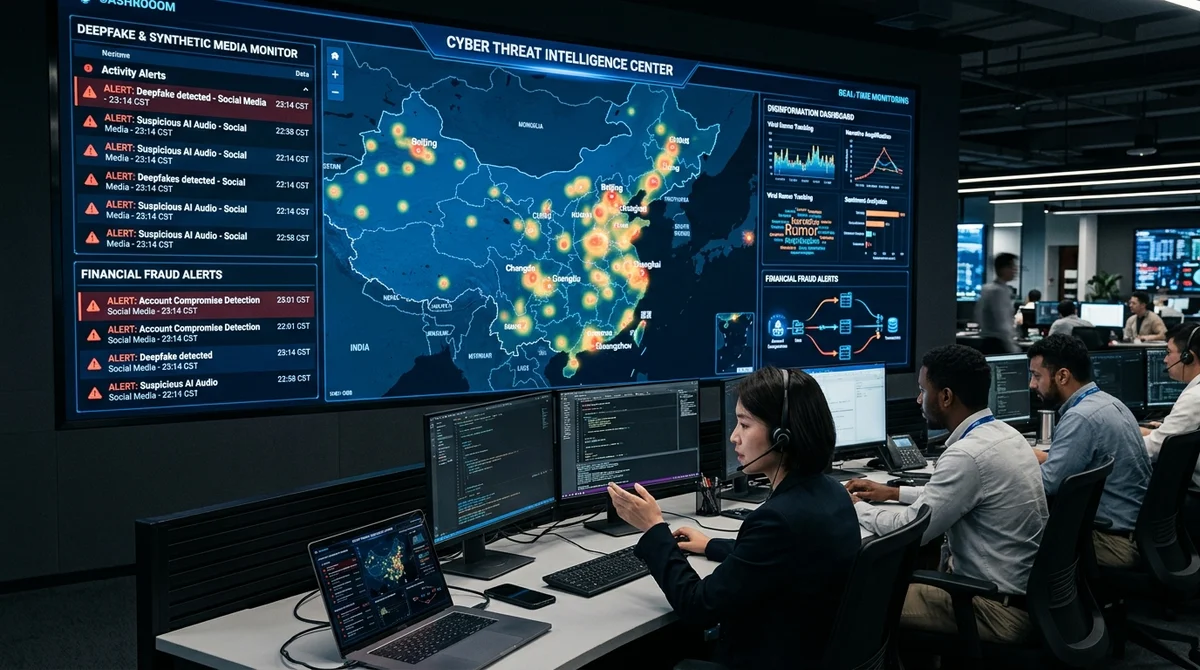
On April 30, 2026, China launched a four-month campaign against AI abuse. It covers deepfakes, fraud schemes, misinformation, and services that violate marking, registration, and personal data handling rules.
Four-Month Campaign
The initiative was launched by China's Cyberspace Administration together with the Ministry of Public Security and other agencies. The inspection is designed for four months and will proceed in two stages. Formally, this is another iteration of the annual Qinglang series — "Clean and Clear" — but in scale it is significantly broader than last year's. Authorities are no longer targeting individual cases, but the entire chain: from model training and market launch to the spread of generated content on platforms.
In 2025, a similar campaign lasted three months and gave an indication of the pace of future cleanups. Upon its completion, regulators deleted more than 960,000 units of illegal or harmful content, shut down over 3,500 AI-related products, and punished more than 3,700 accounts.
The current launch is accompanied by even harsher rhetoric. The regulator directly talks about fighting "violations in AI applications," and this leaves authorities a broad corridor for interpreting violations.
What Will Be Targeted
The list of targets shows that China views AI abuse not as one problem, but as a set of interconnected risks. This includes both technical violations within the services themselves, and how these services are then used to deceive audiences, bypass platform rules, and manipulate public attention. The impact extends not only to model developers, but also to platforms, accounts, app stores, and advertising schemes around them.
- AI fraud: voice, face, and identity spoofing to deceive users
- Misinformation: bot farms, mass drops, and artificial trends
- Registration violations: launching generative services without mandatory approval
- Absence of marking: publishing AI content without visible and technical labels
- Rights violations: using data, images, and materials without proper consent
Special emphasis is placed on identity substitution. Chinese authorities have previously highlighted scenarios where generative systems imitate relatives, friends, celebrities, top executives, or officials for online fraud. Now added to this are harmful content for minors, violent and vulgar materials, as well as services that bypass biometric authentication. Another sensitive area is the use of digital images of deceased people and any real persons without confirmed consent for such use.
New Rules and Context
The main difference of the 2026 campaign from the 2025 version is the density of rules around the industry. Since September 1, 2025, China has mandatory AI content marking standards for text, images, audio, and video. On April 3, 2026, authorities published draft rules for digital virtual people, including requirements for consent to use appearance and prohibition of bypassing biometric systems. And on April 10, temporary measures for anthropomorphic AI services came out, which will take effect on July 15, 2026.
In practice, this means the regulator can rely on several levels of norms at once: requirements for registering public generative services, rules on deep synthesis, marking standards, and a block of norms on personal information protection. If a product has not passed mandatory registration, conceals the artificial origin of content, or uses controversial training data, sanctions can be swift.
For companies, this is a risk of prescriptions, service shutdown, removal from app stores, and in serious cases, referral to law enforcement. The campaign gains additional weight from the international context. On April 23, 2026, the White House accused Chinese companies of "industrial-scale" extraction of capabilities from American advanced AI models through jailbreaking and proxy account networks. China's domestic campaign does not directly respond to these claims, but the timing makes it politically notable. Essentially, Beijing and Washington are talking about the same AI risks — fraud, manipulation, and rights violations — just from different entry points.
What This Means
China shows that the period of soft warnings for AI services is ending. For developers and platforms, this is a signal to check registration, marking, data origin, and consent for using others' images before launching a product. For the market as a whole, this confirms that control over generative AI is quickly turning from a political topic into an everyday operational requirement.
Want to stop reading about AI and start using it?
AI News is a curated feed of AI/tech news. Hamidun Academy teaches you to use AI systematically in your work.