Grok, Claude and Kling: how a designer can quickly prepare complex web animation for frontend
AI is increasingly becoming an intermediary layer between designer and developer. The breakdown presents three working scenarios: water effects for a hero…
AI-processed from Habr AI; edited by Hamidun News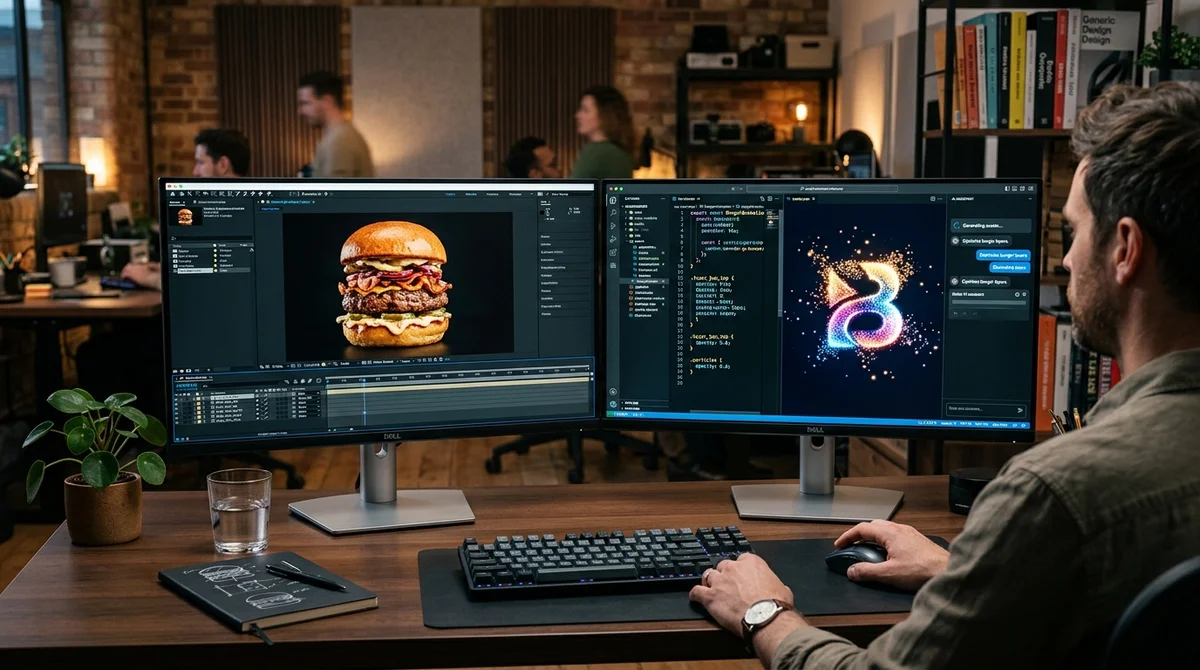
Designers increasingly use AI not to generate the final image, but as a translator between a client's concept and a working task for frontend developers. One breakdown demonstrated three scenarios for quickly assembling a clear deliverable for developing complex web animations using Grok, Gemini, Claude, Kling, CodePen, and Spline.
Water Effects
The first scenario is a hero block with water, ripples, or droplets that respond to cursor movement. If there's a live reference, the task becomes much simpler: a designer can open the code of a website they like, pass it to an AI, and ask it to extract the fragment responsible for the specific animation. This might not work on the first try, but then the model can be used as a debugger: request to add a contrasting background, check for errors, and adjust the effect parameters.
The second approach is not to reverse-engineer someone else's site, but to immediately search for working examples in ready-made animation libraries like CodePen. Here it's important not only to save a link to the example, but also to record the exact name of the effect: this helps find more relevant implementations and explain the task to the developer faster. As a result, the designer brings not a vague description like "something like Apple," but a concrete code prototype and basic settings.
Product Scroll Animation
The most telling case is an "exploded diagram" of a burger, where the product disassembles into layers as the user scrolls. To do this, the author first generated a separate exploded view image in Gemini, then reassembled the object in the same service to get the initial and final frames. After this, both versions are adjusted in Figma to match a single background, identical size, and strictly aligned positioning—otherwise the smooth transition in the next step will break.
Next, the images are sent to Kling, where a short looped video is assembled from the two states. It's needed not as a final video, but as raw material for scroll animation: frames are extracted from the video and then bound to page scrolling.
- complete brief on the landing and sections
- scroll animation configuration with canvas parameters and scroll logic
- source video for frame extraction
- identical file names in the prompt and project folder
- description of the tech stack, for example Next.js and Tailwind CSS
The author emphasizes separately that it's minor organizational mistakes that usually break the result. If naming doesn't match, if the background differs in the images, or if the model starts drawing its own version instead of the original object, quality drops sharply. So AI here works better not as a magic button, but as an accelerator in a clear pipeline.
Particles and Logo
The third scenario is a logo or 3D object that disassembles and assembles from particles. For such tasks, instead of long text explanations, it's suggested to go to Spline and search for ready-made scenes in the Community section. Then the designer uploads their model, selects particle size and density, configures mouse response, speed and sharpness of the effect, and then exports a script or set of files for the frontend.
"Don't try to explain complex animation only in words."
This approach has simple logic: the simpler the shape, the cleaner the result and the less time spent on setup. A complex truck can also be assembled from particles, but a square, symbol, or concise logo usually delivers a stronger visual effect and fewer integration issues. Spline has one drawback—the service is paid, so it's worth connecting where the effect truly influences page perception.
What This Means
The main conclusion is simple: AI doesn't replace design and frontend, but dramatically reduces the distance between idea and implementation. When a designer brings a developer a reference, working code, video, tech specification, and a clear set of files, complex web animation stops being an abstract "beautiful idea" and becomes a task with predictable timelines and clear cost.
Want to stop reading about AI and start using it?
AI News is a curated feed of AI/tech news. Hamidun Academy teaches you to use AI systematically in your work.