Halter raised $220M for global expansion of smart collars for cattle
New Zealand-based Halter raised $220M to scale smart collars for cattle. The company aims to expand its presence on farms and ranches globally, betting on…
AI-processed from Bloomberg Tech; edited by Hamidun News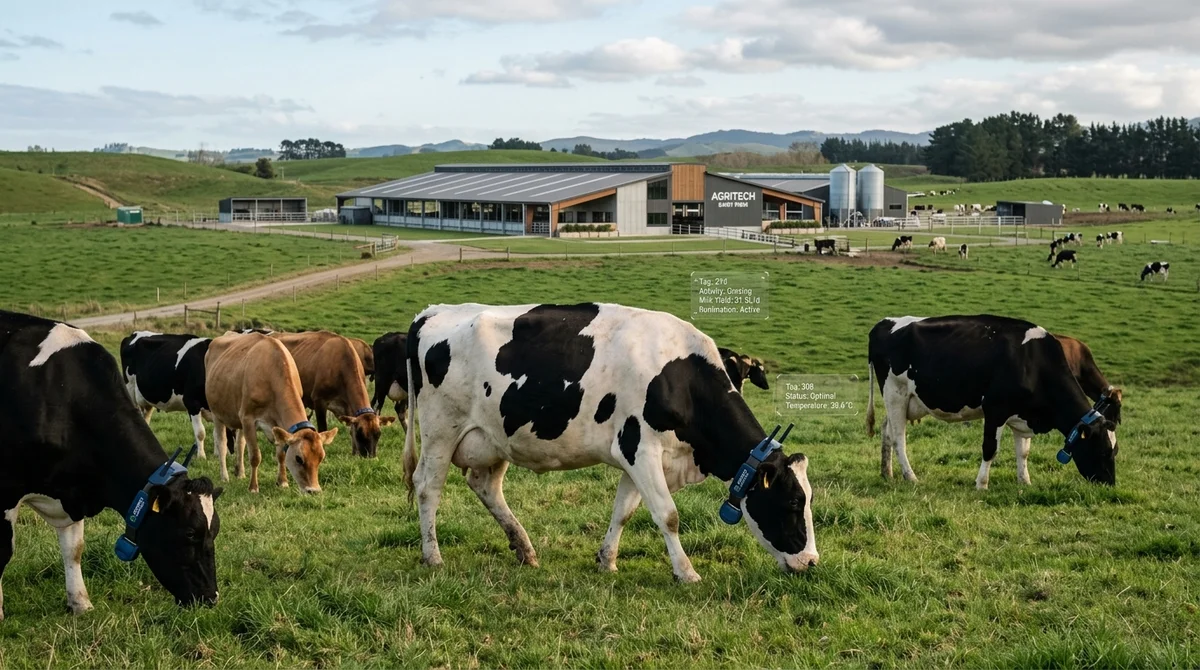
New Zealand startup Halter, which develops AI collars for cattle, has raised $220 million. The company plans to use the funds to expand its presence on farms and ranches worldwide and bring its agritech solution from a niche segment into a broader market.
Export Round
For Halter, this is not just a balance sheet boost, but a signal that investors see a large market beyond New Zealand's local agriculture. From the published description, the main point is clear: the company wants to scale its technology internationally and sell it to a larger number of farming operations. Details like business valuation, investor composition, and deal structure are not revealed in the brief announcement, but the sum itself—$220 million—demonstrates a rare level of ambition for agritech.
This is no longer about pilots, but about preparation for broader deployment. It's also important that Halter operates at the intersection of hardware and software. For such companies, scaling is usually more complex than for purely cloud services: you need to produce devices, maintain connectivity in field conditions, train customers, and prove ROI on real farms.
That's why a major round in this segment reads as a bet on a long game. If the product truly helps manage herds more efficiently, it has a chance to become part of daily operational infrastructure, not just another experiment with a fashionable AI label.
Practice on the Farm
For farmers, the value of such solutions usually lies not in the fact of using artificial intelligence itself, but in the fact that a wearable device turns the herd into a more observable and manageable system. When animals have constant digital coverage, operations have fewer blind spots and more grounds for quick decisions. This is precisely what builds interest in the smart collar category. For large operations this is especially noticeable, because the cost of delays and errors is higher.
- More precise control over animal movement
- Faster detection of atypical activity or behavior
- Reduced volume of manual rounds and routine monitoring
- Better planning of personnel work across large territories
- Collection of data that can be used for long-term decisions
Even if some of these scenarios are already familiar to agriculture from trackers and sensors, the bet on AI changes how the product is positioned. The system promises not just to show a signal, but to interpret it and suggest where there is a deviation, risk, or optimization opportunity. For ranches with large herds and limited teams, this is especially important: any technology that saves hours of manual work and accelerates response quickly moves from the "interesting" category to the "need to calculate implementation economics" category.
Why the Market is Watching
Halter's story is interesting beyond just one company. In recent years, the main conversations about AI have centered around chatbots, content generation, and office digital assistants. The new round reminds us that the next wave of growth may come from industries where effect is measured not by the number of generated words, but by saved time, reduced operating costs, and more predictable management.
Agriculture has long been considered a conservative market, but it's precisely there that technologies with clear economics often take root for the long term. Global expansion in agriculture almost always means complex operational work. You need to account for differences in farm sizes, communication infrastructure, climate, service support, and the local habits of farmers themselves.
That's why the raised $220 million is not only a sales budget, but also a resource for adapting the product to new markets, building service infrastructure, and lowering entry barriers for customers. If Halter succeeds at this stage, the company will be able to establish itself not as a niche device manufacturer, but as a notable player in the market for animal husbandry technologies.
What This Means
Halter's major round shows that AI is increasingly leaving office scenarios for the physical world. If the company can prove its economics across different markets, investors will be even more willing to finance applied solutions where algorithms work not on a screen, but right in the field.
Want to stop reading about AI and start using it?
AI News is a curated feed of AI/tech news. Hamidun Academy teaches you to use AI systematically in your work.