Palantir CTO Names Iran War First Major Conflict With Central Role of AI
Palantir CTO Shyam Sankar said that the Iran war will likely go down in history as the first major conflict where AI played a central role. By his…
AI-processed from Bloomberg Tech; edited by Hamidun News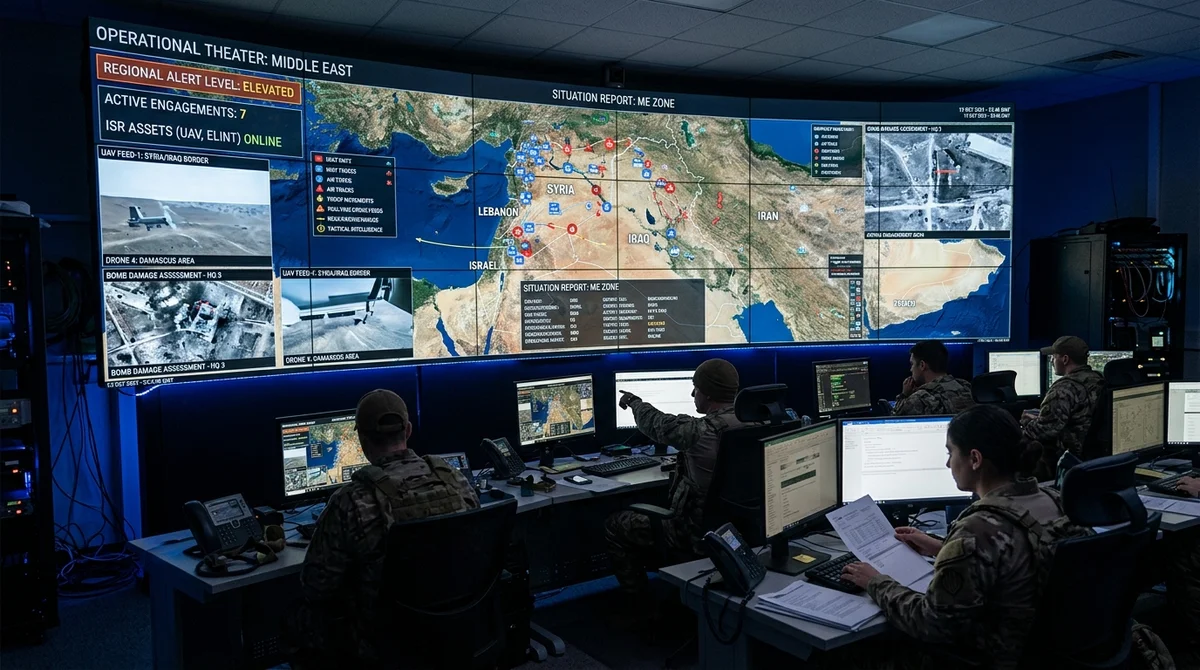
Shyam Sankar, Chief Technology Officer of Palantir, believes that the war in Iran will likely go down in history as the first major conflict where artificial intelligence played a central role. His framing elevates AI from the category of auxiliary military technologies and places it at the center of the conversation about how decisions are now made on the battlefield.
What Palantir Said
Sankar described the war in Iran as a turning point for modern warfare. In his interpretation, this is no longer about algorithms helping individual services sort data faster or automate routine tasks. He speaks of a more fundamental shift: AI essentially becomes part of the very mechanism of conflict and influences how the sides perceive the situation, set priorities, and respond to threats. This is no longer a digital backdrop, but one of the drivers of combat decisions.
The statement carries particular weight coming from a top executive of Palantir — a company whose name has long been associated with analytics platforms for the state, intelligence, and defense sectors. For this reason, his words can be read not only as a political assessment of a particular conflict, but also as a signal of broader change: digital systems no longer stand alongside the military machine, but are embedded in its nervous system and influence it in real time.
Where AI Is at Work
The available fragment does not reveal which specific systems the Palantir CTO had in mind. But when military contexts speak of the central role of artificial intelligence, they typically refer not to one "super-algorithm," but to a set of tools that accelerate the cycle from observation to decision. In other words, AI doesn't necessarily replace humans, but increasingly determines the pace, the volume of information, and the accuracy of the cues that humans rely on.
- Analysis of large arrays of intelligence data — from satellite imagery to signals and text briefings.
- Finding anomalies and probable threats faster than classical manual analytics can.
- Prioritizing targets, routes, objects, and response scenarios in conditions of time scarcity.
- Coordinating decisions between different units when both the force of the strike and the speed of coordination are critical.
It's also important that "central role" doesn't necessarily mean fully autonomous warfare. In practice, it often looks different: commanders, analysts, and operators receive from systems a ranked picture of what's happening — what is more dangerous, where to look, what signals cannot be missed right now. It is in this layer between the chaos of data and human decision that AI is capable of changing the outcome of operations even without dramatic stories about robots on the front lines.
Why This Is a Turning Point
If Sankar's formulation takes hold, the boundary between "software-enabled weapon" and "data-driven war" will become much thinner. Historically, armies gained advantage through industrial power, numbers, and quality of equipment. Now another layer is added: the ability to gather, clean, compare, and interpret information faster, and then convert it into action with almost no delay. In such a mode, victory goes not only to those with more resources, but to those with a shorter decision cycle.
At the same time, such a shift carries not only efficiency, but also new risks. The deeper AI is embedded in critical processes, the harder it becomes to understand where the machine's recommendation ends and human responsibility begins. Errors in data, model drift, opaque selection criteria, and pressure for speed can be too costly. Therefore, talk of the "first AI war" almost inevitably leads to another question: how to verify, limit, and audit such systems in real conflict.
What This Means
The words of Palantir's CTO show that AI in defense is increasingly perceived not as an add-on function, but as decision-making infrastructure. For the market, this means growing demand for military AI platforms, and for states — the need to discuss not only the effectiveness of such systems, but also the rules for their use. It is around this nexus — speed, accuracy, and accountability — that the new stage of military technology in the world will now be built.
Want to stop reading about AI and start using it?
AI News is a curated feed of AI/tech news. Hamidun Academy teaches you to use AI systematically in your work.