SK Hynix Prepares US Listing to Boost Memory Output for AI Market
SK Hynix plans to list on the US exchange in the second half of 2026 through ADR. The goal is straightforward: raise more capital to expand HBM and other…
AI-processed from Bloomberg Tech; edited by Hamidun News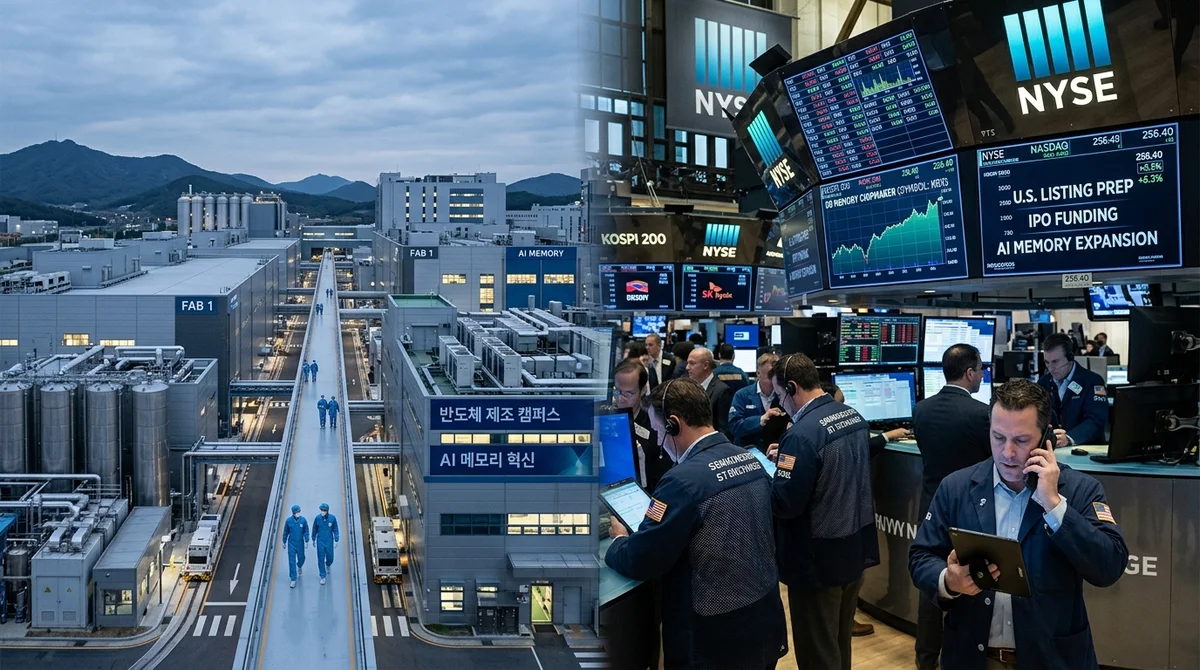
SK Hynix is preparing to enter the American market through ADRs and aims to complete the listing by the second half of 2026. The South Korean memory manufacturer expects to gain access to a deeper pool of capital to keep pace with explosive demand for HBM and other AI-server chips.
Why a US listing
The company confirmed that on March 24, 2026, it confidentially submitted registration documents to the US Securities and Exchange Commission. This is not a direct offering of ordinary shares, but rather an ADR listing — American Depositary Receipts, which give foreign issuers access to American investors without a complete restructuring of the listing structure. SK Hynix says the exact size of the offering, timing, and format have not yet been approved: everything will depend on SEC review, market conditions, and investor demand.
The rationale behind the deal is twofold. The first goal is to raise capital to expand production at a time when AI memory has transformed from a regular commodity segment into a bottleneck for the entire infrastructure. The second is a business revaluation. Management directly states that it wants the company to be valued as a global AI-infrastructure player, rather than merely as a Korean memory manufacturer. Market observers link this to an attempt to reduce the so-called Korea discount: SK Hynix shares trade noticeably cheaper than American counterparts, including Micron, even against the backdrop of record profits and leadership in HBM.
Where the money will go
The AI boom has already forced SK Hynix to significantly accelerate its investment cycle. The company announced that it plans to accumulate over 100 trillion won in net cash reserves in the long term to sustain major capital expenditures even in weaker years. For comparison: at the end of 2025, it had about 12.7 trillion won in net cash, and by the end of the first quarter of 2026, the figure grew to approximately 35 trillion won.
The growth is explained by the fact that demand for HBM, server DRAM, and AI-system SSDs remains very high, and quarterly revenue in early 2026 exceeded 50 trillion won for the first time.
"Financial stability is critical to sustaining investment and growth in the age of AI," said CEO
Kwak No-Jung at the shareholder meeting.
The list of directions where the company needs capital is already fairly clear:
- Memory cluster in Yeongin, where SK Hynix plans to develop several advanced memory fabs
- New capacity in Icheon, oriented in part toward HBM
- A project in Indiana worth approximately $5 billion to expand presence in the US
- ASML equipment orders of nearly $8 billion by the end of 2027 for production of the next generation of memory
Essentially, the company is trying to preemptively address the main risk of the coming years: a shortage of production capacity at a time when AI-infrastructure customers are booking memory far in advance. As the market moves deeper into HBM4 and more complex DRAM processes, SK Hynix needs not only technological advantages but also financial flexibility to quickly purchase equipment and build new production lines.
What concerns investors
The deal does have a weak point: dilution of current shareholders' stakes. At the shareholder meeting, investors directly asked why the company is pursuing an ADR listing through new share issuance rather than through treasury shares. The answer was cautious: the structure has not yet been determined. But the problem is that in February, SK Hynix already retired treasury shares worth about 12 trillion won, and it no longer has a significant buffer for such a scheme.
Market observers are discussing a scenario in which the US offering could involve about 2–3% of capital and raise up to $14 billion, although the company itself has not officially confirmed this estimate. Supporters of the deal believe that even with moderate share dilution, a US listing could pay for itself through higher business valuation and better access to global funds. The case of TSMC is often cited as a precedent, whose American listing helped the company become much closer to the largest investors in the technology market.
What this means
The AI market is increasingly dependent not only on GPUs but also on memory, which has become a separate scarce asset. If SK Hynix successfully completes its US offering, the company will gain not just a new financing channel, but an additional leverage in the race for HBM and AI infrastructure — which means competition between memory suppliers will no longer focus solely on technology, but also on access to capital.
Want to stop reading about AI and start using it?
AI News is a curated feed of AI/tech news. Hamidun Academy teaches you to use AI systematically in your work.