MCP LLM-Agent in Fusion360: First Vibe-Design Test on a Wooden Staircase
Fusion360 rolled out an MCP LLM-assistant — and vibe-design has moved beyond browsers and IDEs into professional CAD packages. The author tested it on a…
AI-processed from Habr AI; edited by Hamidun News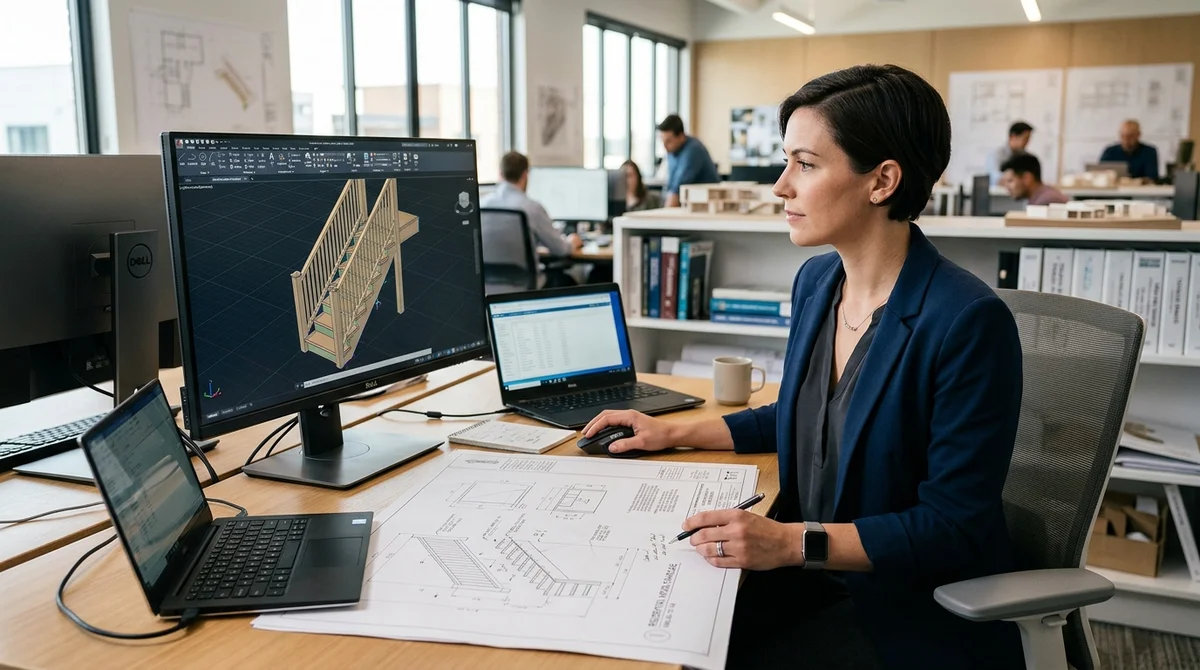
Fusion360 has received an MCP LLM assistant, and early users are already testing it on real engineering tasks. One of Habr's authors tried to design a wooden staircase — an object he had previously created manually over sixty times and unsuccessfully attempted to automate independently.
What is vibe-design
The term "vibe-coding" firmly entered the developer lexicon in 2025: you describe the task in words — AI writes code. "Vibe-design" extends the same idea to 3D modeling. Instead of manually setting parameters in the interface, an engineer explains the desired result to the agent, and it calls the necessary CAD-system commands on its own.
Fusion360 is a professional tool from Autodesk for parametric modeling and manufacturing preparation. Powerful, but demanding: you need to keep in mind the logic of sketches, constraints, and dependencies between bodies. An LLM agent through MCP removes a significant portion of this cognitive load.
Test on a wooden staircase
A deliberately complex task was chosen for the first trial: designing a wooden staircase. Behind the simple appearance lie dozens of interconnected parameters that must simultaneously satisfy building codes.
- Riser height — optimal 150–200 mm
- Tread depth — minimum 250 mm per code
- Inclination angle — comfortable range 30–45°
- String thickness and fastening nodes
- Compliance of the structure with actual floor height
The agent began with the first stage — the steps. It received the task through a text request and began building the model step by step: creating sketches, setting dimensions, establishing dependencies between components. According to the author, the LLM essentially "turned the gears" of Fusion360, calling the system's internal commands directly.
How MCP integration works
MCP (Model Context Protocol) is a protocol that allows a language model to directly manage external tools. In the case of Fusion360, the agent receives current document context, sees the current state of the model, reads parameters and makes changes — without user involvement in technical details. This is fundamentally different from chat hints like "click here, enter this." The user describes the result, the model itself chooses the sequence of operations and calls the necessary API methods. No scripts, no knowledge of the system's internal architecture required.
"Released an MCP LLM assistant to Fusion360.
I immediately tried to do what I had designed already 60 times and tried to automate myself — a staircase," — the author on Habr.
The emergence of MCP integrations in professional CAD packages is the next level after browser agents and IDE assistants. A signal that 2026 is becoming the year of AI agents in engineering software.
What it means
Vibe-design stops being an experiment and becomes a practical tool. If an LLM agent can handle a wooden staircase — one of the classically difficult tasks for automation — the next step is obvious: furniture, construction nodes, mechanical components. For designers, this is not a replacement for Fusion360, but a new way to interact with it — without needing to remember every menu command.
Want to stop reading about AI and start using it?
AI News is a curated feed of AI/tech news. Hamidun Academy teaches you to use AI systematically in your work.