Pony AI and Uber Begin Robotaxi Tests in Croatia, Expanding Partnership to Europe
Pony AI and Uber have launched autonomous vehicle tests in Zagreb. For the partners, this is the first step into Europe: previously their joint projects…
AI-processed from Bloomberg Tech; edited by Hamidun News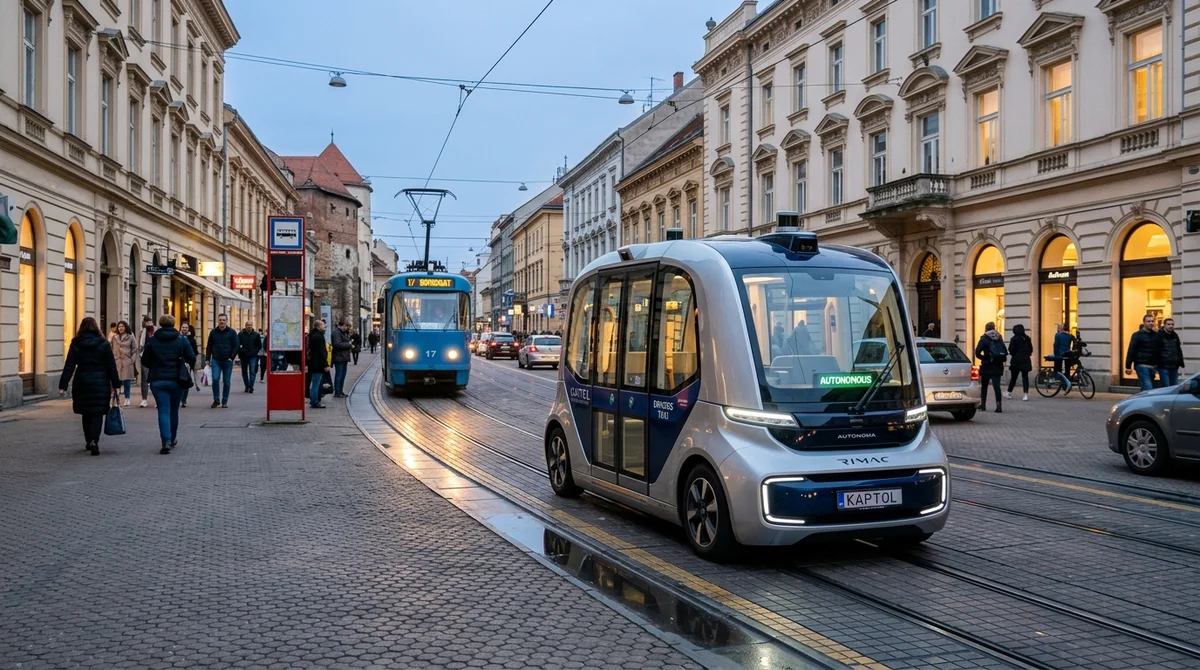
Pony AI and Uber have launched testing of autonomous vehicles in Zagreb. For both companies, this marks the first expansion of their partnership into Europe: previously, joint projects developed in the Middle East, but now the expansion has reached the EU market.
Tests in Zagreb
The launch in the Croatian capital is important primarily because it is not a concept presentation, but real-world testing on city roads. Pony AI is a notable player in the robotaxi market, while Uber in this partnership provides access to its transportation platform and experience in scaling services. At the testing stage, companies typically verify how vehicles behave in regular traffic, their response to complex road scenarios, and infrastructure readiness for future launch.
For now, these are still tests, not a mass commercial service for passengers. This format allows companies to collect data, adjust the autonomous system to the specific city, and meet local safety requirements. For Europe, this is a particularly sensitive issue: autonomous transport here is expected to demonstrate not only technological maturity but also clear logic of accountability if the system fails.
Without this, no such project can move to regular rides.
In this model, the roles of the parties are quite clear. Pony AI is responsible for autonomous technology and vehicle behavior on the road, while Uber handles the user layer—from booking a ride to the familiar interface of calling a car. This combination is currently one of the most realistic on the market: instead of building a new service from scratch, integrating autonomous transport into an already existing consumer platform. This accelerates market entry and reduces implementation costs.
Expansion to Europe
The main news here is actually broader than Zagreb itself: Pony AI and Uber are moving their partnership into new geography. Previously, their joint advancement was in the Middle East, but now they are taking a step toward Europe. For Uber, this is a way to strengthen its stake in a model where the app becomes a showcase for different autonomous operators. For Pony AI, it's an opportunity to establish itself not just as a Chinese robotaxi developer, but as an international technology provider.
The European market for autonomous transport is considered one of the most challenging and simultaneously most valuable. It has dense urban environments, mixed traffic, high safety requirements, and regulator attention to any new transportation models. If the pilot in Croatia proves successful, it will give the companies leverage for further negotiations with other cities and help demonstrate that robotaxis can expand beyond individual demonstration zones.
For Europe itself, this is also a significant moment. Until now, many conversations about robotaxis in the region remained at the level of expectations and cautious pilots. The appearance of a partnership between a major ride-booking platform and a specialized autonomous developer makes the case more grounded: we're discussing not abstract technology, but a future service that a user could potentially order just like a regular ride.
This is why even a limited pilot quickly becomes an indicator of the maturity of the entire category.
What to Watch
Right now, what matters most is not the fact of the tests themselves, but what they will lead to. The market will look not at headline loudness, but at concrete signs that the project is moving toward a real service. For the industry, it is critical whether companies can translate the demonstration stage into a clear operational model: with predictable safety, clear economics, and the ability to scale the model beyond one city. These metrics will determine the project's fate far more than the mere fact of a European debut.
- How many vehicles are participating in the pilot and how quickly is the fleet expanding
- Whether it is closed testing or preparation for public rides
- What requirements local authorities and insurance regulators will impose
- Whether the future service will appear within the Uber app in a familiar form for passengers
For users, the criteria will be even simpler: how quickly the car arrives, how much the ride costs, and whether the service will work stably in ordinary city scenarios, not just in ideal conditions. This is exactly the stage where most autonomous projects encounter reality: technology demonstration is impressive, but mass service requires discipline in operations, safety, and support. A passenger needs not a technological spectacle, but a predictable service every day.
If the companies can navigate this route without notable incidents and delays, Zagreb could become not a one-off point on the map, but an entry point for broader European deployment. For the industry, this is an important test: investors and cities have long awaited proof that autonomous taxis can move from isolated pilots to a sustainable operational model. Then the pilot will begin to be seen as a template for subsequent launches, not as a one-off PR stunt.
What This Means
Pony AI and Uber are not simply conducting a local experiment, but testing whether the robotaxi and ride-booking service combination can be scaled across European territory. If the trials in Croatia go successfully, it will intensify pressure on competitors and accelerate discussions about where autonomous rides will appear next in Europe.
Want to stop reading about AI and start using it?
AI News is a curated feed of AI/tech news. Hamidun Academy teaches you to use AI systematically in your work.