Uber, Pony.ai and Verne prepare Europe's first commercial robotaxi service
Uber, Pony.ai and Verne have announced Europe's first commercial robotaxi service. Road tests are already underway in Zagreb using Pony.ai Gen-7 technology…
AI-processed from TNW; edited by Hamidun News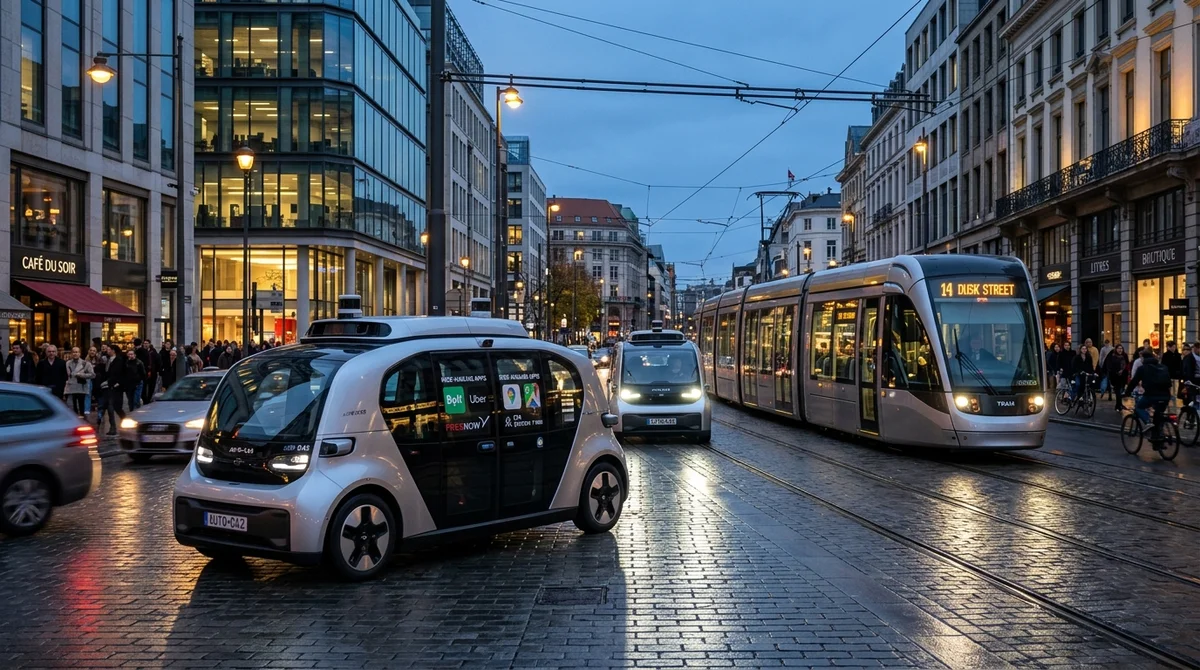
Uber, Pony.ai and Verne announced Europe's first commercial robotaxi service, with road tests in Zagreb already underway. The partners promise to scale the project to thousands of vehicles across the continent, but haven't named a full launch date yet.
What's Being Launched
This is a joint project of three companies with different roles. Uber provides the platform and, as expected, financial support: the company intends to invest in Verne. Pony.ai is responsible for autonomous driving, while Verne handles the European wrapper for the service and local project development. For Uber, this is another step toward a model where the app becomes a storefront not just for regular drivers, but also for driverless transportation.
In practice, the project has already moved beyond the presentation stage. In the Croatian capital, road tests are underway — that is, vehicles aren't just shown in renderings or on closed test tracks, but are being tested in urban conditions. This is crucial for any robotaxi service: it's on the streets that real limitations become visible — the behavior of other drivers, traffic density, road marking quality, unpredictable maneuvers, and the need to respond safely to everything at once. This is typically where it becomes clear how confidently the system operates outside a sterile environment.
Technology and Fleet
For testing, Pony.ai's Gen-7 system is used, installed on an Arcfox Alpha T5 — a Chinese series-production electric vehicle adapted for autonomous operation. From the published details, it's clear that the partners are betting not on a one-off demonstrator, but on a platform that can be scaled. This aligns well with their plans to deploy not dozens, but thousands of vehicles across Europe. The choice of a series-production model also hints at a desire to move beyond a single pilot more quickly.
Several key project details are known:
- road tests are already underway in Zagreb;
- Pony.ai with its Gen-7 system is responsible for autonomous driving;
- the test vehicle is the Chinese-made Arcfox Alpha T5;
- Uber is planning to invest in Verne;
- the alliance's goal is to scale the service to thousands of vehicles across Europe.
However, the most sensitive parameter remains hidden: the commercial launch date. Companies openly say they aren't ready to name it yet. For the market, this is a typical situation. Autonomous transportation is limited not just by software and hardware, but by regulation, insurance, coordination with city authorities, and reputational risks. Even successful tests don't guarantee rapid deployment into commercial operations. Especially when it comes to passenger rides in the city center.
Why This Matters for Europe
Europe has long lagged behind the US and China in public robotaxi launches, especially when it comes to commercial services rather than limited pilots. Against this background, the choice of Zagreb looks logical: the city is large enough for realistic road scenarios, but not as congested and politically sensitive as first-tier megacities. For Verne, this is a chance to build a service not on paper, but on real traffic and real urban environment.
The composition of partners is particularly noteworthy. Mate Rimac's name was previously associated primarily with electric hypercars and the engineering brand Rimac. Now around this name a more applied direction is forming — urban autonomous mobility.
Combined with Uber and Pony.ai, this gives the project three components, without which scale is usually impossible: client channel, autopilot, and a local operator oriented toward the European market. If the plan for thousands of vehicles works out, it won't just mean launching another driverless service.
It will mean an attempt to build a robotaxi network model right from the start with expansion across countries in mind, rather than focused on a single test city. This is what distinguishes the project from many demonstration initiatives that remain in the "interesting experiment" stage for years. That's why it will now be closely watched by both competitors and regulators.
What It Means
The deal between Uber, Pony.ai and Verne shows that the robotaxi market in Europe is finally moving from talk to infrastructure assembly: tests are on the roads, investments are on the table, scaling goals are announced. But without a launch date, the main question remains the same — will Europe be able to quickly turn a technological pilot into a mass commercial service.
Want to stop reading about AI and start using it?
AI News is a curated feed of AI/tech news. Hamidun Academy teaches you to use AI systematically in your work.