Alphabet, Amazon, Meta and Microsoft push combined AI spending plans to $725 billion in 2026
Big Tech in the U.S. escalates the AI arms race: combined capex from Alphabet, Amazon, Meta and Microsoft could now reach $725 billion in 2026. Google and…
AI-processed from Bloomberg Tech; edited by Hamidun News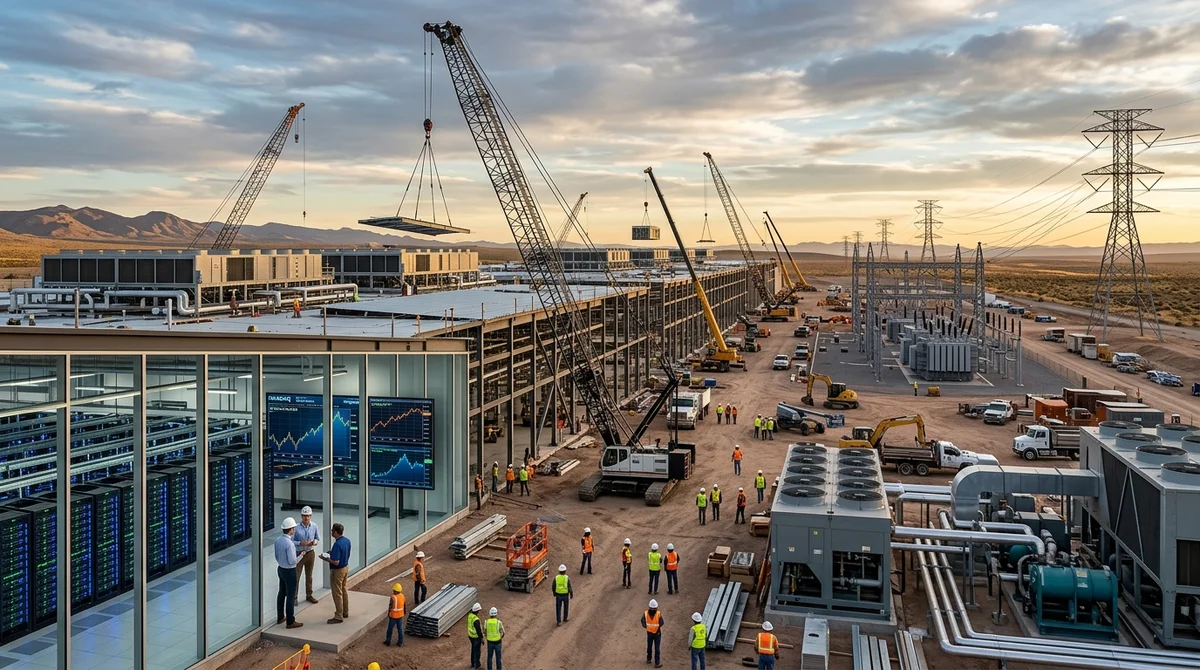
Four of America's largest tech companies are raising the stakes on artificial intelligence spending: the combined capital expenditures of Alphabet, Amazon, Meta, and Microsoft in 2026 could now reach $725 billion. Almost all of this money goes not into applications, but into physical infrastructure — data centers, servers, networking equipment, and the power infrastructure needed to run AI.
New ceiling for capex
Back in February, the combined spending guidance for these companies in 2026 looked like an already nearly unthinkable $650 billion. But after first-quarter earnings reports, the figure has risen again. Alphabet and Meta revised their forecasts upward, Microsoft provided its first guidance for calendar year 2026, and Amazon maintained its previously announced plan.
As a result, the upper bound of combined capex has risen to $725 billion, with the lower bound approaching $700 billion. This shows that the AI race has ceased to be a story only about models and products: computing power has become the key asset. Behind the phrase "investments in AI" lies a quite material set of expenses.
This includes building and equipping data centers, purchasing GPUs and servers, network infrastructure, cooling systems, and connecting new capacity to power grids. For the market, this is an important shift: large language models have definitively transformed into a capital-intensive industry, where competitive advantage depends not just on model quality, but on who can bring new computing clusters online faster.
Who is raising the stakes
If we break down the new estimate by company, we can see that almost each has its own growth logic, but the common denominator is one — demand for cloud and AI services proved strong enough to justify further spending increases. The most telling point is that this is no longer about long-term dreams years ahead, but about revising plans literally mid-year.
- Amazon has maintained its guidance at $200 billion. Meanwhile, AWS grew 28% in the first quarter to $37.6 billion, while free cash flow over the past 12 months fell to $1.2 billion amid sharp growth in investments in property and equipment.
- Microsoft disclosed guidance of approximately $190 billion for calendar year 2026 for the first time. The company also reported that its AI business already exceeded $37 billion in annual run rate, with quarterly capex reaching $31.9 billion.
- Alphabet raised its forecast to $180–190 billion from the previous $175–185 billion. Google Cloud revenue in the first quarter grew 63% to $20 billion, and the company is already warning that 2027 spending will grow significantly again.
- Meta increased its range to $125–145 billion from the previous $115–135 billion. The company directly linked this to rising component prices and additional data center costs for future capacity.
Against this backdrop, Amazon looks more like an exception: it didn't raise its guidance but remains the most aggressive investor in absolute numbers. For the other companies, the trajectory is clear — infrastructure spending continues to grow faster than the market was recently prepared to forecast. Even the minimum amount under current projections is around $695 billion, so the psychological $700 billion mark has essentially already been crossed.
The price of the AI race
The reason for budget increases doesn't come down to a single factor. On one hand, demand for computing power for training and inference still outpaces supply. On the other, components themselves are becoming more expensive, along with the construction, cooling, and connection of new data centers. Microsoft specifically noted that about $25 billion in annual spending is directly related to rising component costs. Meta talks about more expensive components and additional capacity spending for future periods. In other words, companies are paying not just for current demand, but for the right not to face shortages a year down the line.
"We're confident in the returns from these investments because demand signals are strengthening and product usage is growing," —
Amy Hood.
Investors, however, see not only AI market acceleration in these figures, but also risk. The higher capex is, the stronger the pressure on free cash flow and margins, especially if new data center payback stretches out. Amazon already shows how such spending quickly eats into free cash flow. But at the same time, the reports themselves give the companies ammunition in their defense: Google Cloud had a record quarter, AWS showed its fastest growth pace in 15 quarters, and Azure continued growing at 40%. As long as demand holds at this level, Big Tech will buy time and capacity for any reasonable price.
What this means
The AI race has finally become industrial. Winners here won't just be creators of strong models, but those who can build computing infrastructure faster than the rest and finance it without disrupting their core business. For the market, this is a signal that AI demand is real right now, but stakes are rising along with it: the entry ticket to the leadership circle is measured in hundreds of billions of dollars.
Want to stop reading about AI and start using it?
AI News is a curated feed of AI/tech news. Hamidun Academy teaches you to use AI systematically in your work.