RusHydro to allocate almost 100 million rubles for Nvidia H100 servers for AI tasks
RusHydro, through its IT division, is purchasing servers based on Nvidia H100 GPUs for almost 100 million rubles. Such GPUs are typically used for training…
AI-processed from CNews AI; edited by Hamidun News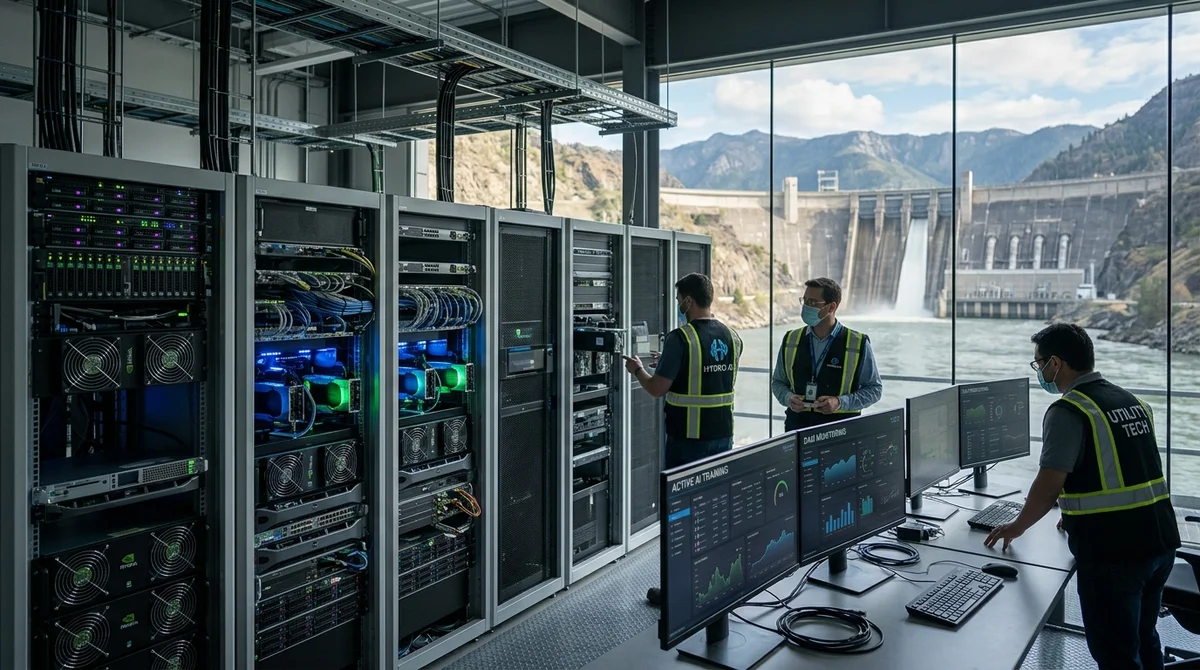
RusHydro is purchasing servers based on Nvidia H100 for almost 100 million rubles through its IT subsidiary. For Russian energy sector, this is a notable step: it's not simply about updating hardware, but about betting on its own computing infrastructure for artificial intelligence tasks.
What exactly are they buying
The essence of the news is simple: the IT subsidiary of Russia's largest hydroelectric generation company is ordering servers with Nvidia H100 graphics accelerators. Such GPUs are typically used where large-scale computing is needed — for training and running AI models, processing large data arrays, computer vision, and complex analytics. Even without configuration details, it's clear that these are not office machines or standard corporate servers, but specialized high-end equipment designed for heavy workloads.
The procurement amount is almost 100 million rubles. For the global AI infrastructure market, this is not a record budget, but as a separate corporate purchase in the Russian industrial sector, it's a notable figure. Especially considering that H100 remains among the most sought-after accelerators for resource-intensive tasks.
The very fact that such technology appears within a large energy company suggests that AI is viewed there as a practical tool, not an experiment at the level of presentations. In all likelihood, this is not about a giant computing cluster, but about an initial setup or infrastructure limited in scale for specific internal tasks. But even this format is important: the company gains the ability to test and deploy AI scenarios on its own hardware, rather than relying solely on cloud services or contractors. For industries with critical infrastructure, this is often a fundamental question, because control over computations and data is especially sensitive.
Why this is needed for the energy sector
Energy companies work with enormous volumes of data: sensor readings, equipment operating modes, load schedules, maintenance cycles, weather factors, and production reports. When a business gains access to its own GPU computing power, it can not only purchase ready-made AI services but also run internal models adapted to its own processes and security requirements. This is already a different level of maturity compared to point pilots or external experiments.
For such infrastructure, there are quite practical scenarios that can pay off not through impressive demos, but through reduced downtime, accelerated diagnostics, and time savings for engineering teams. The discussion involves tasks where data processing speed is critical, the ability to fine-tune models for internal context, and integration with existing corporate systems. This is exactly why such purchases are interesting not only to the IT market but to the entire industrial sector. For business, this is already a direct path to practical AI implementation.
- load and demand forecasting
- predictive equipment diagnostics
- image and video analysis from facilities
- automation of work with technical documents
- corporate AI assistants for employees
In the case of RusHydro, the industrial context is especially important. For energy companies, AI is not just about text generation or chatbots. Much more important are scenarios where the model helps reduce downtime, faster identify system deviations, more accurately plan maintenance, and accelerate internal analytics. If computations are deployed within the company, this also provides more control over data and reduces dependence on external platforms.
Additionally, owning GPU servers allows safer work with sensitive information. For an industrial enterprise, this can be critical: some data is undesirable to transfer to external services even when they are more convenient to use. Local infrastructure provides the ability to build closed AI loops, integrate models with internal systems, and configure access according to corporate requirements. For companies with distributed infrastructure and a large number of technological facilities, this is especially important.
Why this is a notable move
The choice of Nvidia H100 is in itself indicative. These are accelerators associated with the upper segment of AI computing and more often appear in projects where performance and scaling are important. Therefore, the news looks not like cosmetic modernization of the server room, but like a purchase of infrastructure with reserves for serious tasks. In this category of hardware, people usually think not about one demonstration case, but about a range of future applications. For the corporate market, this is a very noticeable marker of maturity in intentions.
It is also important who is making the purchase. When a large player from a traditional industry, not a specialized IT company, invests in AI infrastructure, this usually means a change in approach: technologies transition from the category of pilots to the category of capital systems. For the market, this is a signal that demand for accelerators and specialized servers is being formed not just by model developers, banks, or internet companies, but also by industry. Which means the circle of customers for expensive AI hardware is expanding.
Another important point is the planning horizon. Such equipment purchases are rarely made for a one-time demonstration. Usually behind them stand plans for a series of internal cases: from analytics and document automation to equipment monitoring and assistance for engineering teams. Even if some of these scenarios are still in the hypothesis verification stage, the infrastructure itself creates a foundation for rapid scaling of successful solutions. This is already an investment in the next stage of digitalization, not just a purchase for the sake of a report.
What this means
The purchase of servers with Nvidia H100 by RusHydro's structure shows that Russian industrial companies are beginning to build their own AI base within their business. If such projects reach real production scenarios, AI in the energy sector will become not a showcase of innovation, but a working tool for forecasting, diagnostics, and infrastructure management. And the more often such purchases transition from news to working cases, the faster the entire approach of major industries to AI implementation will change.
Want to stop reading about AI and start using it?
AI News is a curated feed of AI/tech news. Hamidun Academy teaches you to use AI systematically in your work.