US House Strengthens Protection of Nvidia AI Chips Against Leaks to China
The US advanced a bill that would strengthen control over supplies of AI chips to China. Following the case involving Super Micro's co-founder, authorities…
AI-processed from Bloomberg Tech; edited by Hamidun News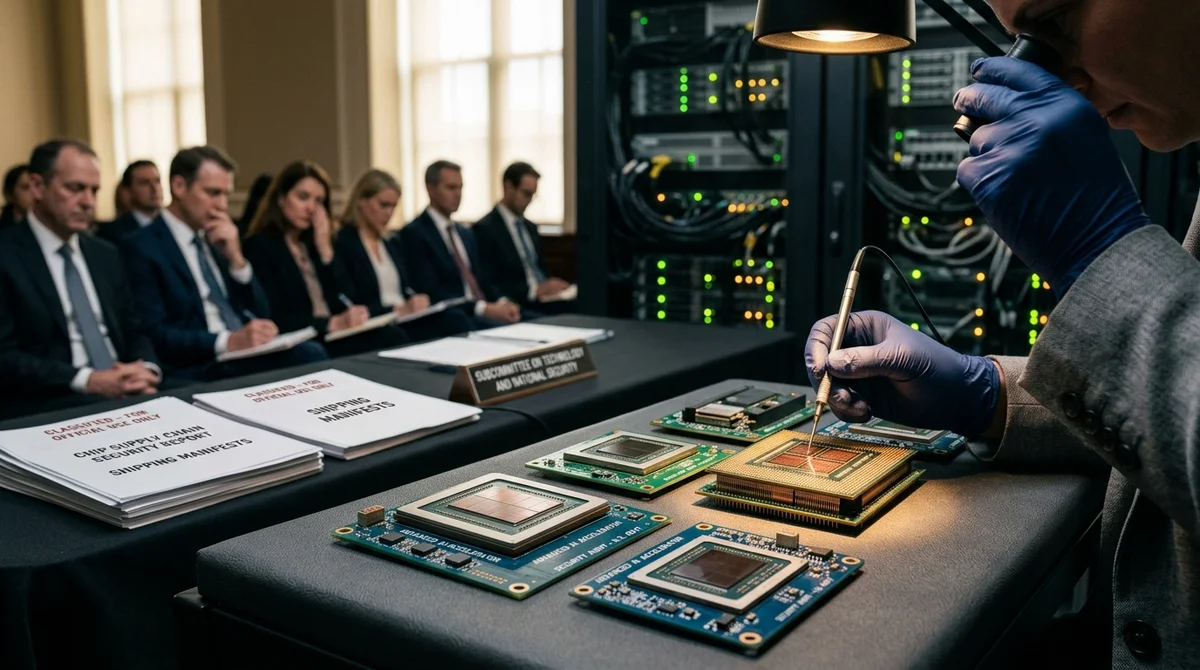
A committee of the U.S. House of Representatives supported a bill that should force chip manufacturers to more actively block gray channels for supplies of AI processors to China. The occasion was a March case involving Super Micro's co-founder, who is accused of redirecting Nvidia processors to Chinese buyers.
Why the topic accelerated
It's not yet about a passed law, but about the next important step: the relevant panel in the House moved the initiative further along the procedure. The essence of the document is to oblige the U.S.
Department of Commerce to require chip makers to take more action to prevent smuggling and circumvention of export restrictions. That is, the state wants not just to catch violations after the fact, but in advance to shift some responsibility onto those who produce key AI components and control the first links in the supply chain. This makes the news important not only for the political agenda, but also for the accelerator market.
American authorities have long been restricting China's access to advanced computing systems, however the Super Micro story showed that formal bans are not enough if there are intermediaries, assemblers, and buyers in the chain willing to circumvent the rules. After the March accusation, pressure shifted from individual violators to the entire distribution system, where chip makers have maximum data and influence.
New control logic
If the bill advances further, manufacturers and their partners will likely be expected to provide not just a single formal certificate, but a set of continuous checks throughout the entire sales and supply chain. It is important for the regulator to see not only the fact of export itself, but also who acts as an intermediary, where the shipment moves after the first international dispatch, how its ownership changes, and whether documents match the actual equipment route. The minimum set of expectations looks like this:
- stricter checks on distributors and intermediaries
- confirmation of final buyer and shipment purpose
- monitoring of suspicious routes through third countries
- prompt alerts to authorities about circumvention schemes
The exact wording can still change, but the direction is already clear. Washington wants compliance to stop being a formal checkbox in export documents and become a continuous monitoring process. For companies, this means more internal analytics, more legal risks in case of mistakes, and more additional costs for transaction verification, especially if it comes to large servers and systems with multiple AI accelerators inside these products.
Who will be affected first
Pressure will intensify first on the ecosystem around Nvidia, because it is its processors that feature in the case that became a political trigger for the bill. But in practice, the circle will be wider: server assemblers, distributors, integrators, and any companies through which cutting-edge chips physically pass to the end customer will come under additional scrutiny. The longer and less transparent the chain, the higher the chance that regulators will consider it a weak point.
For the market, this will almost certainly result in increased compliance costs and slower deals in sensitive regions. Manufacturers will have to check partners more deeply, and buyers will have to more thoroughly prove the legitimacy of purchases and final equipment use. For China, this is a bad signal: even if demand for cutting-edge AI chips remains, obtaining them through indirect channels will be harder.
For the U.S., this is an attempt to close not a declarative but an operational hole in export control.
What this means
The U.S. is taking the next step from general export restrictions to personal responsibility throughout the entire supply chain of AI hardware. If the initiative advances further, manufacturers like Nvidia will have to prove not only what they sell, but also where each critically important accelerator ultimately ends up.
Want to stop reading about AI and start using it?
AI News is a curated feed of AI/tech news. Hamidun Academy teaches you to use AI systematically in your work.