Bloomberg Tech: How AI Changes the Battlefield and Launches an Autonomous Weapons Race
In the latest Bloomberg Tech: Asia episode, they discuss how AI reshapes military logic: decisive factors are no longer just missiles, but algorithms…
AI-processed from Bloomberg Tech; edited by Hamidun News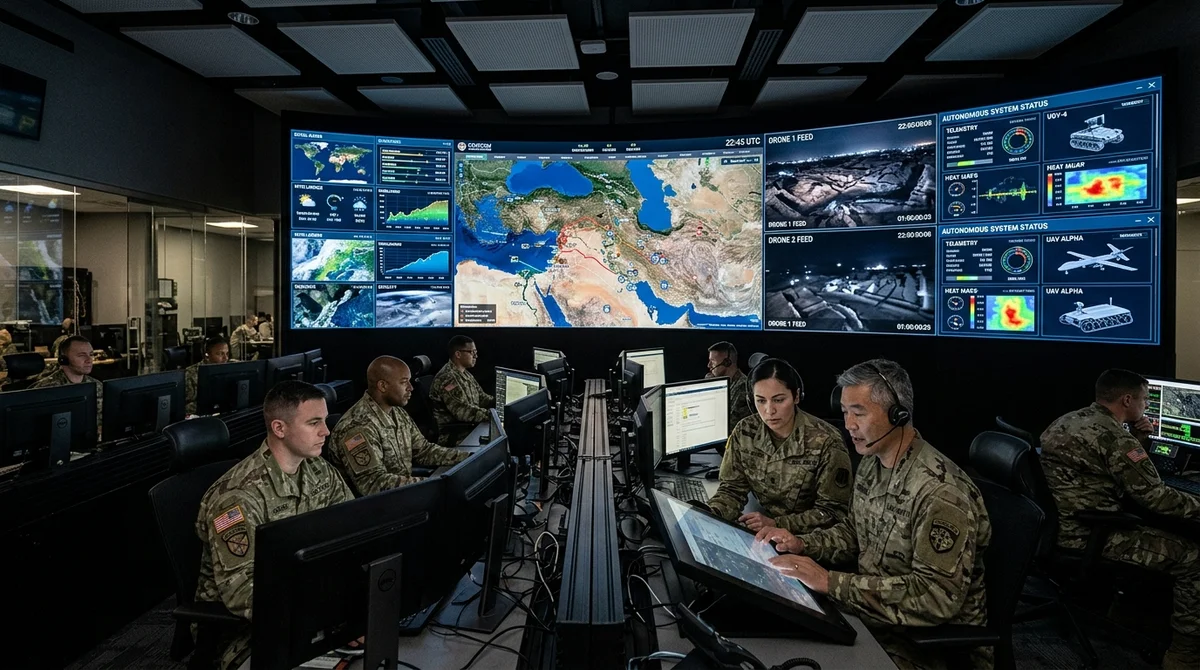
In the Bloomberg Tech: Asia edition from March 27, 2026, hosts discuss how AI is transforming into one of the main factors of military power. Algorithms, sensor networks, and autonomous systems come to the forefront, along with them—a new round of technological race between nations.
New Logic of Conflict
The conversation is no longer only about who has more equipment or ammunition. Increasingly, advantage is determined by who collects data faster, interprets it more accurately, and makes decisions earlier. AI here becomes not a separate tool, but a connecting layer between intelligence, command, communication, and strike platforms.
The denser an army connects sensors, software, and autonomous machines into a single system, the higher its reaction speed and the smaller the role of human pause between target detection and action. Because of this, geopolitics itself is changing. Competition is not only over weapons, but also over computing power, chips, communication channels, satellite infrastructure, and access to data arrays on which models are trained.
AI makes military power dependent on the civilian technology stack: from clouds and semiconductors to drone manufacturers and algorithm developers. In the end, the border between defense industry and big tech becomes thinner, and the global arms race becomes more distributed and digital.
What Systems Change
When Bloomberg talks about war increasingly defined by algorithms, sensors, and autonomous systems, it refers to a practical shift in how armies see the battlefield and act on it. AI accelerates the cycle from observation to decision and reduces the load on operators who previously had to manually reconcile too many signals simultaneously. As a result, commanders get a more complete picture of the situation and can act in a window that previously simply closed too quickly.
- Consolidates data from satellites, radars, cameras, and drones into one stream
- Helps find targets, anomalies, and changes in the situation faster
- Coordinates autonomous platforms in air, land, and sea
- Suggests probable scenarios and consequences of choices to commanders
- Automates parts of intelligence, logistics, and operation planning
This does not mean that humans disappear from the decision-making loop. But his role shifts: he increasingly controls, confirms, limits, or cancels actions that the system has already proposed or prepared. This approach increases the pace of operations, but at the same time makes the reliability of the model, data quality, and resilience of communication channels especially important. An error in object classification, a sensor failure, or vulnerability in the software layer can now scale much faster than in traditional systems.
Main Dispute
The more autonomy machines gain, the sharper the question of responsibility becomes. If the system incorrectly recognized a target, who is responsible for the consequences: the developer, the operator, the commander, or the state that deployed it? This is why the conversation about AI on the battlefield quickly goes beyond engineering and comes down to law, ethics, and international rules for the use of force.
The speed of machines looks like an advantage only as long as there remains an understandable mechanism of control and the possibility of human intervention. The second node of the dispute is the risk of escalation. When decisions are made faster and counter-actions are increasingly automated, parties have less time for verification, doubt, and de-escalation.
This raises the price of any error and makes particularly dangerous situations in which autonomous systems operate on the edge of trust in incomplete data. Therefore, the discussion about AI in defense today takes place in two planes at once: how to use the technology for advantage and how to prevent the same advantage from making a conflict less predictable.
What This Means
AI is becoming for defense what radars, satellites, or precision-guided weapons were before: a technology that changes the basic logic of power. For states, this means a new race for computing, data, and autonomous platforms. For industry—a tighter connection between military orders and the civilian AI market. And for everyone else—the urgent need to agree on rules before the speed of systems outpaces political control in the coming years.
Want to stop reading about AI and start using it?
AI News is a curated feed of AI/tech news. Hamidun Academy teaches you to use AI systematically in your work.