Habr AI Breaks Down Gradient Descent in C++ and CUDA Through MNIST Model Training
Habr AI released the fourth part of the 'From MNIST to Transformer' series—this time covering gradient descent and actual MNIST model training. The author…
AI-processed from Habr AI; edited by Hamidun News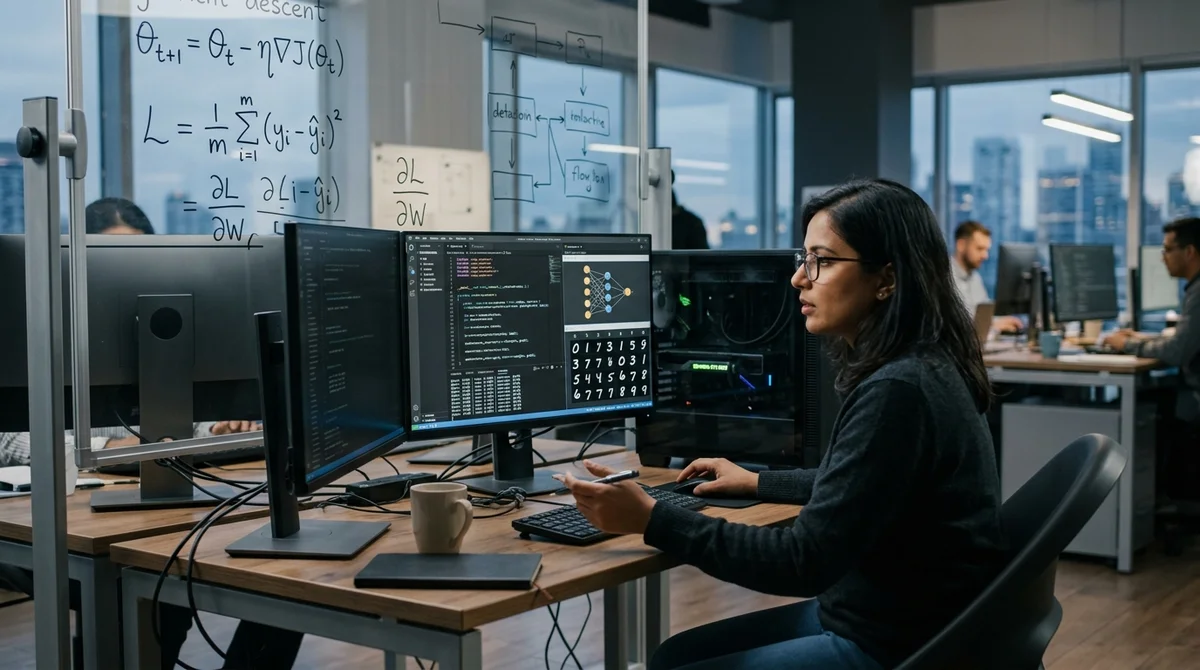
Habr AI has published the fourth part of the "From MNIST to Transformer" series, and this time the author moves to the most practical stage — training a model through gradient descent. The material shows how to assemble a basic training loop in C++ and CUDA without PyTorch and bring the model to recognize handwritten digits.
What
This Part Is About The series is structured as a route from minimal examples to the architecture of modern neural networks. Instead of ready-made frameworks, the author consistently breaks down the low level: CUDA cores, memory, GPU computations, and the math that governs all of this. In the fourth part, the focus shifts to gradient descent — a mechanism without which the model doesn't learn and simply makes random predictions.
This is an important step because this is where fragmented pieces of code transform into a full training process. The main idea of the article is to lift the "black box" effect from familiar AI tools. When a developer works only through high-level libraries, weight updates, error calculation, and movement across the loss function surface often remain hidden.
Here, the author proposes assembling everything by hand: understanding where the gradient comes from, how it affects parameters, and why even a simple model requires careful work with data and memory. For those who want to understand the foundation of LLM, such an approach is more useful than yet another ready-made notebook.
How
Training Works At the center of the material is a practical implementation of training a model on the MNIST dataset. The author doesn't limit himself to the gradient descent formula, but connects math to code: how error is calculated, how weights are updated, and how these operations fit into C++ and CUDA. Because of this, the article simultaneously works as an algorithm breakdown and as a step-by-step engineering breakdown on assembling your own training loop.
breakdown of gradient descent mechanics without abstractions training a model to recognize digits from MNIST implementation of key steps in C++ and CUDA working with memory and GPU computations * linking math, code, and accelerator architecture Separately valuable is the emphasis that training is not a single formula, but a chain of dependent decisions. You need to properly organize data, not lose performance on copying, understand the cost of each GPU operation, and track how model parameters change from step to step. At such a scale, it's especially clear why modern ML frameworks are so complex internally: they automate not magic, but a huge volume of engineering routine.
Why
Go to the Low Level For a broad audience, MNIST might seem too simple an example, but that's the point. On a compact task, it's easier to see basic principles that then scale up to more serious architectures, including Transformer. If you understand how gradient is calculated, how weights are updated, and how this executes on GPU, many "magical" properties of large models stop seeming unexplainable. The article essentially reminds: the path to LLM starts not with prompt engineering, but with understanding the computational foundation.
"Only this way can you truly understand how LLM works and what's behind it".
The material also fits well into the demand for engineering education around AI. Currently, the market is flooded with tools that deliver quick results but rarely explain the internal architecture. The "From MNIST to Transformer" series does the opposite: it slows down the process and forces attention to detail — from memory architecture to the logic of parameter updates. For students, ML engineers, and backend developers who care about understanding hardware limitations, this is a useful format.
What
This Means Interest in low-level AI development is growing: developers no longer have enough to simply call a model through an API. Such materials demonstrate a shift toward deeper understanding of neural network training, where C++, CUDA, and math again become key skills, not optional extras.
Want to stop reading about AI and start using it?
AI News is a curated feed of AI/tech news. Hamidun Academy teaches you to use AI systematically in your work.