Kandou AI raises $225M for copper interconnects in AI infrastructure
Kandou AI raised $225M at a $400M valuation, backing copper interconnects between chips even as the market increasingly pivots to optics. Backers including…
AI-processed from TNW; edited by Hamidun News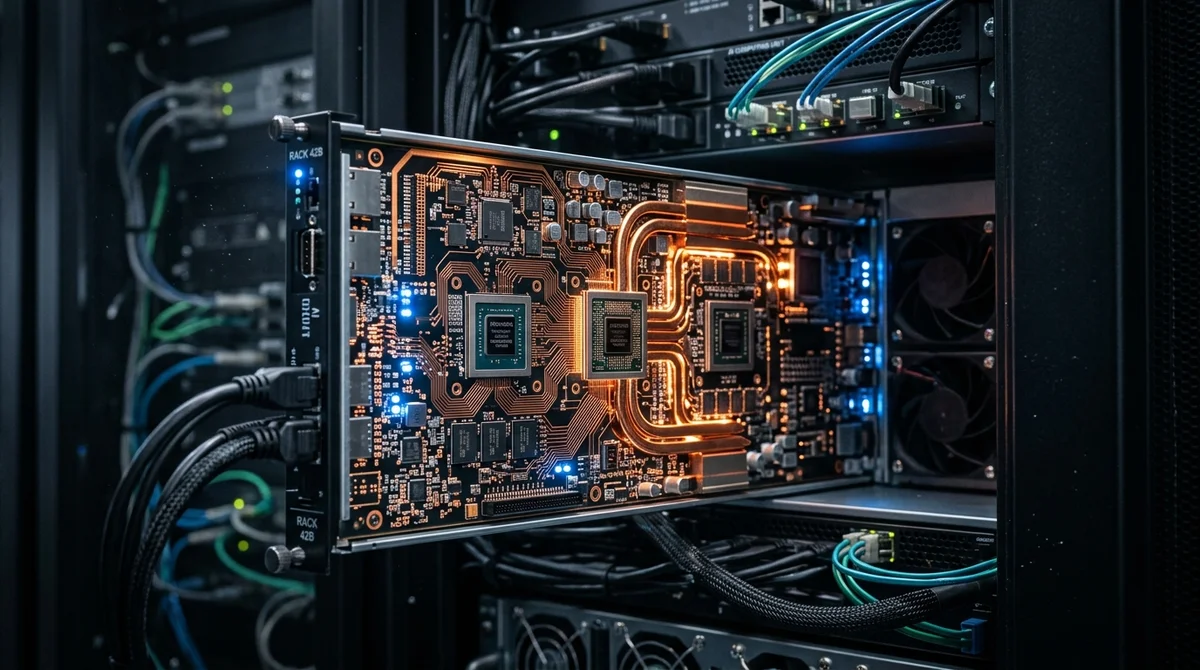
Kandou AI, a Swiss chip-to-chip communication technology developer, raised $225 million in a round the company calls Series A. The startup with a $400 million valuation is betting that copper interconnects have not exhausted their potential and will remain an important part of AI infrastructure.
Why the round matters
For the market, this is not just another investment in "hardware." Kandou operates in a layer that rarely makes headlines but directly affects the performance of AI systems: data transmission between chips. As models grow larger and accelerators are packed more densely in servers and racks, the bottleneck increasingly becomes not the computation itself, but the speed and efficiency of data exchange. That is why capital flows not only to chip creators themselves, but also to companies solving the interconnection problem between them.
The amount also stands out. $225 million for a company with this profile is a signal that investors are ready to finance not only prominent platforms around generative AI, but also the basic infrastructure without which scaling data centers runs into cost, power consumption, and assembly complexity. The $400 million valuation shows that the market sees Kandou not as a niche component supplier, but as a potentially important player in the AI equipment supply chain. This is yet another reminder that the most expensive segments of the AI stack are currently located deep below the application layer.
Betting on copper
Kandou's core idea is already readable from the deal headline: the company believes that copper connections can live longer than proponents of a rapid transition to optics expect. Against the backdrop of the AI infrastructure boom, optical interconnect solutions are often perceived as an inevitable future, especially where large volumes of data need to be transmitted with minimal losses. But within servers, accelerator modules, and short transmission routes, copper retains strong advantages—from cost to manufacturing maturity and compatibility with existing architectures.
Kandou is building chip-to-chip interconnect technologies, meaning it operates at the level where bandwidth, latency, power consumption, and packing density matter. If the company can improve these parameters on copper lines, it extends the economic life of existing approaches and reduces pressure on data center operators who do not need to immediately rebuild all physical infrastructure for optics. In other words, the bet here is not against light as such, but for a more pragmatic transition path.
Who backed the round
The composition of participants underscores that this story goes beyond a classic venture round. Maverick Silicon led, and the deal also included SoftBank, Synopsys, Cadence Design Systems, and Alchip Technologies. This matters because alongside financial capital, the project gains players connected to the design, supply, and scaling of semiconductor solutions. Such an investor list often means not only money, but access to industry connections, customers, and future integrations.
- Maverick Silicon — lead investor of the round
- SoftBank — strategic participant with a major bet on the AI ecosystem
- Synopsys — key player in chip design tools
- Cadence Design Systems — another important EDA tools supplier
- Alchip Technologies — partner connected to bringing specialized chips to market
It is worth noting separately that the deal is labeled Series A. With a round of this size, this mix of participants, and a $400 million valuation, the company looks more mature than a typical early-stage startup. This is not necessarily a contradiction: in infrastructure semiconductor business, cycles are longer, and round status sometimes reflects company maturity worse than the list of partners and capital raised. In Kandou's case, what matters more than the letter on the slide is who exactly bet money on this thesis.
What it means
Investors continue to seek not only winners among models and clouds, but also those solving the physical constraints of AI infrastructure. If Kandou can prove that copper interconnect solutions retain cost and efficiency advantages over short distances, the transition to fully optical systems may turn out to be not a revolution, but a stretched evolution. For the market, this means a longer life for hybrid architectures and renewed interest in companies that improve the foundational layer of data centers.
Want to stop reading about AI and start using it?
AI News is a curated feed of AI/tech news. Hamidun Academy teaches you to use AI systematically in your work.