Researchers: Deepfakes of Trump and Fake Military Women Became Propaganda Weapons
Political deepfakes are becoming a distinct industry: creators not only forge famous people, they invent entire AI characters. These images already gather…
AI-processed from Guardian; edited by Hamidun News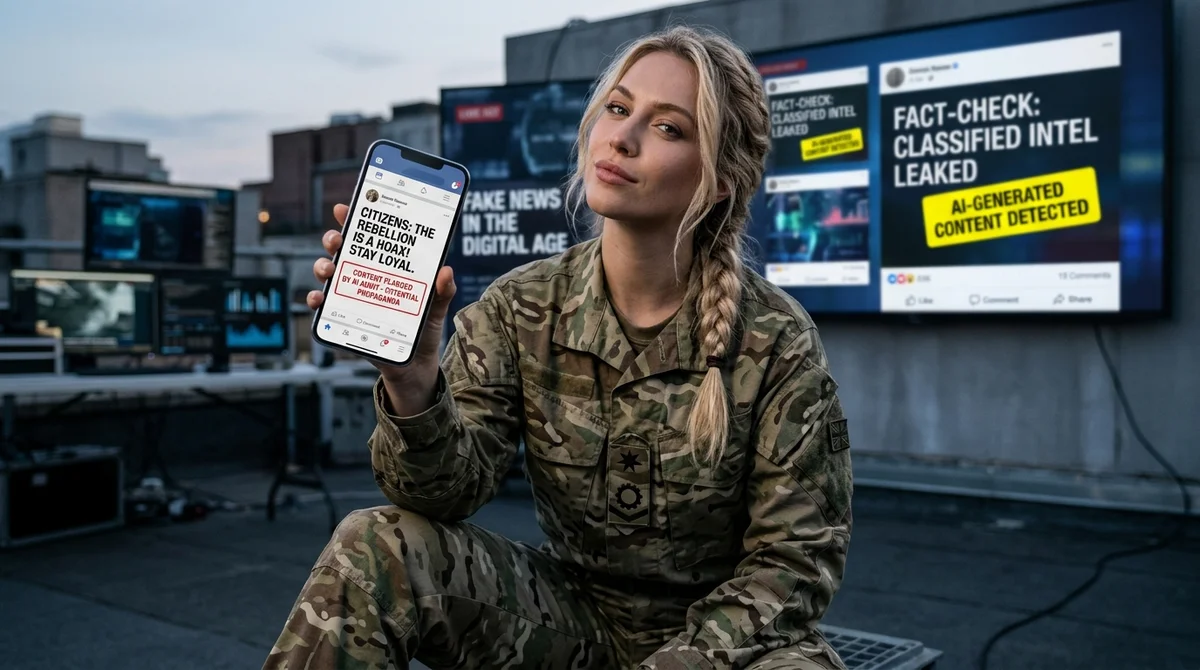
Political deepfakes are quickly ceasing to be mere memes or parodies. Researchers warn: synthetic characters created with generative AI are already making money, building audiences, and functioning as a convenient form of propaganda — even when the viewer suspects they are looking at a fake.
The Scale of the New Wave
The Governance and Responsible AI Lab (Grail) is tracking a sharp rise in such content. Since the beginning of 2025, researchers have counted more than 1,000 English-language social media posts featuring fake images and videos of politicians, publicly significant events, and controversial topics. For comparison, over the previous eight years combined, the Grail database collected 1,344 similar cases.
This surge is attributed not only to the popularity of the topic, but also to the fact that generative models have made creating plausible scenes an almost instantaneous task. The main change is not that there are more fakes of famous faces. Now creators increasingly invent entirely non-existent characters and place them in politically charged contexts: barracks, police stations, conflict zones, rallies.
This is no longer simply replacing a politician's face in a video, but constructing an entire "reality" where the viewer receives not a fact, but an image that conveniently aligns with their beliefs. This is where the new power of deepfakes lies: they don't need to be accurate, they only need to seem plausible.
Money and Beliefs
One of the most notable examples is the AI character Jessica Foster, a blonde woman in American military uniform, who appeared on Instagram in December 2025. Posts featuring her — on a bunk in a barracks, sitting at a desk with feet on the table, standing next to Donald Trump on an airfield in high heels — gathered a huge audience. The account had over a million followers, and traffic was then directed to OnlyFans, where users were sold purported photos of her. In other words, the synthetic image simultaneously functioned as a political visual symbol and as a commercial product. Similar cases are already emerging in several formats:
- fake "Iranian soldiers" in videos designed to go viral during wartime
- AI policewoman on TikTok with an audience of over 26,000 followers and messages supporting strict deportation policy
- at least 18 deepfakes posted by Donald Trump and the White House since 2024
- deepfakes against Trump that Governor of California Gavin Newsom has also begun using
Researchers especially emphasize an unpleasant effect: such content can persuade even when the viewer notices oddities in it. Incorrect insignias, absurd scenes, mismatched details, and overly glossy visual style don't necessarily hinder its impact. If the image supports an already existing opinion held by the person, it works as emotional confirmation. In this logic, a deepfake is not needed to prove a fact, but to reinforce the feeling: "this seems like the truth, so it must be so."
Labels and Defense
Defense is currently being pinned on content provenance standards and automatic labels. The Coalition for Content Provenance and Authenticity promotes an approach where cryptographically signed metadata is embedded in images or videos: where the file was created, whether it was edited with AI tools, and what happened to it next. The idea is simple: if the platform can read such information, it can warn the user before the synthetic content spreads across feeds.
For now, this is working poorly. In an experiment by The Indicator journalist, 200 AI images and videos were uploaded to major platforms to check how they label them. Even the best results from LinkedIn and Pinterest covered only about 67% of materials.
Instagram labeled only 15 out of 105 fake images. At the same time, researchers warn about the next stage — AI swarms, when networks of synthetic accounts could autonomously coordinate, embed themselves in communities, and simulate public consensus without the familiar "troll farms" of real people.
What This Means
The political risk now does not come down to the question "will people literally believe the fake." What matters much more is whether it reinforces the needed emotion, the image of an enemy, or a sense of rightness. As long as platforms slowly label AI content while monetization of such characters works quickly, deepfakes will increasingly be used not only for entertainment, but for persuasion, radicalization, and sales.
Want to stop reading about AI and start using it?
AI News is a curated feed of AI/tech news. Hamidun Academy teaches you to use AI systematically in your work.