ChatGPT Helped Design a Controller for a 32-Juice Vending Machine
A brief but instructive case study appeared on Habr: the author asked ChatGPT to help design a controller schematic for a juice vending machine. The model…
AI-processed from Habr AI; edited by Hamidun News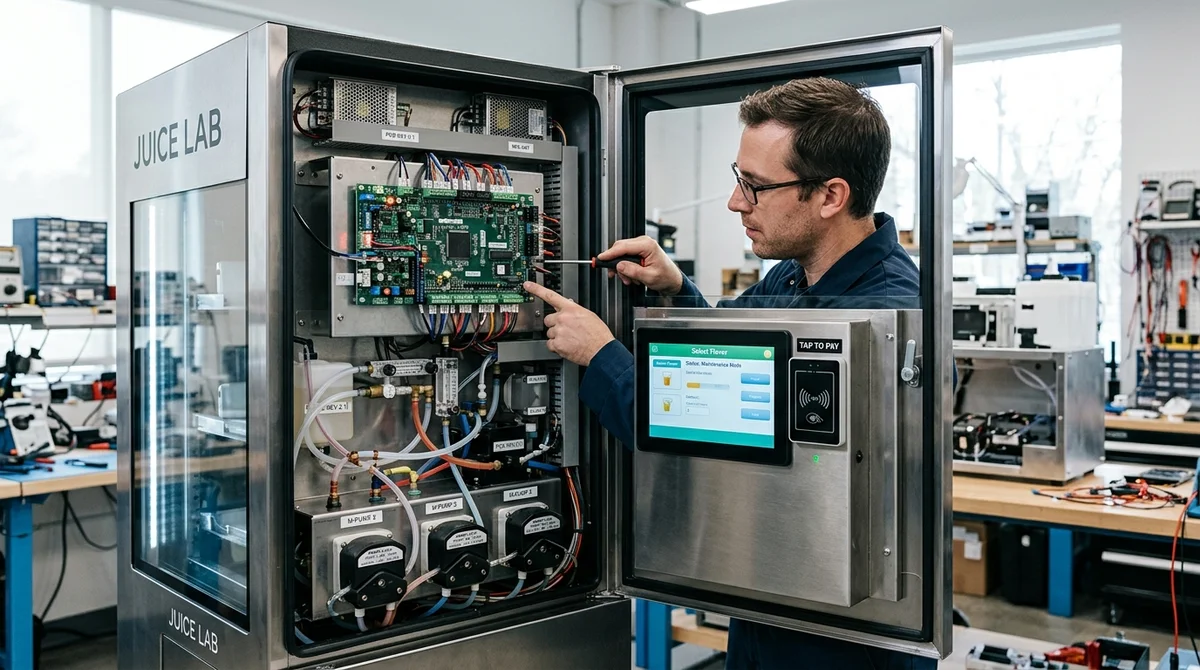
A notable post appeared on Habr showing how ChatGPT was used not for text or code, but for early hardware design — specifically a controller for a juice vending machine. The author doesn't show the finished device, but the conversation itself is a good illustration of how an LLM can conduct an engineering interview and gather requirements step by step.
How the Requirements Were Formed
The author started with a straightforward request: could ChatGPT develop a schematic and Gerber files for a controller of a juice vending machine? In response, ChatGPT didn't immediately "draw the board." Instead, it first requested basic parameters: payment methods, number of dispensing channels, cooling requirements, user interface type, server communication format, and preferred computing platform. For a hardware task, this is an important moment: the model behaved not like a generator of random solutions, but like an engineer at the requirements-gathering stage.
After clarifications, the picture became more concrete. The device should accept NFC cards, mix drinks from 32 juices, pour a standard cup, work with cooling, have a touchscreen, and send telemetry to a cloud system via sockets. Next, the user set not an abstract but quite specific direction: separate the power board and interface board, use Orange Pi, a 10-inch TFT, PN532, and LTE connectivity for a Linux server.
What the Model Proposed
Based on these requirements, ChatGPT broke down the system into modules and proposed a preliminary architecture. The conversation included not only general ideas but also practical blocks that such a device genuinely needs.
- separate power board for controlling actuators and power distribution
- user interface board based on Orange Pi
- PN532 NFC module for card acceptance
- 10-inch TFT display for drink selection scenarios
- LTE modem and server communication via sockets
Separately, the model proposed options for liquid dispensing and cooling control. Initially, stepper motors, solenoid valves, and even alternatives like Raspberry Pi, STM32, and ESP32 in different roles were discussed. For cooling, ChatGPT mentioned either Peltier elements with fans or a compressor system — that is, it didn't reduce everything to a single template solution.
It was also useful that the model continued asking questions rather than pretending all parameters were already known. It clarified whether juice level monitoring was needed, which server communication stack would be more convenient, whether there would be multiple cup types, and which drivers should be selected. It's on these details that overly optimistic AI demos often break down.
How the Schematic Evolved
During the conversation, the author reconsidered one key component: instead of stepper motors, he asked to use mini-peristaltic pumps from AliExpress because they're cheaper. ChatGPT agreed to this compromise and immediately noted the limitation: such pumps are simpler to control and cheaper, but typically have lower dosing precision.
"Peristaltic pumps are simpler to control and cheaper, although they
have slightly lower dosing precision."
After that, the model proposed a logical sequence of work: first design the power board, then work on layout and Gerber files. The author confirmed this order.
The published excerpt contains no actual schematics, PCB, or production files. So it's not yet about a fully finished controller, but an early stage of engineering development where ChatGPT helps package an idea into system structure and turn a vague request into a more formal specification. This is why the post is interesting not as proof that LLMs already replace electronics developers, but as an example of a different scenario. The model acts as a discussion partner who helps ensure critical system blocks aren't forgotten, structures component selection, and quickly iterates through architectural options before real design work begins.
What This Means
Such cases show that ChatGPT is already useful in hardware tasks as a tool for preliminary design and requirements gathering. But the value emerges not where the model "did everything itself," but where the person uses it to accelerate early engineering iterations and verifies each solution before production.
Want to stop reading about AI and start using it?
AI News is a curated feed of AI/tech news. Hamidun Academy teaches you to use AI systematically in your work.