Anthropic reveals in largest AI survey what people actually expect from it
Anthropic surveyed 80,508 Claude users from 159 countries and obtained a rare honest snapshot of AI expectations. First place goes not to hype or 'human…
AI-processed from TNW; edited by Hamidun News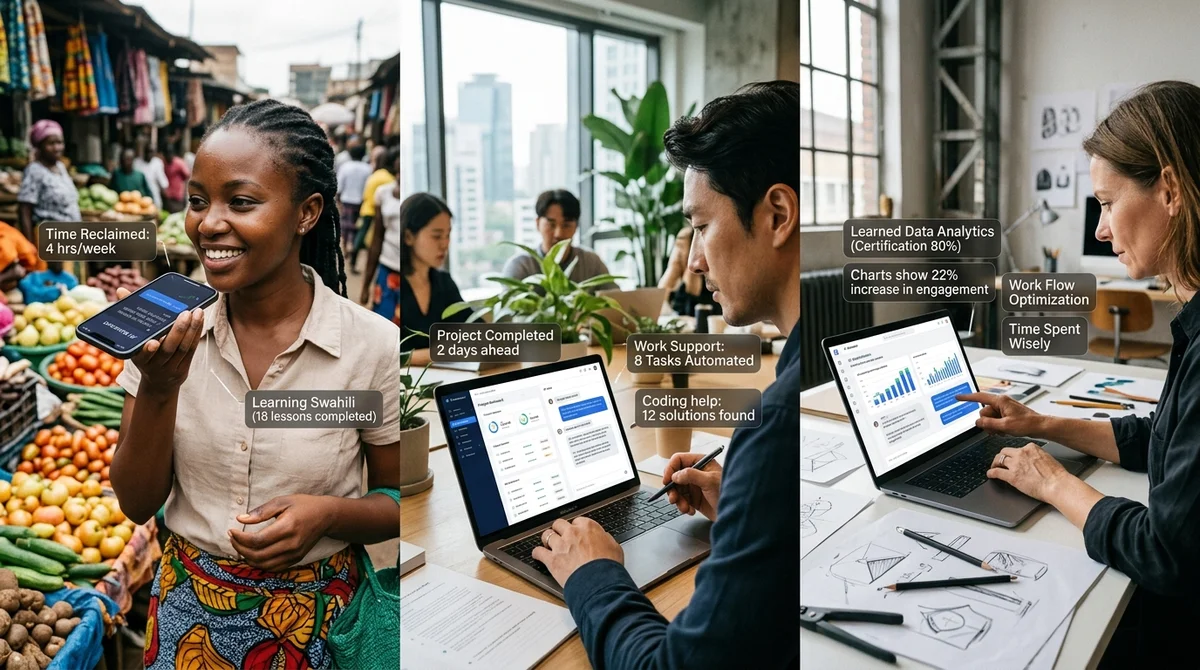
Anthropic published the results of one of the most large-scale studies about what people expect from AI: the company conducted 80,508 interviews in 159 countries and 70 languages. The main conclusion for the market sounds uncomfortable for conventional AI marketing: most people are asking not for "magical productivity," but for less overwhelm, more access, and more time for normal life.
How the research was structured
In December 2025, Claude users were offered to talk not with a questionnaire, but with an AI interviewer—a special version of Claude that asked basic questions and clarified answers throughout the conversation. Within a week, Anthropic collected 80,508 conversations. Then the responses were automatically categorized: what people want from AI, what they've already gotten, what they fear, and how they feel about the technology overall.
By scale and language coverage, this is probably the largest qualitative study of its kind. At the same time, the sample is not ideal. This is not a random cross-section of the population, but active Claude users—people already willing to try AI.
Plus, the interview first asked about positive scenarios, and only then about risks. But even with these caveats, the picture turned out to be revealing: when people are given the opportunity to speak freely, the conversation quickly shifts from words about efficiency to themes of time, attention, education, health, and money.
What people want
The largest category became professional efficiency—18.8% of participants wanted AI to take on routine work and free up space for more complex work. But right alongside were very non-"corporate" requests: personal transformation, help with life organization, and getting free time back. Together, this shows an important shift: people use the language of productivity, but describe very human goals—less mental burden, more control over their day, and the ability to be near loved ones.
- 18.8% — professional efficiency
- 13.7% — personal transformation and wellbeing
- 13.5% — life management and cognitive relief
- 11.1% — time for family, rest, and hobbies
- 9.7% — financial independence
Regions stand out where access to education, capital, and expertise is more limited. There, AI is more often perceived as an equalizer of opportunities: a tool that helps launch businesses, learn without expensive teachers, and compensate for lack of expertise around you. That's why in Africa, South and Southeast Asia, optimism is noticeably higher than in the USA or Western Europe, where risks to employment, regulation, and control more often come to the fore.
Where benefit and fear lie
When asked whether AI had taken even one step toward the desired future, 81% answered "yes." Most often, people spoke about accelerating work, cognitive partnership, learning, and access to complex tasks without specialized training. Some use AI to complete documentation faster and get home on time, some learn math without fear of making mistakes, some build products outside their profession. In these stories, AI is valued not for "magic," but for patience, 24/7 availability, and lack of judgment.
"If AI really lifted the mental burden from me, it would give me back
something priceless: undivided attention."
But that same set of qualities breeds anxiety. The most common fear is unreliability: 27% of participants worry that AI simply won't do what it should. Another 22% each mentioned threats to jobs and loss of human autonomy. At Anthropic they separately describe the "light and shadow" effect: people whom AI helps learn at the same time fear degradation of thinking; those who find emotional support in it more often worry about dependency. Globally, 67% of those interviewed viewed AI rather positively, but almost always optimism came alongside specific caveats.
What this means
For AI companies, this is a signal: selling AI only as a task accelerator is no longer enough. People don't just want to write emails faster—they want to get their time back, reduce everyday friction, and gain access to opportunities that didn't exist before. The winning products will be those that deliver this effect without failures in reliability, dependency, and loss of control.
Want to stop reading about AI and start using it?
AI News is a curated feed of AI/tech news. Hamidun Academy teaches you to use AI systematically in your work.