Starcloud raises $170M at $1.1B valuation for orbital data centers
Starcloud raised $170M in Series A and achieved a $1.1B valuation. The company wants to turn orbital computing experiments into a full business: it already…
AI-processed from TNW; edited by Hamidun News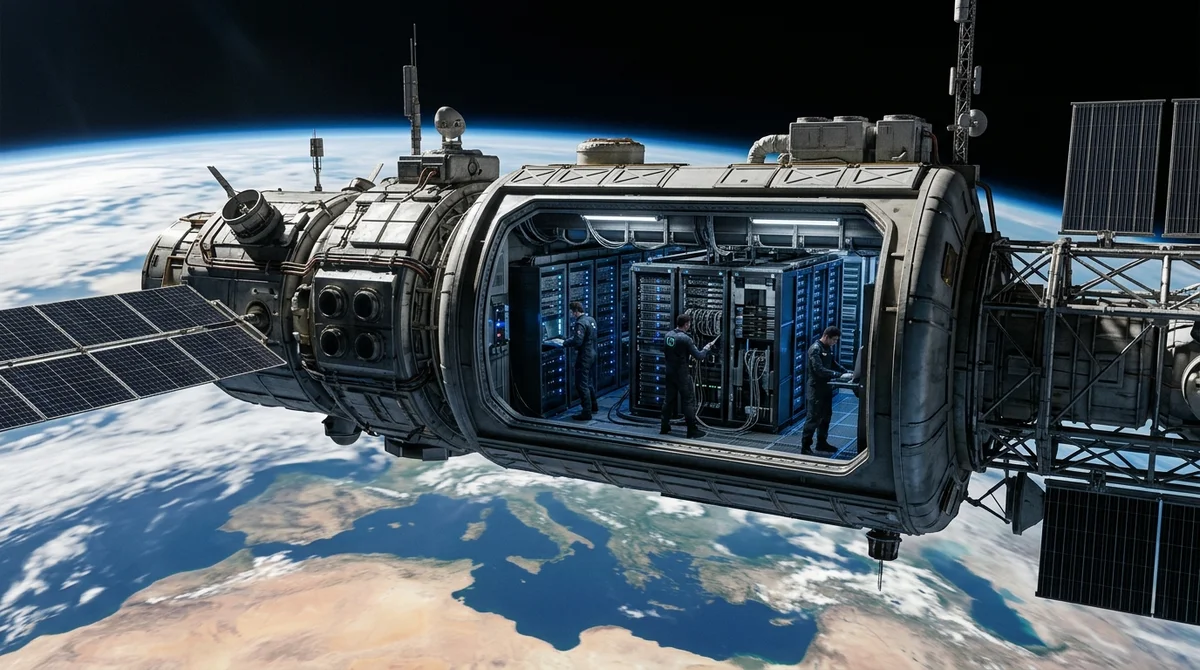
Starcloud raised $170 million in a Series A round at a $1.1 billion valuation to accelerate the development of orbital data centers. The startup from Redmond, Washington is trying to transform space computing from an impressive experiment into an infrastructure business with clear economics.
Orbital Bet
Starcloud's main goal now is to create a spacecraft of Starship class, which will serve as the foundation for the first orbital data center capable of competing on cost with ground-based facilities. This is an important shift in positioning: the conversation is no longer about a one-off technology demonstration, but about attempting to build a new category of computing infrastructure. Against the backdrop of an AI boom and power shortage on Earth, Starcloud is betting that orbit could eventually become not an exotic novelty, but another platform for placing resource-intensive computations.
The round itself also demonstrates the level of expectations around the project. For a relatively young company, a $1.1 billion valuation at the Series A stage is a signal that investors are buying not current revenue, but the scale of the vision.
Benchmark led the round. The full list of other participants is not disclosed in the available fragment, but that's enough to see the trend: the market is ready to fund not just models and chips, but also alternative physical infrastructure for AI.
What's Already Working
Starcloud came to this round not with just renderings. The company already has an Nvidia H100 GPU working in orbit, and this is precisely what makes the story significantly more serious than a typical space pitch. Additionally, the startup claims to have trained its first AI model in space. Even though for now we're talking not about mass deployment, but about early working demonstrations, the company has already crossed the threshold where you can discuss not the idea, but engineering execution. For the market, this is an important marker for several reasons:
- the project already relies on a working space-based computing module;
- the team has not only a concept but also experience launching AI workloads beyond Earth;
- focus has shifted from experiment to a larger-scale apparatus;
- the company is talking not just about flight, but about cost parity with ground-based data centers.
The last point is the most ambitious here. Launching hardware to space is difficult, but proving the economics is even harder. If Starcloud can approach the claimed level, the conversation about orbital computing will quickly move from the category of futuristic news into the realm of profitability, reliability, and competition for corporate AI workloads. For now this is a promise, not a confirmed result, but now the company has capital to verify it not on slides, but in hardware.
Where the Money Goes
The new capital Starcloud needs is not just to continue research. The next phase requires far more expensive and complex engineering: scaling the platform, designing a large-class apparatus, and preparing for the transition from isolated demonstrations to a system that can be compared with Earth-based infrastructure in terms of cost and useful computational output. Looking at the deal as a market signal, it shows the new vector of the AI industry well.
Money is flowing not just into foundation models, applications, and clouds, but into a deeper layer of the stack — where the physical limits of computing are determined. The higher the demand for training and inference, the more actively investors seek unconventional ways to boost capacity. Starcloud is trying to occupy this niche ahead of others and establish itself as an infrastructure player, not just a space startup with a nice presentation.
What This Means
The Starcloud deal shows that the race for AI computing power is expanding beyond Earth-based data centers. If the company can confirm the declared economics of orbital computing, the market will get not another space PR case, but a new class of infrastructure for heavy AI tasks.
Want to stop reading about AI and start using it?
AI News is a curated feed of AI/tech news. Hamidun Academy teaches you to use AI systematically in your work.