AWS showed how to search for solar flares in SageMaker AI using ESA STIX instrument data
AWS demonstrated a practical scenario for SageMaker AI: the service can be used not only for business analytics but also for scientific tasks. In the new…
AI-processed from AWS Machine Learning Blog; edited by Hamidun News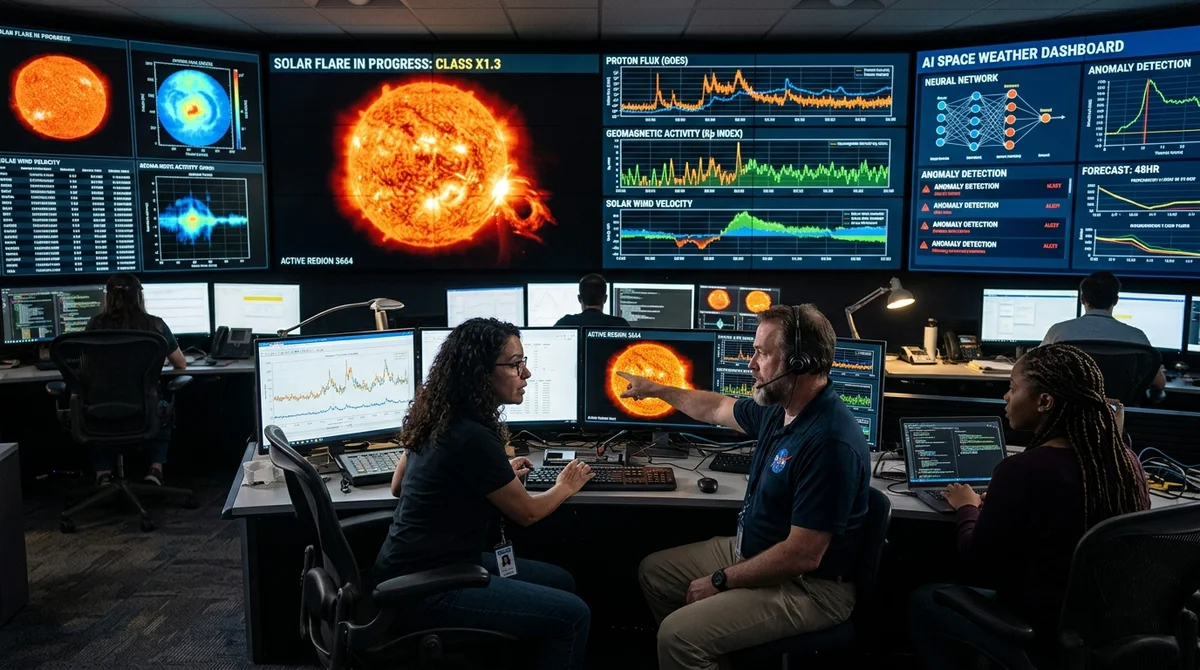
AWS published a practical breakdown of how to build a solar flare detection system in Amazon SageMaker AI. The foundation is an LSTM network for working with time series and STIX data, a scientific instrument from the European Space Agency.
What AWS Showed
Instead of an abstract demo task, AWS took a scenario where machine learning solves a real scientific problem: you need to detect surges in solar activity in time based on instrument telemetry. Formally this is an educational project, but in essence the company demonstrates a complete production pipeline: data preparation, model training, quality verification, and cloud deployment. For SageMaker AI itself, this is a good case study: the service is positioned not only as a platform for enterprise analytics, but also as a tool for research where large arrays of signals and reproducible ML pipelines matter.
Solar flares are not a niche topic for astrophysicists alone. Such events affect space weather, which in turn can impact satellite communications, navigation, and the resilience of individual technical systems. So the task here isn't about beautiful data visualization, but about early detection of characteristic patterns in a time series.
This is exactly what LSTM does well: the architecture can work with sequences and catch dependencies between neighboring and more distant measurements, when simple threshold analysis starts to lose signal in noise.
How the System Is Organized
The key data source in this example is STIX, an instrument from the European Space Agency that records solar X-ray radiation. Based on the description of the material, AWS builds a pipeline around sequences of observations: the raw stream must be cleaned, split into windows, brought to a convenient format, and only then fed into the model. Here, it's not just the choice of LSTM that matters, but also the fact that SageMaker AI handles the infrastructure side. The team doesn't need to separately set up servers for experiments, manually link training and deployment, or assemble wrapper code around the prediction service.
- loading and preparing STIX data
- forming time windows for training
- training LSTM model in SageMaker AI
- deploying the model for predictions
- evaluating quality on new observations
The value of this scenario is that it shows ML not as a notebook with a pretty graph, but as a repeatable process. The same approach can be applied to other telemetry streams where there is signal, noise, and the need to respond quickly. If the model is trained correctly on historical flares, it can then be used for automatic anomaly flagging, preliminary event sorting, or as a supporting layer for scientists who analyze observations manually. For business, this is a familiar pattern: time series, event classification, and cloud deployment.
Why This Matters
AWS has two goals here. First, to show that SageMaker AI remains a platform not only for generative models, but also for applied deep learning on classical data. Second, to provide a clear example where a neural network solves a high-value task without requiring exotic architecture.
Against the constant noise around LLMs, this kind of material is useful because it refocuses attention on practical engineering: you have a dataset, you have a sequence of signals, you have an event label, and from this you can build a working system without magic or manual heroics. Another important point is that the bridge between science and cloud development is becoming shorter. Previously, such projects often lived within research teams and were poorly transferable: code ran locally, the environment wasn't reproducible, and the model existed separately from the service that should use it.
SageMaker AI allows you to pack this into a more standard process. So AWS's article is interesting not only to those who follow space. It's a template for any task where there is a stream of sensor data: from industrial monitoring and IoT to medicine and cybersecurity.
What This Means
AWS reminded the market of something simple: the value of AI doesn't end with chatbots. Cloud platforms are increasingly turning scientific and industrial tasks with time series into ready, reproducible pipelines that can quickly go from experiment to working service.
Want to stop reading about AI and start using it?
AI News is a curated feed of AI/tech news. Hamidun Academy teaches you to use AI systematically in your work.