Equinix to invest 7.5 billion rand in new data centers in South Africa amid AI demand growth
Equinix is set to expand data centers in South Africa with a 7.5 billion rand investment—roughly $438 million. The company aims to position itself amid rapid…
AI-processed from Bloomberg Tech; edited by Hamidun News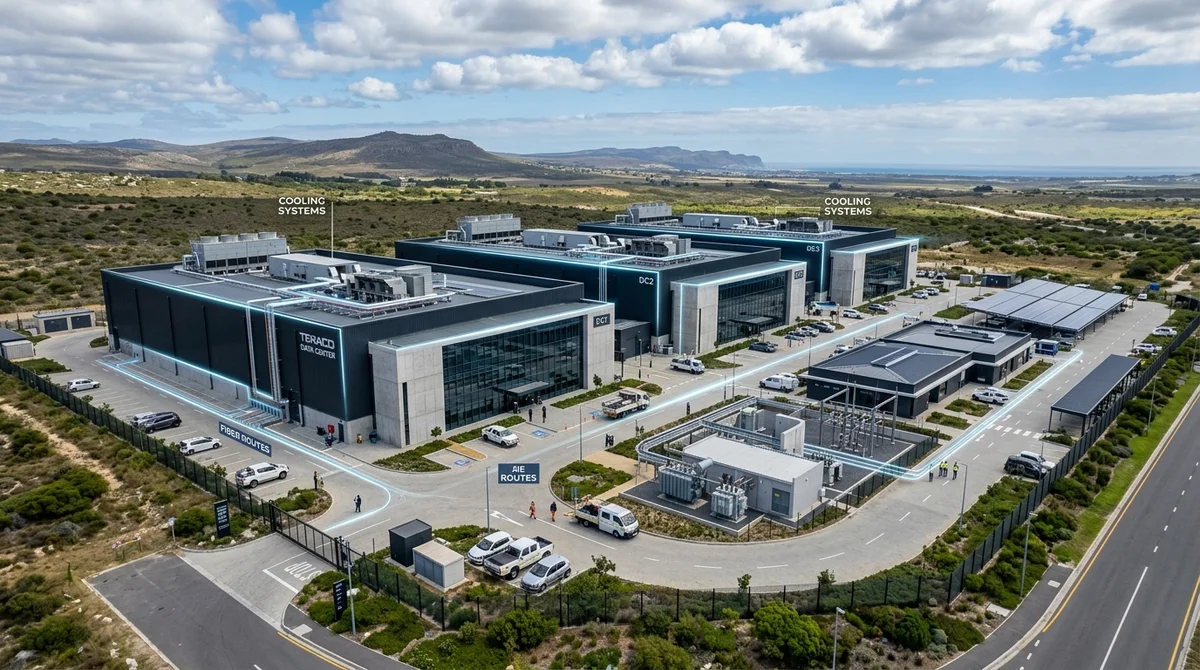
Equinix is planning to expand its data center network in South Africa, investing 7.5 billion rand to keep pace with growing local demand for AI infrastructure. The company clearly expects the market on the continent to transition from discussions about AI to real spending on computing, storage, and service placement.
Betting on South Africa
Global data center operator Equinix has announced plans to build new facilities in South Africa as part of a 7.5 billion rand program, or approximately $438 million. This is not a token expansion for the sake of formal presence, but a significant investment in a market the company considers promising precisely because of the AI boom. When a player of this scale moves into capital-intensive infrastructure, it usually means they see not a short-term spike in interest, but sustained future demand from businesses, cloud services, and digital platforms.
For Equinix, South Africa looks like the most straightforward entry point into the broader African market. It is easier here to launch new capacity, connect international clients, and serve companies for whom reducing latency and keeping data closer to users matters. Against the backdrop of growing interest in generative AI and corporate automation, local data centers are transforming from "back office" into basic infrastructure for new products. Without them, it is difficult to scale models, deploy services, and ensure stable operation of AI applications in the region.
Why Demand Is Accelerating
Equinix's investment matters not only because of the amount. It shows that demand for computing power in Africa is becoming significant enough to justify building new facilities rather than just leasing existing capacity. For the local market, this is a particularly sensitive moment: AI services require more servers, networking, cooling, and reliable power supply than traditional corporate applications. The more actively companies launch AI functions internally, the faster the load on physical infrastructure grows.
In practice, such demand is usually driven by several factors at once:
- launching local AI services and corporate pilots that need stable infrastructure
- the desire to reduce latency in application operation and keep data closer to clients
- growing requirements for sovereign data storage and regional placement of computing
- expansion of cloud and SaaS platforms that are shifting more and more load to data centers
There is also a broader effect for the ecosystem. When new world-class data centers appear on the market, startups and large companies have more options for where to launch AI products, reserve capacity, and build hybrid schemes between local infrastructure and global clouds. This lowers the barrier to entry for those who previously depended on facilities outside the region. At the same time, the importance of telecom operators, energy suppliers, and integrators is growing: the AI economy brings with it an entire chain of infrastructure contractors, not just one server room owner.
For business, this means the market is gradually maturing. If previously many companies on the continent could test AI tools through external clouds without local presence, now there is economic logic in building capacity locally. This also changes competition: winners will not only be model developers, but also those who control the channels for computing delivery—from colocation and internet exchange to cloud integration. Equinix is essentially betting on this market layer.
What This Means
Equinix's expansion in South Africa is a sign that the AI boom is beginning to express itself not only in new models and applications, but also in heavy infrastructure investments. If such projects continue, Africa will get more local capacity for AI, and business will have less dependence on remote facilities and better conditions for launching its own services.
Want to stop reading about AI and start using it?
AI News is a curated feed of AI/tech news. Hamidun Academy teaches you to use AI systematically in your work.