Goldman Sachs disabled access to Anthropic's Claude for employees in Hong Kong
Goldman Sachs disabled access to Anthropic's Claude for employees in Hong Kong. The restriction affects the AI tool that accelerates code writing, but the…
AI-processed from Bloomberg Tech; edited by Hamidun News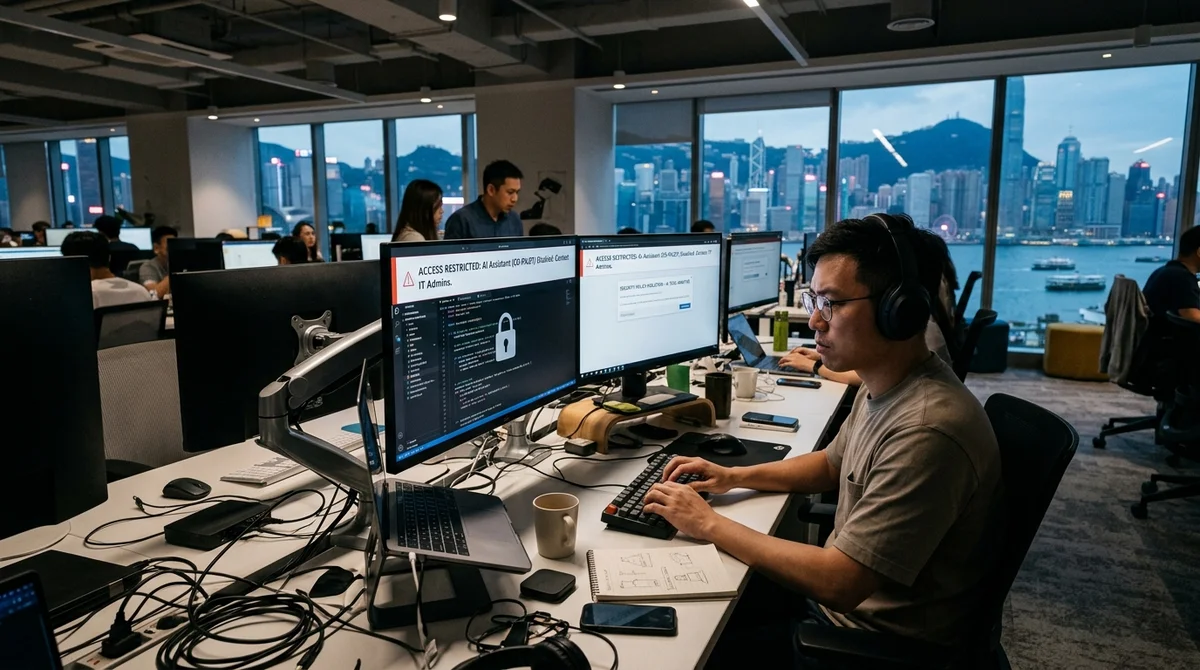
Goldman Sachs has disabled Claude access for employees in Hong Kong — an AI tool that helps write code faster. According to Bloomberg, the restriction is already in effect, but the bank has not provided a public explanation for the reasons.
What Happened in Hong Kong
This is not a complete abandonment of generative AI by Goldman Sachs, but rather a targeted restriction in one of its key Asian offices. Bloomberg, citing a source familiar with the situation, reports that employees in Hong Kong can no longer use Claude. It remains unclear whether the decision affected other divisions of the bank, whether this is a temporary measure, or whether it is related to an internal review, security policy, or local data handling requirements.
The fact of a regional restriction is no less important than the shutdown itself. In large international banks, access to internal and external digital services is often configured not uniformly, but by country, legal entity, and team function. Therefore, even a targeted change in one office could mean either a local adjustment of rules or a broader review of how AI tools are allowed in engineering processes within a global organization.
What Could Have Influenced It
The material does not name the reason, so any explanations here are only cautious conclusions based on context. For major banks, tools like Claude are not just chatbots, but a potential point of access to internal code, documentation, workflows, and customer data. When employees use AI to accelerate development, banks typically separately assess which code fragments can be sent to an external service, where requests are stored, how auditing is configured, and who is responsible for compliance with local regulations.
- sending internal code fragments and configurations to an external service
- regional restrictions on data processing and storage
- review of pilot AI programs following internal audits
- different sets of permitted tools for different offices and teams
Claude is described in the news as an agent that accelerates software development. For a bank, this is a useful but sensitive scenario: the assistant can suggest code fragments, explain system logic, and help with refactoring, yet any speed gain must be weighed against compliance risks and intellectual property leakage. This is especially true for international organizations, where a single platform must pass review across multiple jurisdictions.
Signal for the Market
The Hong Kong office story matters beyond one bank. Financial organizations are actively testing generative AI, but banks more than others run into security, regulatory, and governance requirements. Any tool that helps write code automatically falls into a stricter zone of control than a regular corporate chat. Because it is not just about text, but also about access to the logic of internal systems, libraries, engineering practices, and potentially to data that is tied to critical business infrastructure.
For Anthropic, this is also a telling episode. Even if the restriction applies only to one region, it reminds us that victory in the corporate segment depends not only on model quality. Deployment conditions, data routing, log transparency, flexibility of admin control, and readiness to adapt to local rules are equally important. In corporate AI, a product is bought not for an impressive demo, but for predictability, control, and the ability to pass an internal risk review.
What This Means
The Goldman Sachs news shows that the corporate AI market is entering a phase of stricter filtering. Large companies no longer find it sufficient for a tool to simply be powerful: it must fit within regional policies, compliance, and access management models. For vendors, this means one thing — corporate sales are increasingly decided not in the interface, but in the security department.
Want to stop reading about AI and start using it?
AI News is a curated feed of AI/tech news. Hamidun Academy teaches you to use AI systematically in your work.