EVRAZ Implements Neural Network for Steel Heating and Gas Consumption Reduction in Rolling Mill
EVRAZ demonstrated how it applied AI in NTMK hot rolling to reduce gas consumption. Instead of manual furnace adjustment, the company built a recommendation…
AI-processed from Habr AI; edited by Hamidun News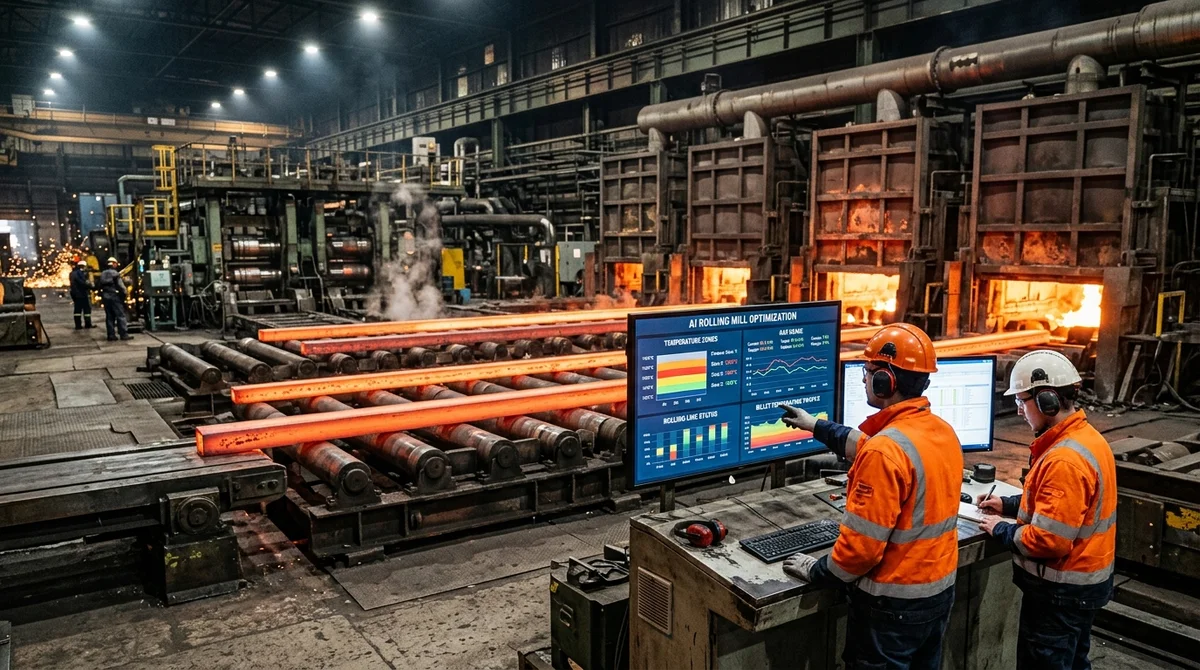
EVRAZ told how hot rolling at NTMK replaced manual furnace tuning with a recommendation system based on a mathematical model and neural network. The goal was not automation for reporting's sake, but reducing gas overconsumption during blank heating without losing rolling quality.
Why gas was disappearing
In hot rolling, blanks pass through heating furnaces before being fed to the mill, and on paper this stage looks standard. In practice, each furnace behaves differently: construction differs, burner condition, refractory lining wear, and even the path the blank takes to the first stand. The result is also affected by steel grade, cross-section, temperature before loading, planned transshipments, and unplanned shutdowns.
For a workshop with broad nomenclature, this means the same regime almost never suits all batches in a row. Previously, operators manually regulated temperature, heating time, and gas consumption based on instruction, experience, and current equipment condition. Formally, the rules were common to all, but in real shifts they had to be constantly adapted to the situation.
Because of this, different crews showed different fuel consumption, and when switching between product types, overconsumption almost became the norm. EVRAZ directly describes the problem through the gap between document and real shop floor.
"Follow the technological instruction."
What the model was made of
The team quickly understood that pure ML model wouldn't help here. Blank temperature is measured only at furnace inlet and outlet, and there's almost no data on how metal heats during the cycle. So they made the foundation physical: a numerical heating model based on heat conduction law, accounting for burner heat, convection, radiation and contact heat exchange, and metal properties at different temperatures.
Separately, the model accounted for scale formation, which effectively creates a heat-insulating layer on the blank surface. To make the system work in a real shop, the model had to be tuned for specific furnaces and real production modes. During tuning, details emerged that are rarely visible in abstract schemes: air suction from the shop, effect of blank layout spacing, known downtime during transshipments, and even difficulties with pyrometer data interpretation after the roll-down stand.
- furnace geometry differences and burner placement
- air suction from shop into furnace atmosphere
- blank layout spacing and gaps between them
- known downtime during stand transshipments
- features of dozens of steel grades and different cross-section shapes
Then they packed the numerical modeling results into a neural network. It was trained on calculation data from tens of thousands of heating scenarios extracted from historical archive over several years. This hybrid approach gave the system two things at once: physical meaningfulness and speed sufficient for soft real-time. The result was a digital twin of the heating process that not only predicts blank temperature but suggests to operators how to tune furnace zones and burners for a specific batch.
Production testing
Before implementation, the model was validated on two main criteria. First, they compared calculated blank temperature with pyrometer data right at furnace discharge, not after the roll-down stand where the picture is already distorted by subsequent cooling. Second, they used archived tests of thermally instrumented blanks with sensors inside the metal.
Even though the furnace had undergone major repair since those tests, the data helped confirm the model correctly reflects real heating profile. Separately, EVRAZ assessed how accurately the system calculated required energy resource consumption over time. For this, they compared actual and model values using the coefficient of determination R².
The company reports achieving 0.75 — enough to demonstrate model adequacy to production and management. After the technical part, they created a working interface: operators see the furnace diagram by zones and recommendations for burner settings.
The pilot in one shop was deemed successful, exact savings figures aren't disclosed, but the system is already being prepared for scaling to other furnaces at the enterprise.
What this means
This case well demonstrates where industrial AI is really headed. The most useful effect here came not from a universal chatbot, but from a combination of digital twin, historical data, and operator-understandable prompts. If such systems start proliferating, metallurgy will be able to save energy not through rigid restrictions, but through more precise process tuning for each specific batch.
Want to stop reading about AI and start using it?
AI News is a curated feed of AI/tech news. Hamidun Academy teaches you to use AI systematically in your work.