Mayo Clinic: AI Learned to Detect Pancreatic Cancer Years Before Clinical Diagnosis
Mayo Clinic presented the REDMOD model, which can detect signs of pancreatic cancer on routine CT scans well before clinical diagnosis. In the study, the…
AI-processed from Bloomberg Tech; edited by Hamidun News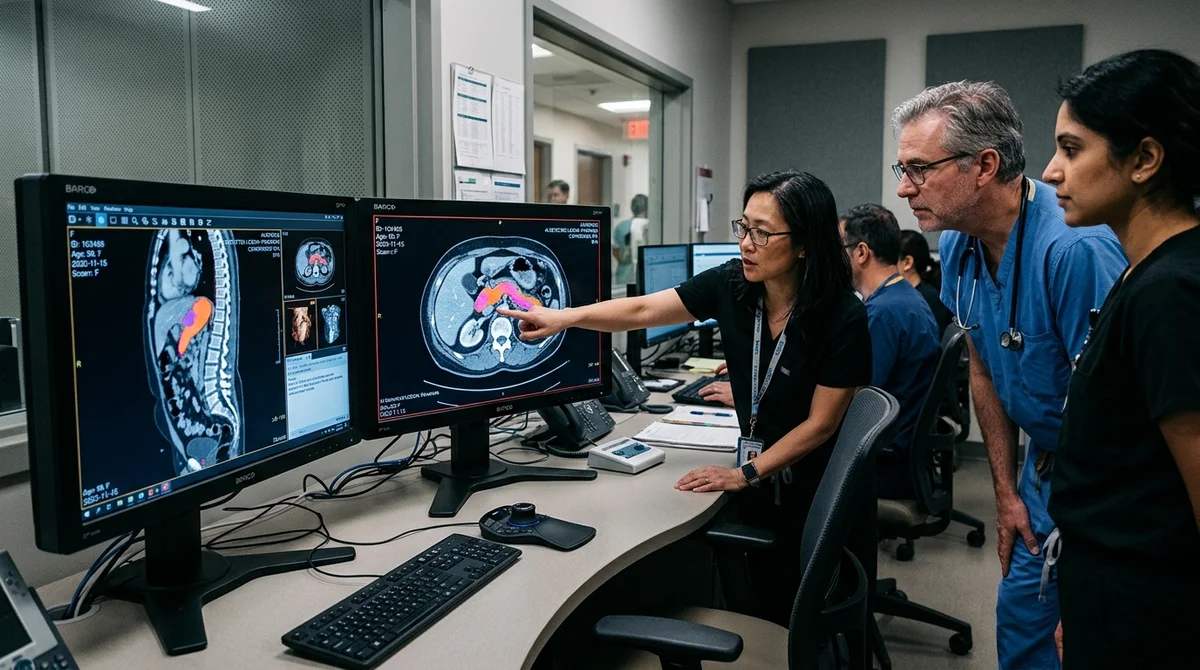
Mayo Clinic has demonstrated an AI system that detects signs of pancreatic cancer on routine CT scans long before clinical diagnosis. In a validation study, the REDMOD model identified the disease on average 475 days before diagnosis and significantly more often than specialists without AI assistance.
Why This Matters
Pancreatic cancer is one of the most dangerous types of oncology not because it cannot be seen at all, but because it is usually detected too late. In early stages, the tumor produces almost no symptoms and often looks like normal tissue on imaging. According to Mayo Clinic data, more than 85% of patients learn of their diagnosis only after the disease has spread, and five-year survival remains below 15%.
This is why the idea of 'catching' the disease on scans performed for other reasons looks so compelling. CT scanning is already widely used in clinics, and if AI can reliably identify subtle disease precursors on routine CT scans, it would give doctors an additional window of time for further investigation, monitoring, and in some cases, treatment at a stage when surgery is still possible.
What the Validation Showed
The Mayo Clinic team tested the system on data closer to real-world practice than typical laboratory demonstrations. REDMOD analyzed nearly 2,000 CT scans from different clinics, different machines, and different protocols. The main cohort included 219 patients whose scans were previously considered normal by radiologists but who were later diagnosed with pancreatic cancer, as well as 1,243 control subjects without such a diagnosis in the following three years.
- The model identified 73% of pre-diagnostic cases at a median of approximately 16 months before diagnosis
- The average lead time was approximately 475 days
- On scans taken more than two years before diagnosis, AI showed approximately three-fold advantage over specialists without system support
- REDMOD sensitivity was 73% versus 39% for radiologists, and in the subgroup 'more than two years before diagnosis' — 68% versus 23%
- On repeated scans of the same patients, the model's predictions remained stable in 90–92% of cases
The approach is not about the algorithm 'seeing the invisible' in a magical way. REDMOD measures hundreds of quantitative tissue features — texture, structure, and subtle changes that the human eye typically does not recognize as obvious tumors. According to the authors, the system operates automatically and does not require labor-intensive manual image preparation before analysis.
'The main barrier to saving lives in pancreatic cancer is our
inability to see the disease while it is still treatable.'
Where the Method's Limits Lie
Despite the strong numbers, this is not a story about ready-to-deploy mass screening tomorrow. The study was a validation study and largely retrospective: the model was tested on existing scans rather than in real clinical workflow, where routing, additional investigations, cost of errors, and physician burden must be considered. The authors explicitly state that prospective validation is needed to confirm the clinical utility of the approach.
There are also more practical questions. Even good AI in oncology must not only find suspicious cases but also avoid generating too many false alarms. Additionally, the sample was not ideally diverse in ethnic composition, meaning the generalizability of results to all populations remains to be demonstrated.
The next step is already underway: in the AI-PACED study, clinicians are testing how to integrate such prompts into care for higher-risk patients, such as those with newly diagnosed diabetes.
What This Means
For AI in medicine, this is a rare example of news where value is immediately apparent: not a chat interface or administrative automation, but a chance to shift the diagnosis of one of the deadliest cancers by months or even years earlier. If prospective trials confirm REDMOD's results, hospitals will have a tool for a 'second look' at already-performed CT scans, and early diagnosis will become not theory but a working process.
Want to stop reading about AI and start using it?
AI News is a curated feed of AI/tech news. Hamidun Academy teaches you to use AI systematically in your work.