Solaria raises €300M to power AI data centers with solar and batteries
Solaria has raised nearly €300M and aims to convert solar assets into AI data center infrastructure. The company offers sites with confirmed grid…
AI-processed from TNW; edited by Hamidun News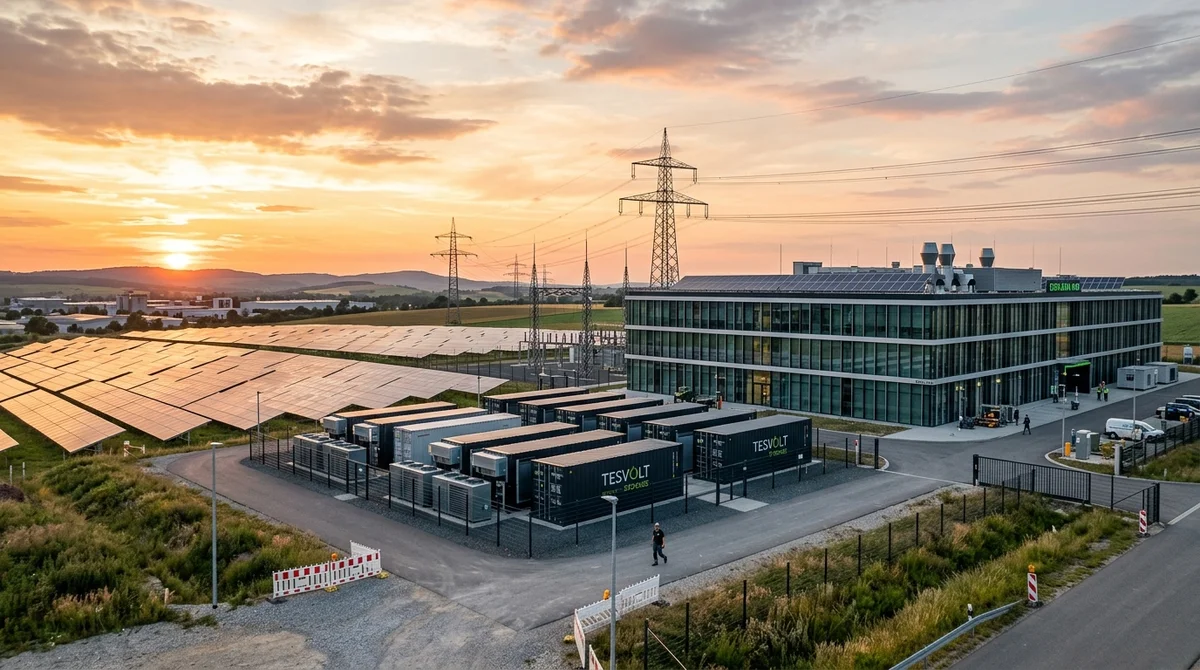
Spanish Solaria has attracted €299.88 million to develop sites for data centers with solar generation and battery storage located near the facilities themselves. Against the backdrop of the AI boom, the company is betting on the scarcest resource in Europe — not the panels themselves, but already confirmed access to electrical grids.
Why the market believed
European data centers are hitting multiple constraints at once: energy grids are struggling to keep up with growing demand, approvals for new connections move slowly, and connection queues in the UK, Ireland, and Germany stretch out for years. For operators this means that even with land, capital, and clients, launching a new facility can be delayed by three to five years.
Solaria is trying to circumvent this bottleneck by offering infrastructure where part of the energy problem is already solved in advance. The company conducted a private placement of nearly €300 million at €24 per share, placing up to 10% of the capital. The key signal lies not only in the amount, but in the demand: the placement turned out to be oversubscribed 6.7 times across the entire price range. This is particularly striking against the backdrop of pressure on Spanish solar companies, where electricity prices have declined due to strong hydrogeneration and new capacity. In other words, investors are betting not on a typical solar energy sales business, but on Solaria's pivot toward infrastructure for AI.
How the scheme works
Solaria's model is called Powered Land. Essentially, the company offers hyperscalers and colocation operators sites next to existing or planned solar generation, where grid connection is already secured, electrical infrastructure is partially built, and long-term contracts for green energy supply can be signed immediately. For the data center market, this is a rare combination: not just a plot for construction, but a ready-made energy envelope, which is usually hardest to obtain quickly.
Solaria already has a set of assets that supports this model:
- more than 70 solar power plants in Spain, Italy, Portugal, and Germany
- approximately 1000 km of its own electrical grid infrastructure
- 97 substations
- confirmed grid capacity accumulated over more than 20 years
It's this last point that makes the company's offer hard to replicate: panels can be built relatively quickly, but replicating the path to agreed connections and substations — cannot be.
What's already in the portfolio
As of November 2025, Solaria assembled a portfolio of 3.4 GW of confirmed capacity for data centers in five countries. The largest volumes fall to Italy — 1.4 GW and Germany — 1.2 GW, followed by the UK and Spain.
Two major deals have already been signed with Merlin Properties for a combined 438 MW of data center capacity, 871 MW of solar PPAs for 40 years, and a ten-year contract for 600 MW·h of battery storage. Another deal of approximately 500 MW is currently at an advanced stage of discussion.
The second investment direction is to eliminate the main drawback of solar generation for data centers: it cannot be used as a sole power source without storage. Solaria intends to invest €770 million in hybridization of its parks, adding wind and BESS to them. The goal by the end of 2028 is 500 MW of wind capacity and 4 GW·h of storage on the Iberian Peninsula. Across all of Europe, the company already has a storage portfolio of 5.1 GW, of which 1.9 GW have confirmed connection permits.
A separate joint venture with Stoneshield Capital and Gravyx is developing another 14 GW·h of storage projects.
What this means
The market is beginning to assess energy for AI as an independent layer of infrastructure, not as a supporting service. If Solaria's model works, it will benefit not only owners of solar assets, but also data center operators, who increasingly need not just access to electricity, but quick access to already distributed, contractible, and partially reserved capacity.
Want to stop reading about AI and start using it?
AI News is a curated feed of AI/tech news. Hamidun Academy teaches you to use AI systematically in your work.