All3 raises $25M to automate construction with AI and quadruped robots
London startup All3 raised $25M to automate construction from design to building assembly. The model centers on an AI platform for architecture, modular…
AI-processed from TNW; edited by Hamidun News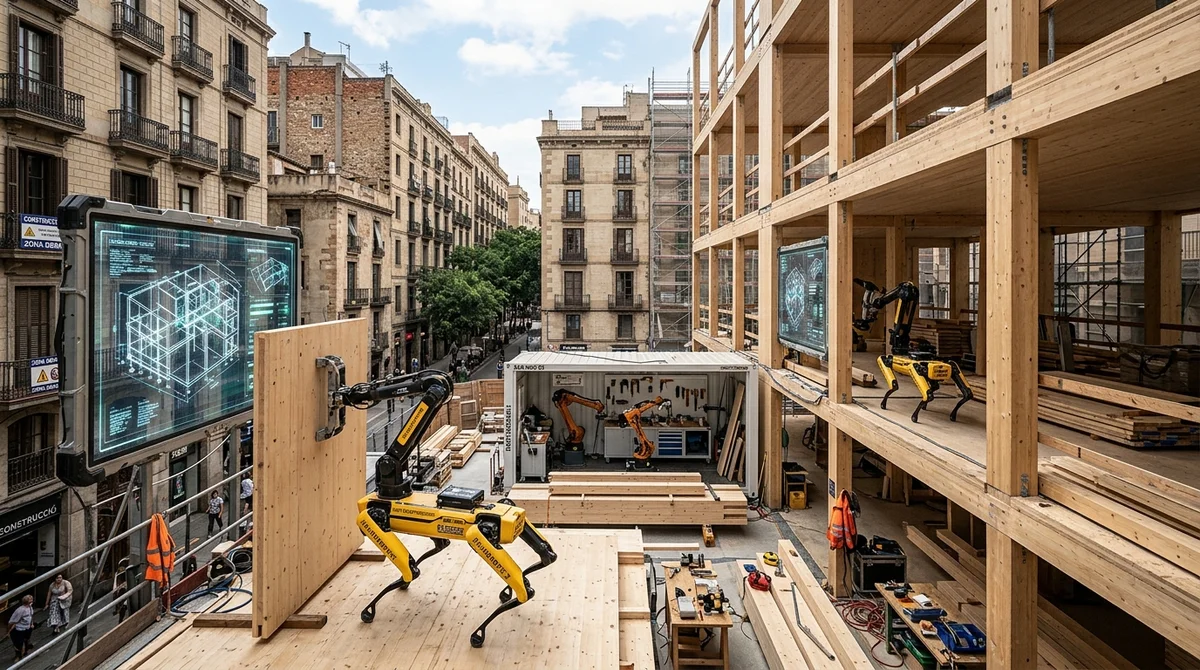
London-based startup All3 raised $25M in seed funding for a platform that promises to automate construction from design to on-site building assembly. The company is betting not on a single robotic tool, but on a complete overhaul of the construction process around AI, fabrication, and its proprietary walking robot Mantis.
Betting on the whole cycle
Construction remains one of the world's largest industries by monetary volume and one of the least automated. All3 builds its business on a simple idea: the problem isn't in a single narrow segment, but in the fact that the entire process still consists of a long chain of manual handoffs between architects, contractors, manufacturing, construction sites, and regulatory bodies. Instead of selling developers separate software or a single robot, the startup wants to close the entire loop itself.
The All3 system consists of three interconnected components:
- AI platform translates a brief or site address into a building design that takes into account local regulations, site constraints, and requirements for robotic manufacturing.
- Modular robotic factories produce custom elements from wood composites with claimed precision down to 0.2 mm.
- The Mantis walking robot handles assembly, fastening, finishing operations, and inspection directly on-site.
- According to the company, this approach can reduce costs by up to 30%, timelines by up to 50%, and the carbon footprint of materials by up to 25%.
The material choice is not arbitrary either. All3 is betting on engineered wood composites, which look favorable against concrete and its high carbon footprint. This is important for the European market, where pressure comes simultaneously from housing shortages and climate requirements. However, the claimed savings and emissions figures are currently based on the company's own models and have not yet been verified by independent audit.
Where the money goes
The $25M round was led by RTP Global. Also participating were SuperSeed, Begin Capital, s16vc, and VNV Global, and RTP Global partner Yelmeer de Jong joined All3's board of directors. The company was founded by Rodion Shishkov and has offices in Berlin and Zug, with research and development focused in London and Belgrade. The startup emerged from stealth mode only in mid-2025, but began testing its robotic system earlier.
The primary launch market is Germany. All3 plans to deploy its first commercial projects there, with the first object slated to enter construction later in 2026. The company has already processed over 100,000 square meters of residential projects through its AI platform, forming a pipeline for 2026–2027. Germany's choice makes sense: the country acutely needs new housing but is projected to build only around 175,000 homes in 2026 against a target of 400,000.
The main risk
The main distinction of All3 from many contech startups is its level of vertical integration. The company doesn't want to automate only masonry, only design, or only prefab manufacturing. It wants to replace nearly the entire traditional building supply chain. This is simultaneously a strength and the primary risk.
For such a model to work, it's not enough to assemble a functioning stack of AI and robotics. The company needs regulatory approvals across different jurisdictions, developer trust, component certification, and the ability to manufacture a fleet of robots that will operate reliably on real construction sites, not just in demonstration conditions.
"Europe needs its own champions in physical AI,"
RTP Global explains its bet on All3. For investors, it sounds like a bet on a new industrial platform rather than just another construction service. But the thesis will be tested very pragmatically: can the company actually deliver its first projects in Germany with results that match the promises on speed, cost, and quality. On construction sites, mistakes are costlier than in purely digital products, and feedback cycles are significantly longer.
What it means
If All3 demonstrates that AI can manage not just a project on screen but the physical assembly of a building, the market will gain one of the strongest physical AI case studies in Europe. If not, the story will be a reminder that automating construction entirely is far harder than automating individual operations. In any case, investor interest is already shifting from AI software to companies attempting to transform real industries with heavy physics and long-cycle economics.
Want to stop reading about AI and start using it?
AI News is a curated feed of AI/tech news. Hamidun Academy teaches you to use AI systematically in your work.