Bloomberg Tech: why humanoid robots are becoming the main frontier for AI
Humanoid robots are rapidly transforming from an impressive showcase into a new applied market for AI. The human-like form factor is becoming a convenient…
AI-processed from Bloomberg Tech; edited by Hamidun News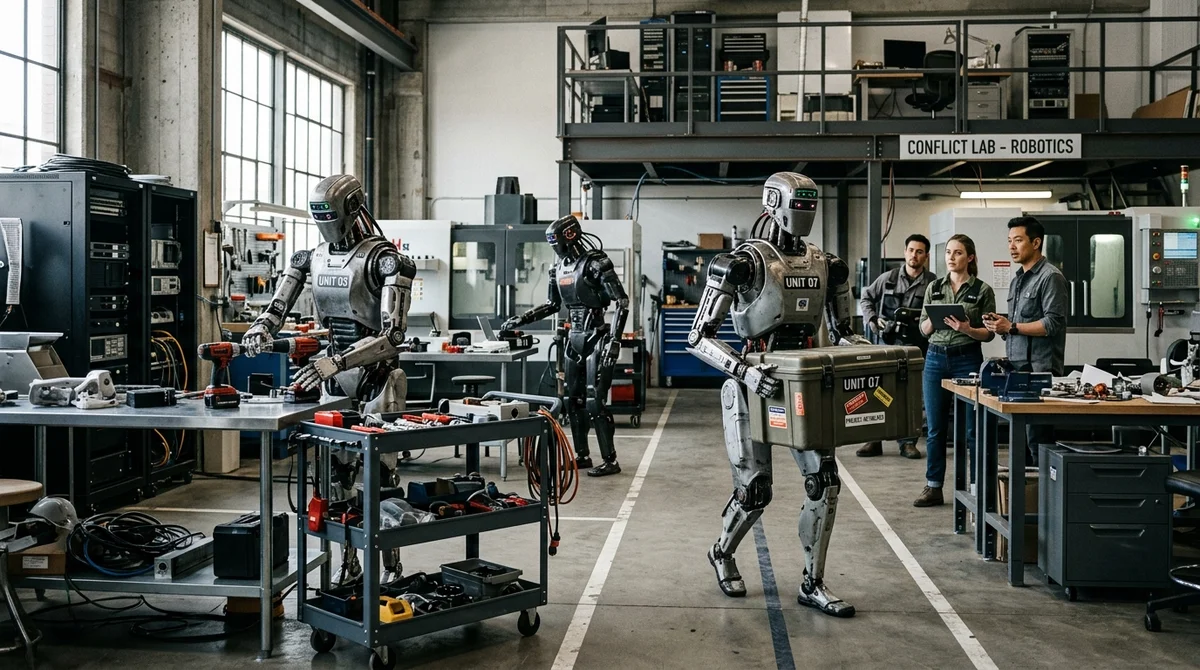
Humanoid robots are increasingly being viewed not as a distant sci-fi showcase, but as the next major market for artificial intelligence. Bloomberg Tech's latest Primer examines why this particular format could become the main testing ground for demonstrating what AI is capable of beyond the screen.
Why Robots Specifically
After the generative model boom, the industry approached the next logical question: what if systems could not only respond to requests, but also act in the physical world. A humanoid robot appears to be an almost ideal target here. It doesn't require designing a separate environment, unlike industrial manipulators, because our entire world is already built around the human body: doors, stairs, shelves, carts, tools, and workplaces.
That's why humanoid robotics is now perceived not simply as an engineering spectacle. It has become a test for the entire AI stack at once—from computer vision and language planning to motor control, memory, safety, and the ability to make decisions in changing environments. If a model can understand a task, see obstacles, choose a sequence of actions, and execute them carefully with its hands, that's already a completely different level of usefulness compared to a chat interface.
The gap between futuristic hype and reality may narrow faster than it seems.
Where Reality Lags
But the main story here isn't about impressive demonstrations—it's about the difference between a lab video and stable operation in the real world. A robot can't just navigate a route once or lift a box in front of a camera. It needs to do this hundreds of times in a row without losing balance, breaking objects, creating risk to humans, or requiring constant operator intervention.
This is precisely where the main gap between expectations and the product lies today. The problem doesn't come down to a single technology. You need precise sensors, reliable actuators, energy-efficient batteries, robust software control, and enormous amounts of data on how humans move and use their hands. Even a powerful reasoning model is useless if a robot reacts slowly, makes mistakes in grasping objects, or gets confused in unpredictable situations.
So the question is no longer just how intelligent AI will be, but how well that intelligence will connect with a "body."
What Accelerates Progress
Nevertheless, the window of opportunity is rapidly widening. Several factors are simultaneously pushing the market, and together they make a scenario of mass growth noticeably more realistic than it was just a couple of years ago.
- More powerful multimodal models better link text, images, sound, and action into a single chain.
- Simulations and synthetic data allow training behavior faster than is possible with real robots alone.
- Sensors, cameras, and computing are gradually becoming cheaper, reducing the cost of experimentation and failures.
- Business doesn't need a perfect robot, but a sufficiently reliable executor for repetitive tasks—in warehouses, logistics, service, or manufacturing.
If this entire stack improves simultaneously, humanoids will stop being a media symbol of "the future someday" and become a new practical interface for AI. Not necessarily universal from day one and not necessarily cheap, but already useful enough that companies will start calculating the economics of implementation.
In this sense, Bloomberg is talking not so much about distant fantasy, but about a frontier where software intelligence first seriously confronts the constraints of the physical world.
What This Means
The next major stage of AI development may unfold not in chatbots and search, but in machines that can perceive space and act within it. Winners won't be those who show the most spectacular video, but those who quickly narrow the gap between demo and reliable everyday operation.
Want to stop reading about AI and start using it?
AI News is a curated feed of AI/tech news. Hamidun Academy teaches you to use AI systematically in your work.