Bernie Sanders Urges US and China to Rein In the "Runaway AI Train"
On April 29, Bernie Sanders held a Capitol Hill panel with Chinese scientists and urged the US and China to agree on AI rules modeled on international…
AI-processed from Guardian; edited by Hamidun News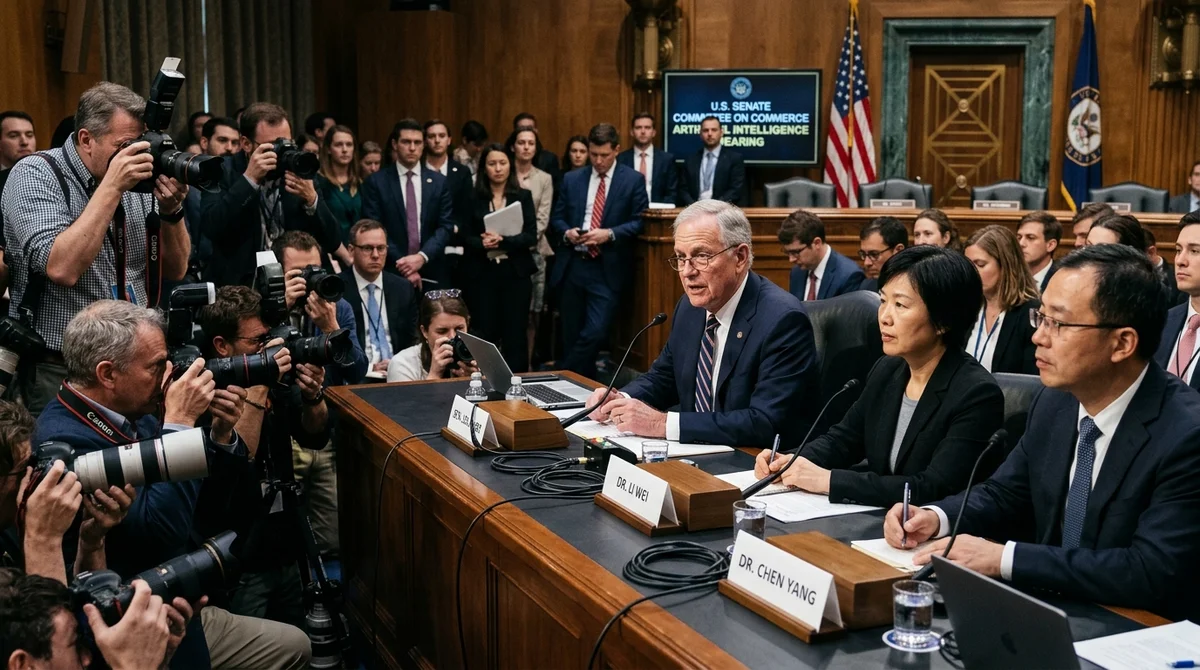
On April 29, 2026, Senator Bernie Sanders held a panel on Capitol Hill about the risks of artificial intelligence and called for international rules of the game. His main thesis — the race between the US and China for more powerful systems cannot be left uncontrolled, otherwise the consequences will hit the labor market, privacy, and public stability.
Panel in Congress
For the discussion, Sanders invited two Chinese specialists on AI regulation — Xue Lan from Tsinghua University and Zeng Yi from the Beijing Institute for AI Security and Governance. For American politics, this is an atypical format: instead of talking only about technological leadership, the senator emphasized joint rules and said that without dialogue between the world's major powers, regulation will not work. According to his logic, if countries only compete in the speed of development, every new precautionary measure will look like a concession to the competitor.
Sanders compared the necessary approach to international agreements from the time of the Cold War and essentially proposed transferring this logic to the sphere of AI. He argues that Congress is already far behind in understanding the scale of changes that automation and robotization bring. This is not a new position for the senator: on March 25, 2026, he together with Alexandria Ocasio-Cortez presented a bill on a moratorium on building new data centers for AI until the US has strict federal safety guarantees.
What risks he sees
The main line of Sanders' speech — not abstract fear of technology, but a set of concrete threats that, in his opinion, are already beginning to materialize as AI is massively implemented.
- misinformation and intensified manipulation in the public sphere
- loss of privacy and deeper collection of user data
- social isolation of teenagers dependent on chatbots
- rise in unemployment if companies begin to massively replace people with automated labor
- risk of emergence of superintelligent systems beyond the control of developers
"The richest and most influential people in the world are building a train without brakes," — this is how Sanders described the current race in AI.
For him, the problem is not only in the models themselves, but also in the pace at which corporations are deploying them. The senator warns of a scenario where decisions affecting the economy and democratic institutions are made by a few major Big Tech players, and society gets the consequences after the fact. One of the Chinese panelists, Xue Lan, supported the idea of coordination and said that it is difficult to imagine a world in which the most powerful tools are concentrated among a few countries and companies, while the rest of the world remains on the sidelines of the AI economy.
Why this sparked controversy
The very fact of Chinese academics appearing on Capitol Hill irritated some American conservatives. The criticism was not so much against the idea of regulation itself, but against cooperation with China as a geopolitical rival. Conservative analyst Michael Sobolik wrote that questions about child safety, impact on communities, and job displacement should be discussed, but doing so in partnership with Chinese participants in such discussions is a bad idea.
Against this backdrop, US Treasury Secretary Scott Bessent was pushing a tougher line: America, according to him, should set the global standard for AI safety on its own, not allowing other countries to determine the rules. This is where the main split in the current discussion lies. One camp believes that regulation is only possible through international agreements between power centers.
The other — that such agreements will weaken the US in the technological race and give competitors a political advantage.
What this means
The Sanders panel story shows that the debate about AI is quickly moving beyond conversations about new products and turning into a question of geopolitics, employment, and control over infrastructure. If the topic of international rules becomes entrenched in Washington's agenda, the next stage of debate will no longer be about whether AI oversight is needed, but about who exactly will write these rules — the US alone or several countries together.
Want to stop reading about AI and start using it?
AI News is a curated feed of AI/tech news. Hamidun Academy teaches you to use AI systematically in your work.