Local Vision for z.ai GLM-5.1: 8B Model Closes 70% of the Gap to the Frontier
Low-cost coding models face a typical limitation: they generate interfaces but cannot see the result on screen. For z.ai GLM-5.1, a local vision-sidecar was…
AI-processed from Habr AI; edited by Hamidun News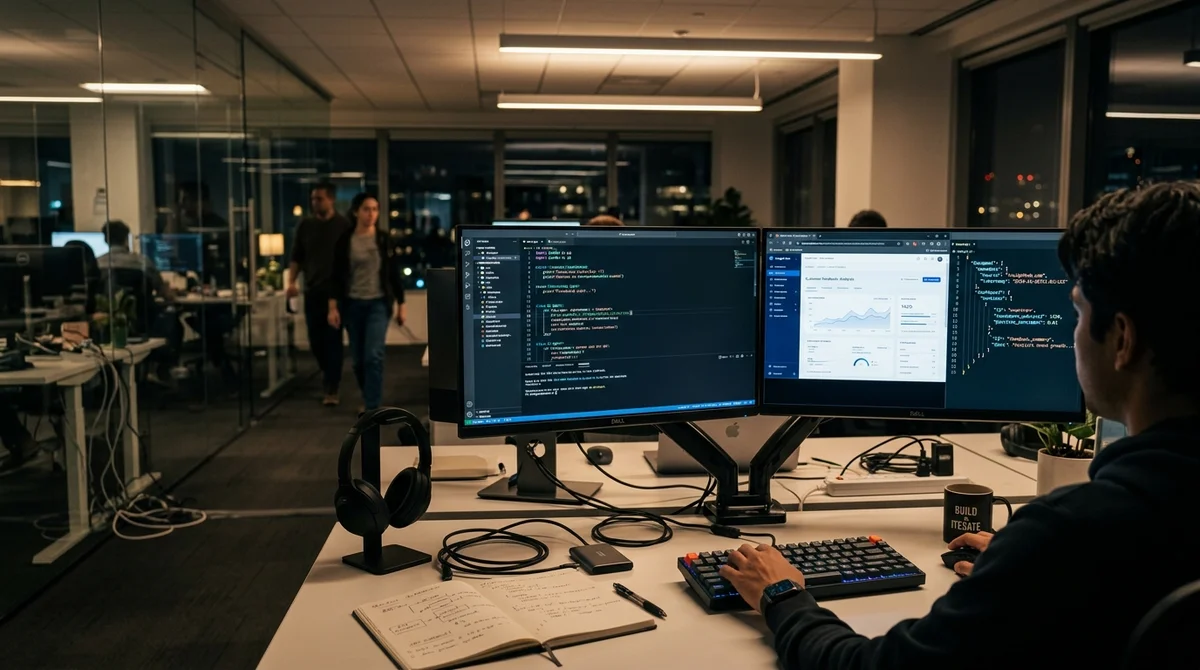
A developer showed how to fix one of the main weaknesses of cheap coding models: blindness to their own UI. For z.ai GLM-5.1, he assembled a local vision-sidecar that reads screenshots, returns interface structure as JSON, and lets the agent verify results after code generation.
The Problem
The problem is familiar to anyone who has tried economical models instead of expensive frontier systems. An agent can write HTML, spin up a page, run Playwright, and save a screenshot, but then hits a wall: the image exists, but there's no understanding. If a button moved, a table got cut off, text overlapped a card, or the mobile grid broke, the model doesn't notice. As a result, a human has to manually check the interface again and becomes not a task setter, but a constant QA between iterations.
The author started from a simple hypothesis: such feedback doesn't require the strongest multimodal system on the market. On web interface screenshots, what usually matters is not abstract reasoning, but fact extraction: OCR, button list, block structure, presence of clipping, and table correctness. If that's true, then a compact open vision model can be turned into a cheap sensory layer for a coding agent and close the "write -> look -> fix" cycle without a cloud API.
How the Pipeline Was Built
They used qwen3-vl:8b for vision, deployed locally via Ollama. On top of that, the author built the vision-sidecar-mcp MCP server, which takes screenshots and returns a structured screen description. This layer doesn't turn GLM-5.1 into a full multimodal model, but gives it what was missing in practical development: the ability to read the visual result of its work through a text interface.
On a regular GPU or Apple Silicon, the entire setup, according to the author, takes about 20 minutes to deploy.
- qwen3-vl:8b as a local vision model
- Ollama for fast deployment
- MCP server with analyze_image, analyze_structured, and extract_table methods
- JSON responses that can be directly passed to a coding agent
The key engineering part turned out to be not in retraining weights, but in tuning inference. The author fixed the seed, tightened sampling with top_p=0.9 and top_k=20, and converted responses to strict JSON schema. A separate field for symbols and icons helped eliminate typical recognition errors when decorative glyphs were misread. This is an important insight: if the task comes down to structure extraction, a good prompt, schema, and generation discipline sometimes give more benefit than immediately jumping to fine-tuning.
What Numbers Came Out
Testing was done on ten screenshots of a real web application, from a small mobile screen 320×568 to a desktop 1440×900. Three modes were compared: baseline qwen3-vl:8b, the same model after tuning, and Claude Opus 4.7 as the upper bound.
The average score went from 3.99 to 4.70 out of 5, and the gap to the frontier shrank from 1.01 to 0.30. In other words, the local 8B model closed about 70% of the gap without fine-tuning and without additional data.
"The testing cycle is closed. The model is no longer blind."
After tuning, the combination achieved near parity where it matters for an agent's practical interface verification:
- OCR and accurate text extraction
- detection of UI elements and CTAs
- understanding of layout structure
- table extraction and suitability for further automated processing
The main remaining gap is related to hallucinations and visual nuances. The local model could confuse shades, misinterpret small decorative elements, and was weaker at reading design intent, especially where color itself carries status or priority. But for tasks like checking clipping, presence of CTAs, table correctness, and section structure, this doesn't look like a blocker: critical interface errors it already detects reliably and predictably.
What This Means
The practical conclusion is simple: expensive frontier models remain useful as a checking layer for complex cases, but the bulk of UI iterations can already be delegated to a local combination of coder, screenshots, and a compact vision model. The next logical step is routing, where simple screens are processed locally, and disputed ones automatically go to a stronger model or a human. For teams that count inference budget and want more autonomy in frontend development, this looks like not an experiment anymore, but a working approach.
Want to stop reading about AI and start using it?
AI News is a curated feed of AI/tech news. Hamidun Academy teaches you to use AI systematically in your work.