SoftBank Prepares US IPO for AI Robotics Company Roze, Betting on Robots and Data Centers
SoftBank plans to spin off the Roze project into a separate company and list it on US exchanges in 2026. The new asset will combine AI robotics and data…
AI-processed from Bloomberg Tech; edited by Hamidun News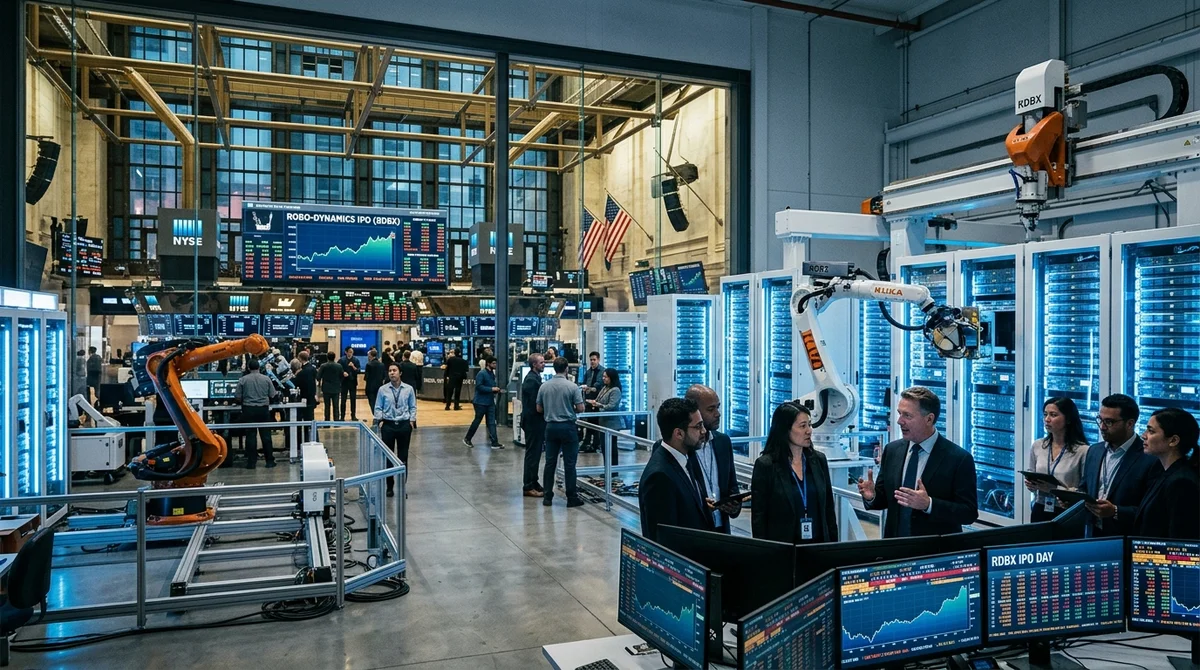
SoftBank is preparing to create a separate company called Roze in the US that will focus on AI robotics and data center construction, and then take it public. According to Financial Times, which was later cited by Bloomberg and Reuters, the Japanese holding company is targeting a valuation of up to $100 billion and could accelerate the listing as early as 2026.
What is known
This is about a separate structure: SoftBank wants not just to expand its existing portfolio, but to assemble a separate public asset around the two most expensive directions of the AI race — robotics and computational infrastructure. Financial Times writes, citing sources familiar with the plan, that the new company will be named Roze and will be based on the American capital market, not in Japan. Reuters clarifies that SoftBank declined to comment, so the project remains at the planning stage rather than a confirmed corporate announcement.
- company name — Roze
- focus — AI robotics and data centers
- listing planned in the US
- target valuation — up to $100 billion
- placement possible as early as 2026
Neither the structure of assets that will go into Roze nor the revenue volume of the future company nor the share that SoftBank is willing to sell to investors have been disclosed yet. This is an important caveat: the news speaks more to Masayoshi Son's strategic vision than to an almost-ready IPO prospectus. But even in this form, it shows that SoftBank wants to package AI infrastructure into a growth story that the public market can understand. This is why the market currently perceives Roze as a bet on the future rather than as a ready-made issuer.
Why SoftBank is doing this
The Roze plan fits well with SoftBank's official strategy in recent months. In the holding company's materials, AI is already described not as a single bet on models, but as a chain of four basic components: AI chips, AI robots, AI data centers, and energy. Roze brings together two of these blocks in a single asset.
For Son, this is a logical construction: if the future of AI depends not only on algorithms but also on physical infrastructure, then the most expensive layer of the market will be not with applications, but with those who build the computational and robotic foundation. The context also supports such a move. In March 2025, SoftBank agreed to buy Ampere for $6.
5 billion, strengthening its position in AI computing. In fall 2025, the group announced the purchase of ABB's robotics business for $5.375 billion and at that time directly named the next frontier as "Physical AI".
In December 2025, SoftBank signed a deal to buy DigitalBridge for $4 billion to expand control over digital infrastructure, including data centers and networks. The company is separately already participating in Stargate with OpenAI and Oracle: partners reported in September 2025 about five new facilities in the US, almost 7 gigawatts of planned capacity, and investments exceeding $400 billion over the next three years. Against this backdrop, Roze looks not like a side experiment but as an attempt to gather scattered AI assets into one coherent story for the market.
According to Bloomberg, Son is driving the project in part to compensate for the tens of billions of dollars that SoftBank has already committed to the AI sphere. Put simply, the holding company is seeking not only technological influence but also future liquidity. And this well explains why it is precisely a separate IPO being discussed, not an internal division.
Why the US was chosen
The choice of an American platform looks logical — this is already a conclusion from the context of the deal, not a direct statement from SoftBank. Right now in the US are concentrated the largest AI data center construction projects, the most aggressive budgets for computational infrastructure, and the deepest capital market for technology offerings. SoftBank is also strengthening its presence there through Ampere, Stargate, and other infrastructure projects.
If Roze truly will build a business around data centers, American jurisdiction gives it both access to customers and a clear growth story for investors. There is a second reason. A separate public company provides more flexibility than developing the entire direction within a conglomerate.
If the plan is implemented, SoftBank will be able to attract outside capital for a specific AI asset without mixing it with the holding's other bets, from Arm to OpenAI projects. For the market this is more convenient: investors will get a cleaner story about "robots plus computational infrastructure" rather than yet another complex holding with dozens of overlapping interests.
What this means
The AI market is increasingly shifting from discussions of models to competition for the physical layer: chips, energy, data center construction, and automation. If SoftBank brings Roze to an IPO, it will be a signal that infrastructure and robotics are becoming an independent class of AI assets that investors are willing to pay tens of billions of dollars for.
Want to stop reading about AI and start using it?
AI News is a curated feed of AI/tech news. Hamidun Academy teaches you to use AI systematically in your work.