OpenAI achieves key US AI capacity milestone ahead of schedule, accelerating data center expansion
OpenAI closed an important US AI computing capacity target ahead of schedule. For the company, this transcends infrastructure news: computational reserves…
AI-processed from Bloomberg Tech; edited by Hamidun News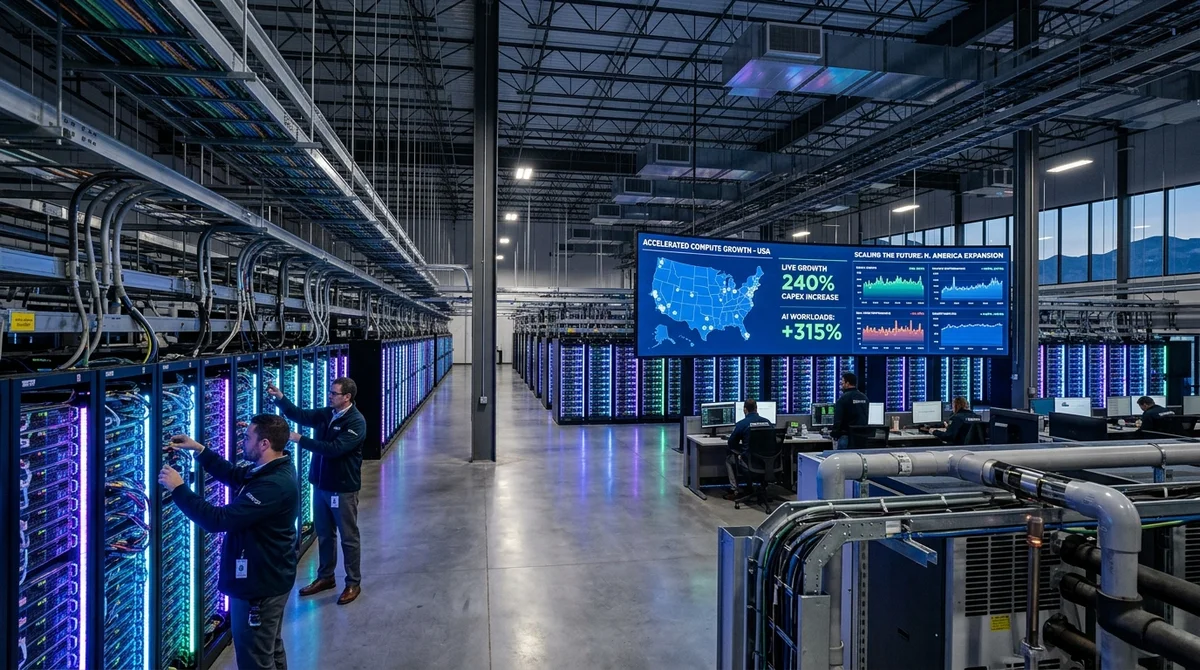
OpenAI has achieved its key milestone in securing AI computing capacity in the USA ahead of schedule. This removes one of the company's main infrastructure constraints and accelerates its plans to expand its network of data centers.
What was achieved
According to Bloomberg Tech, the company has reached an important goal in reserving AI computing capacity on the American market several years ahead of its own timeline. For OpenAI, this is not just a formality or a pretty KPI: it is about access to a computational base without which it is impossible to reliably train new models, scale already-launched services, and handle the growth in user load. At this stage, a time advantage becomes a real competitive edge, because demand for computing in the industry is growing faster than players can deploy new capacity.
When people talk about computing capacity for AI, they usually mean not just the chips themselves. It also includes racks, networking, cooling, power supply, facilities, and contracts that keep clusters operational. At this level, the market has long faced a shortage: demand for accelerators and electricity is growing faster than new infrastructure comes online.
Therefore, achieving the goal ahead of schedule gives OpenAI not an abstract advantage, but a more solid operational foundation for its next launches. This is especially important for a company whose products simultaneously demand resources for both model training and everyday processing of large request flows.
Why it matters
For OpenAI, computing capacity is a direct measure of product release tempo. The more infrastructure available, the fewer internal queues between training, testing, and launching new features. This is especially important at a time when the generative AI market competes not only on model quality but also on the speed of releasing updates, API reliability, and operational cost for business.
In other words, computational capacity has become part of product strategy, not just a backend issue. If computing is insufficient, the company must choose what is most important right now: training the next model, serving current users, or maintaining reserves for new releases. Closing this milestone ahead of schedule also strengthens OpenAI's plans for data center expansion in the USA.
Once the key volume of capacity is ensured, it is easier for the company to move forward: enter into new agreements, plan larger installations, and distribute load across facilities. For the ecosystem around OpenAI, this is also a positive signal: partners, corporate clients, and developers gain more confidence that growing demand will not hit a hard infrastructure ceiling. This reduces anxiety about future launches and simplifies planning several cycles ahead.
- more resources for training next-generation models
- lower risk of capacity shortages as traffic grows
- more room for launching new products
- stronger position in negotiations over future data centers
Still, the news does not mean that infrastructure problems have ended. Data center expansion remains a capital-intensive and slow task: you need to synchronize construction, network connectivity, cooling, and power consumption. It also matters that this specifically concerns the USA: for OpenAI, this is a question of controlling the supply chain, access to electricity, and more predictable planning. But the fact that the company reached its goal ahead of schedule shows that it is moving through the most painful part of the industry faster than many expected. And this already affects not only OpenAI's internal plans, but the balance of power across the entire AI infrastructure market.
What it means
The AI race is increasingly hinged on infrastructure, not just model quality. If OpenAI has indeed closed its key goal for computing capacity in the USA ahead of time, this strengthens its position in the next phase of the market: winners will be those who can not only create strong AI but quickly back it with hardware, power, and scale. For users and businesses, this is a good signal: services based on OpenAI have more chances to grow without constant shortage mode and painful constraints on development speed.
Want to stop reading about AI and start using it?
AI News is a curated feed of AI/tech news. Hamidun Academy teaches you to use AI systematically in your work.